

465
for a bandwidth parameter of ON = 4; this means that (in this example)
the effective spectral resolution is 4/N, where N is the number of data
points and 20 is the predetermined bandwidth, centered on a given line
frequency outside which leakage is to be minimized. The maximum K is,
accordingly, K = 7.
0.10
2
~---0.05
3
/ - ) / - - ,
"
oo::t
"I
4
/
I \
\
"/
I
\
\
/
"
I
---Cf)
0.00
/
I
\
/
\
Cf)
" "
/
I
\
\
/
0/
"- "
/
\
' -<
/
0
/
",
"- / \
/
-0.05
",
/
'v
,
/
' - ---- -
-0.10 0
100
200
300
400
500
600
Time (months)
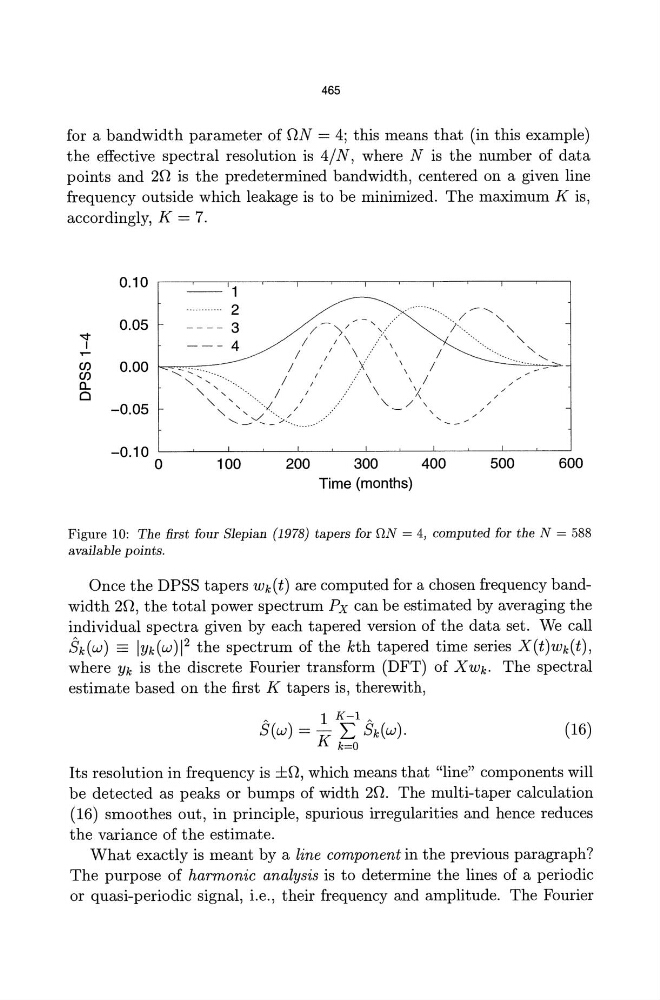
Figure 10: The first four Slepian (1978) tapers for ON = 4, computed for the N = 588
available points.
Once the DPSS tapers Wk(t) are computed for a chosen frequency bandwidth 20, the total power spectrum Px can be estimated by averaging the
individual spectra given by each tapered version of the data set. We call
Sk(W) == !Yk(W)12 the spectrum of the kth tapered time series X(t)Wk(t),
where Yk is the discrete Fourier transform (DFT) of X Wk. The spectral
estimate based on the first K tapers is, therewith,
A
1 K-l A
S(w) = K Eo Sk(W),
(16)
Its resolution in frequency is ±O, which means that "line" components will
be detected as peaks or bumps of width 20. The multi-taper calculation
(16) smoothes out, in principle, spurious irregularities and hence reduces
the variance of the estimate.
What exactly is meant by a line component in the previous paragraph?
The purpose of harmonic analysis is to determine the lines of a periodic
or quasi-periodic signal, i.e., their frequency and amplitude. The Fourier
for a bandwidth parameter of ON = 4; this means that (in this example)
the effective spectral resolution is 4/N, where N is the number of data
points and 20 is the predetermined bandwidth, centered on a given line
frequency outside which leakage is to be minimized. The maximum K is,
accordingly, K = 7.
0.10
2
~---0.05
3
/ - ) / - - ,
"
oo::t
"I
4
/
I \
\
"/
I
\
\
/
"
I
---Cf)
0.00
/
I
\
/
\
Cf)
" "
/
I
\
\
/
0/
"- "
/
\
' -<
/
0
/
",
"- / \
/
-0.05
",
/
'v
,
/
' - ---- -
-0.10 0
100
200
300
400
500
600
Time (months)
Figure 10: The first four Slepian (1978) tapers for ON = 4, computed for the N = 588
available points.
Once the DPSS tapers Wk(t) are computed for a chosen frequency bandwidth 20, the total power spectrum Px can be estimated by averaging the
individual spectra given by each tapered version of the data set. We call
Sk(W) == !Yk(W)12 the spectrum of the kth tapered time series X(t)Wk(t),
where Yk is the discrete Fourier transform (DFT) of X Wk. The spectral
estimate based on the first K tapers is, therewith,
A
1 K-l A
S(w) = K Eo Sk(W),
(16)
Its resolution in frequency is ±O, which means that "line" components will
be detected as peaks or bumps of width 20. The multi-taper calculation
(16) smoothes out, in principle, spurious irregularities and hence reduces
the variance of the estimate.
What exactly is meant by a line component in the previous paragraph?
The purpose of harmonic analysis is to determine the lines of a periodic
or quasi-periodic signal, i.e., their frequency and amplitude. The Fourier