

464
10- 6
0.0
0.1
0.2
0.3
0.4
0.5
Frequency (cycles/months)
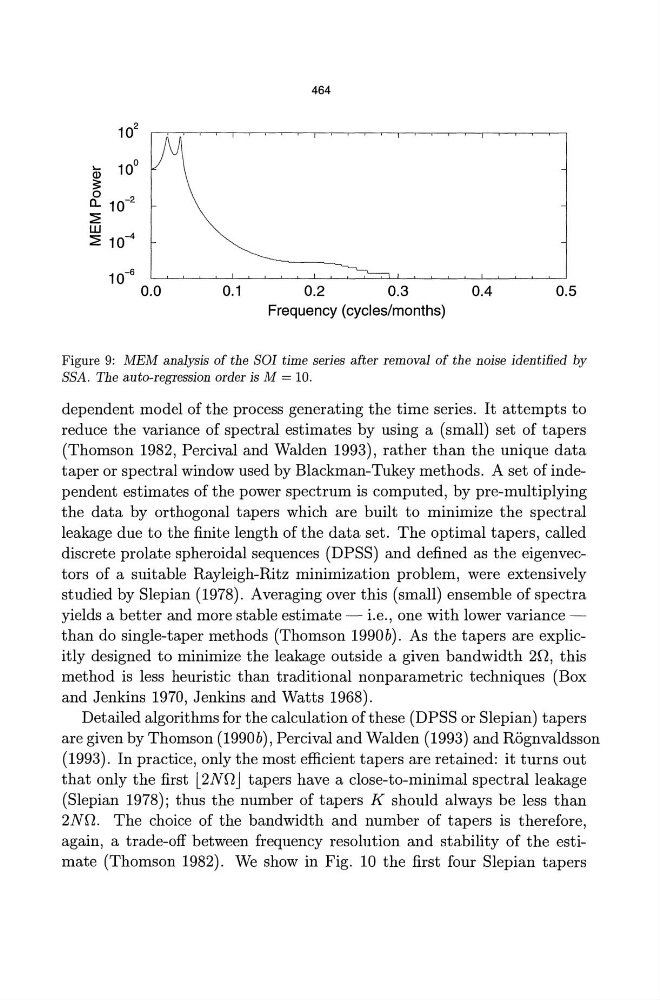
Figure 9: MEM analysis of the Sal time series after removal of the noise identified by
SSA. The auto-regression order is M = 10.
dependent model of the process generating the time series. It attempts to
reduce the variance of spectral estimates by using a (small) set of tapers
(Thomson 1982, Percival and Walden 1993), rather than the unique data
taper or spectral window used by Blackman-Tukey methods. A set of independent estimates of the power spectrum is computed, by pre-multiplying
the data by orthogonal tapers which are built to minimize the spectral
leakage due to the finite length of the data set. The optimal tapers, called
discrete prolate spheroidal sequences (DPSS) and defined as the eigenvectors of a suitable Rayleigh-Ritz minimization problem, were extensively
studied by Slepian (1978). Averaging over this (small) ensemble of spectra
yields a better and more stable estimate - i.e., one with lower variancethan do single-taper methods (Thomson 1990b). As the tapers are explicitly designed to minimize the leakage outside a given bandwidth 20" this
method is less heuristic than traditional nonparametric techniques (Box
and Jenkins 1970, Jenkins and Watts 1968).
Detailed algorithms for the calculation of these (DPSS or Slepian) tapers
are given by Thomson (1990b), Percival and Walden (1993) and R6gnvaldsson
(1993). In practice, only the most efficient tapers are retained: it turns out
that only the first l2NO J tapers have a close-to-minimal spectral leakage
(Slepian 1978); thus the number of tapers K should always be less than
2NO. The choice of the bandwidth and number of tapers is therefore,
again, a trade-off between frequency resolution and stability of the estimate (Thomson 1982). We show in Fig. 10 the first four Slepian tapers
10- 6
0.0
0.1
0.2
0.3
0.4
0.5
Frequency (cycles/months)
Figure 9: MEM analysis of the Sal time series after removal of the noise identified by
SSA. The auto-regression order is M = 10.
dependent model of the process generating the time series. It attempts to
reduce the variance of spectral estimates by using a (small) set of tapers
(Thomson 1982, Percival and Walden 1993), rather than the unique data
taper or spectral window used by Blackman-Tukey methods. A set of independent estimates of the power spectrum is computed, by pre-multiplying
the data by orthogonal tapers which are built to minimize the spectral
leakage due to the finite length of the data set. The optimal tapers, called
discrete prolate spheroidal sequences (DPSS) and defined as the eigenvectors of a suitable Rayleigh-Ritz minimization problem, were extensively
studied by Slepian (1978). Averaging over this (small) ensemble of spectra
yields a better and more stable estimate - i.e., one with lower variancethan do single-taper methods (Thomson 1990b). As the tapers are explicitly designed to minimize the leakage outside a given bandwidth 20" this
method is less heuristic than traditional nonparametric techniques (Box
and Jenkins 1970, Jenkins and Watts 1968).
Detailed algorithms for the calculation of these (DPSS or Slepian) tapers
are given by Thomson (1990b), Percival and Walden (1993) and R6gnvaldsson
(1993). In practice, only the most efficient tapers are retained: it turns out
that only the first l2NO J tapers have a close-to-minimal spectral leakage
(Slepian 1978); thus the number of tapers K should always be less than
2NO. The choice of the bandwidth and number of tapers is therefore,
again, a trade-off between frequency resolution and stability of the estimate (Thomson 1982). We show in Fig. 10 the first four Slepian tapers