

451
The episodes during which the solution circles near the ghost limit cycle
result in nearly periodic parts of the time series and hence contribute to a
spectral peak with that period. This concept was illustrated using 40 years
of an atmospheric multivariate time series by Kimoto and Ghil (1993) for
the so-called intraseasonal oscillations of the Northern Hemisphere (see
also Ghil and Mo 1991a). We shall show in the subsequent sections of the
present chapter how this concept can be generalized to associate multiple
spectral peaks with a robust "skeleton" of the attractor, as proposed by
Vautard and Ghil (1989).
2 SIN Enhancement: Singular Spectrum Analysis
2.1 Motivation
SSA is designed to extract information from short and noisy time series,
and thus provides insight into the (unknown or partially known) dynamics
of the underlying system that generated the series (Broomhead and King
1986a, Vautard and Ghil1989). We outline here the method for univariate
time series and generalize for multivariate ones in Sec. 4. The starting point
is to embed a time series of observables {X(t), t = 1, ... , N} in a vector
space of dimension M, with M presumably larger than the effective but
unknown dimension d of the underlying system. For topological reasons
(Whitney 1936), the embedding dimension M must be larger than 2d + 1
(Broomhead and King 1986a). The embedding procedure constructs a
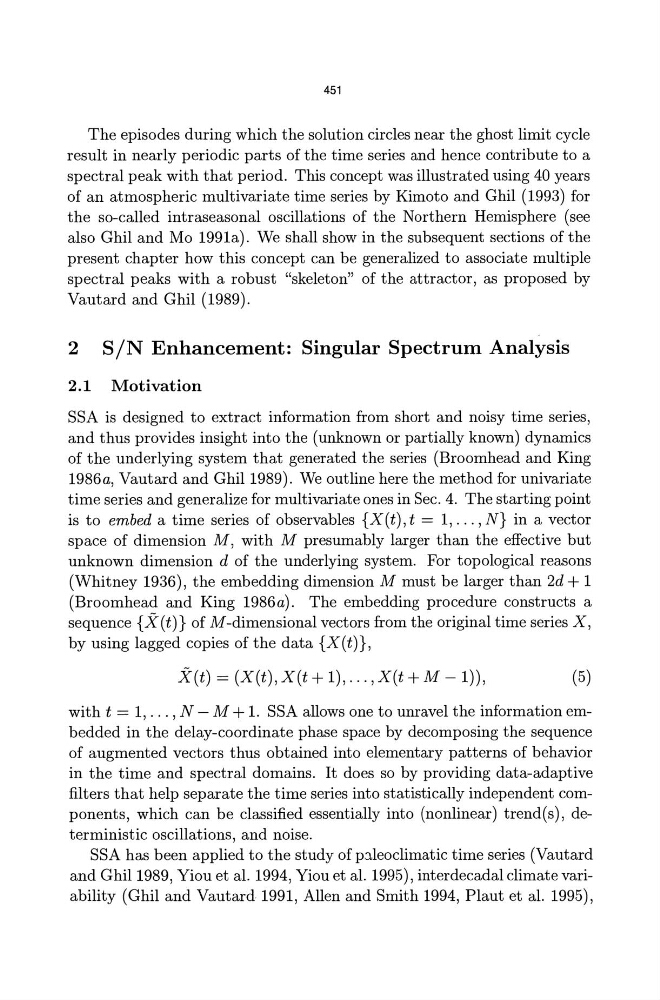
sequence {X(t)} of M-dimensional vectors from the original time series X,
by using lagged copies of the data {X(t)},
X(t) = (X(t), X(t + 1), ... , X(t + M - 1)),
(5)
with t = I, ... , N - M + 1. SSA allows one to unravel the information embedded in the delay-coordinate phase space by decomposing the sequence
of augmented vectors thus obtained into elementary patterns of behavior
in the time and spectral domains. It does so by providing data-adaptive
filters that help separate the time series into statistically independent components, which can be classified essentially into (nonlinear) trend(s), deterministic oscillations, and noise.
SSA has been applied to the study of p:1leoclimatic time series (Vautard
and Ghil1989, Yiou et al. 1994, Yiou et al. 1995), interdecadal climate variability (Ghil and Vautard 1991, Allen and Smith 1994, Plaut et al. 1995),
The episodes during which the solution circles near the ghost limit cycle
result in nearly periodic parts of the time series and hence contribute to a
spectral peak with that period. This concept was illustrated using 40 years
of an atmospheric multivariate time series by Kimoto and Ghil (1993) for
the so-called intraseasonal oscillations of the Northern Hemisphere (see
also Ghil and Mo 1991a). We shall show in the subsequent sections of the
present chapter how this concept can be generalized to associate multiple
spectral peaks with a robust "skeleton" of the attractor, as proposed by
Vautard and Ghil (1989).
2 SIN Enhancement: Singular Spectrum Analysis
2.1 Motivation
SSA is designed to extract information from short and noisy time series,
and thus provides insight into the (unknown or partially known) dynamics
of the underlying system that generated the series (Broomhead and King
1986a, Vautard and Ghil1989). We outline here the method for univariate
time series and generalize for multivariate ones in Sec. 4. The starting point
is to embed a time series of observables {X(t), t = 1, ... , N} in a vector
space of dimension M, with M presumably larger than the effective but
unknown dimension d of the underlying system. For topological reasons
(Whitney 1936), the embedding dimension M must be larger than 2d + 1
(Broomhead and King 1986a). The embedding procedure constructs a
sequence {X(t)} of M-dimensional vectors from the original time series X,
by using lagged copies of the data {X(t)},
X(t) = (X(t), X(t + 1), ... , X(t + M - 1)),
(5)
with t = I, ... , N - M + 1. SSA allows one to unravel the information embedded in the delay-coordinate phase space by decomposing the sequence
of augmented vectors thus obtained into elementary patterns of behavior
in the time and spectral domains. It does so by providing data-adaptive
filters that help separate the time series into statistically independent components, which can be classified essentially into (nonlinear) trend(s), deterministic oscillations, and noise.
SSA has been applied to the study of p:1leoclimatic time series (Vautard
and Ghil1989, Yiou et al. 1994, Yiou et al. 1995), interdecadal climate variability (Ghil and Vautard 1991, Allen and Smith 1994, Plaut et al. 1995),