

413
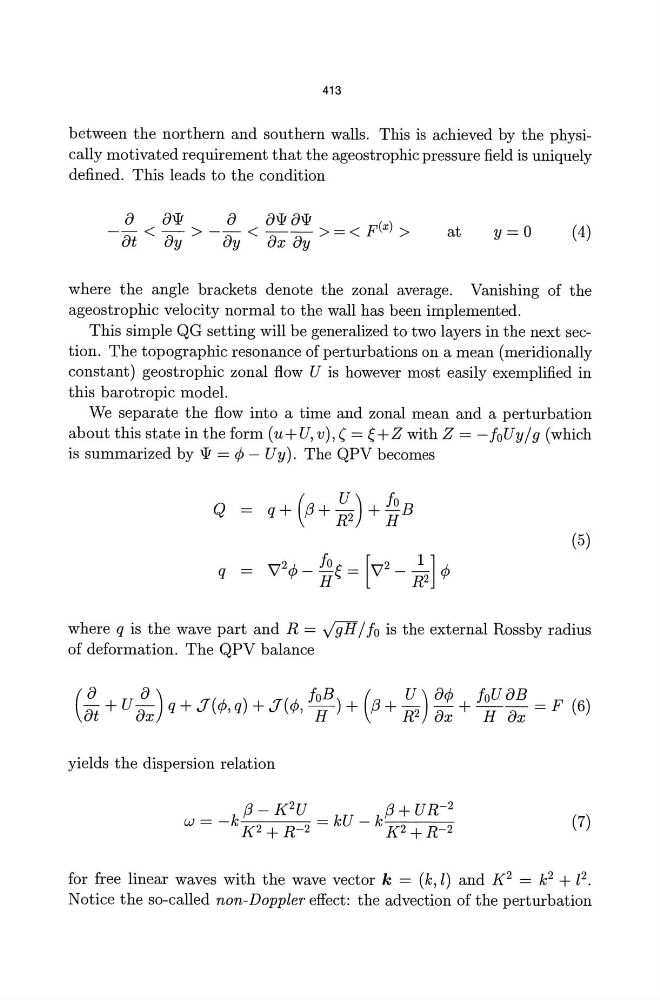
between the northern and southern walls. This is achieved by the physically motivated requirement that the ageostrophic pressure field is uniquely
defined. This leads to the condition
fJ
fJ \lI
fJ
fJ\lI fJ \lI
x
- - < - > - - < - - > = < F( ) >
fJt
fJy
fJy
fJx fJy
at
y=O
(4)
where the angle brackets denote the zonal average. Vanishing of the
ageostrophic velocity normal to the wall has been implemented.
This simple QG setting will be generalized to two layers in the next section. The topographic resonance of perturbations on a mean (meridionally
constant) geostrophic zonal flow U is however most easily exemplified in
this barotropic model.
We separate the flow into a time and zonal mean and a perturbation
about this state in the form (u+U, v), (= e +Z with Z = - foUy/g (which
is summarized by \lI = ¢ - U Y ). The QPV becomes
(5)
where q is the wave part and R = V gH / fo is the external Rossby radius
of deformation. The QPV balance
yields the dispersion relation
(7)
for free linear waves with the wave vector k = (k, l) and K2 = k 2 + l2.
Notice the so-called non-Doppler effect: the advection of the perturbation
between the northern and southern walls. This is achieved by the physically motivated requirement that the ageostrophic pressure field is uniquely
defined. This leads to the condition
fJ
fJ \lI
fJ
fJ\lI fJ \lI
x
- - < - > - - < - - > = < F( ) >
fJt
fJy
fJy
fJx fJy
at
y=O
(4)
where the angle brackets denote the zonal average. Vanishing of the
ageostrophic velocity normal to the wall has been implemented.
This simple QG setting will be generalized to two layers in the next section. The topographic resonance of perturbations on a mean (meridionally
constant) geostrophic zonal flow U is however most easily exemplified in
this barotropic model.
We separate the flow into a time and zonal mean and a perturbation
about this state in the form (u+U, v), (= e +Z with Z = - foUy/g (which
is summarized by \lI = ¢ - U Y ). The QPV becomes
(5)
where q is the wave part and R = V gH / fo is the external Rossby radius
of deformation. The QPV balance
yields the dispersion relation
(7)
for free linear waves with the wave vector k = (k, l) and K2 = k 2 + l2.
Notice the so-called non-Doppler effect: the advection of the perturbation