

414
stretching vorticity by the mean flow cancels the advection of the mean
stretching vorticity by the perturbed flow. Stationary waves do exist for
eastward currents (U > 0) and due to the non-Doppler effect they occur for
U = f3 / K2 rather than for U equal to the phase velocity of the Rossby wave
in the reference frame of the mean flow. If the short-wave limit (K R)2 » 1
is applicable this distinction disappears.
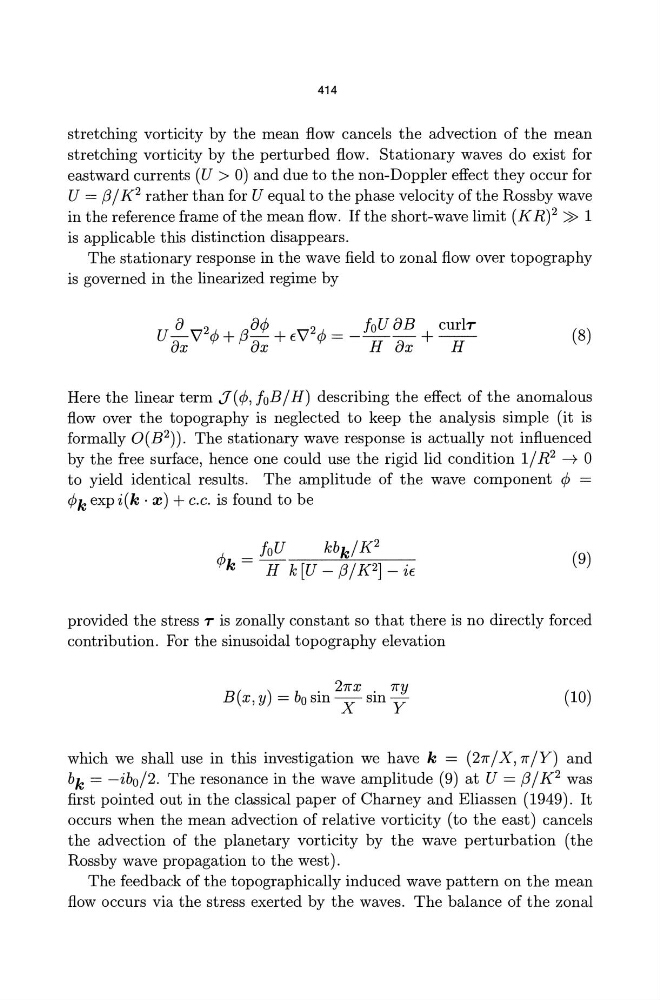
The stationary response in the wave field to zonal flow over topography
is governed in the linearized regime by
(8)
Here the linear term :r (
formally O(B2)). The stationary wave response is actually not influenced
by the free surface, hence one could use the rigid lid condition 1/ R2 --+ 0
to yield identical results. The amplitude of the wave component
kbk/K2
provided the stress T is zonally constant so that there is no directly forced
contribution. For the sinusoidal topography elevation
(10)
which we shall use in this investigation we have k = (271"/ X, 71" /Y) and
bk = -ibo/2. The resonance in the wave amplitude (9) at U = f3/K 2 was
first pointed out in the classical paper of Charney and Eliassen (1949). It
occurs when the mean advection of relative vorticity (to the east) cancels
the advection of the planetary vorticity by the wave perturbation (the
Rossby wave propagation to the west).
The feedback of the topographically induced wave pattern on the mean
flow occurs via the stress exerted by the waves. The balance of the zonal
stretching vorticity by the mean flow cancels the advection of the mean
stretching vorticity by the perturbed flow. Stationary waves do exist for
eastward currents (U > 0) and due to the non-Doppler effect they occur for
U = f3 / K2 rather than for U equal to the phase velocity of the Rossby wave
in the reference frame of the mean flow. If the short-wave limit (K R)2 » 1
is applicable this distinction disappears.
The stationary response in the wave field to zonal flow over topography
is governed in the linearized regime by
(8)
Here the linear term :r (
formally O(B2)). The stationary wave response is actually not influenced
by the free surface, hence one could use the rigid lid condition 1/ R2 --+ 0
to yield identical results. The amplitude of the wave component
kbk/K2
provided the stress T is zonally constant so that there is no directly forced
contribution. For the sinusoidal topography elevation
(10)
which we shall use in this investigation we have k = (271"/ X, 71" /Y) and
bk = -ibo/2. The resonance in the wave amplitude (9) at U = f3/K 2 was
first pointed out in the classical paper of Charney and Eliassen (1949). It
occurs when the mean advection of relative vorticity (to the east) cancels
the advection of the planetary vorticity by the wave perturbation (the
Rossby wave propagation to the west).
The feedback of the topographically induced wave pattern on the mean
flow occurs via the stress exerted by the waves. The balance of the zonal