

412
2 Topographic resonance in the CdV model
The effect of large-scale topographic obstacles on a zonal flow is investigated in a zonal periodic channel of length X and width Y on a ,6-plane with
Coriolis parameter f = fo+,6y. The meridional boundaries at y = 0, Yare
rigid and to begin with we are considering a layer of fluid with thickness
H + (- B where H is the undisturbed layer height, B is the elevation of
the bottom topography and ( is the elevation of the upper surface. We
assume quasigeostrophic (QG) dynamics: the horizontal velocities in the
layer and the surface elevation are expressed in terms of the streamfunction
W which equals the geostrophic pressure devided by fo. Thus, in particular, the surface elevation relates to the streamfunction by ( = fowl g. The
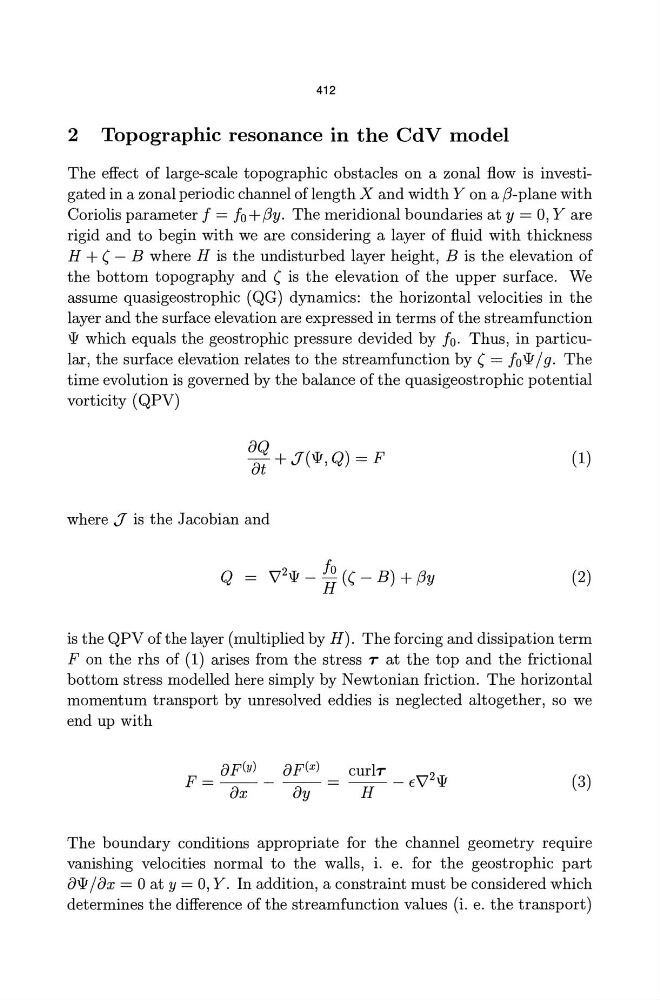
time evolution is governed by the balance of the quasigeostrophic potential
vorticity (QPV)
(1)
where J is the Jacobian and
Q
(2)
is the QPV ofthe layer (multiplied by H). The forcing and dissipation term
F on the rhs of (1) arises from the stress T at the top and the frictional
bottom stress modelled here simply by Newtonian friction. The horizontal
momentum transport by unresolved eddies is neglected altogether, so we
end up with
(3)
The boundary conditions appropriate for the channel geometry require
vanishing velocities normal to the walls, i. e. for the geostrophic part
ow lox = Oat y = 0, Y. In addition, a constraint must be considered which
determines the difference of the streamfunction values (i. e. the transport)
2 Topographic resonance in the CdV model
The effect of large-scale topographic obstacles on a zonal flow is investigated in a zonal periodic channel of length X and width Y on a ,6-plane with
Coriolis parameter f = fo+,6y. The meridional boundaries at y = 0, Yare
rigid and to begin with we are considering a layer of fluid with thickness
H + (- B where H is the undisturbed layer height, B is the elevation of
the bottom topography and ( is the elevation of the upper surface. We
assume quasigeostrophic (QG) dynamics: the horizontal velocities in the
layer and the surface elevation are expressed in terms of the streamfunction
W which equals the geostrophic pressure devided by fo. Thus, in particular, the surface elevation relates to the streamfunction by ( = fowl g. The
time evolution is governed by the balance of the quasigeostrophic potential
vorticity (QPV)
(1)
where J is the Jacobian and
Q
(2)
is the QPV ofthe layer (multiplied by H). The forcing and dissipation term
F on the rhs of (1) arises from the stress T at the top and the frictional
bottom stress modelled here simply by Newtonian friction. The horizontal
momentum transport by unresolved eddies is neglected altogether, so we
end up with
(3)
The boundary conditions appropriate for the channel geometry require
vanishing velocities normal to the walls, i. e. for the geostrophic part
ow lox = Oat y = 0, Y. In addition, a constraint must be considered which
determines the difference of the streamfunction values (i. e. the transport)