

220
Greenland Regional Pressure Anomaly
4
· · · ··~
O~--~~-r-r--~-+.~---.~~~~~~~~v-~ · ' ~ · ~ "·r ··' · ·
,
".
-I
-2
1900
1910
1920
1930
1940
1950
l. eo
1970
1980
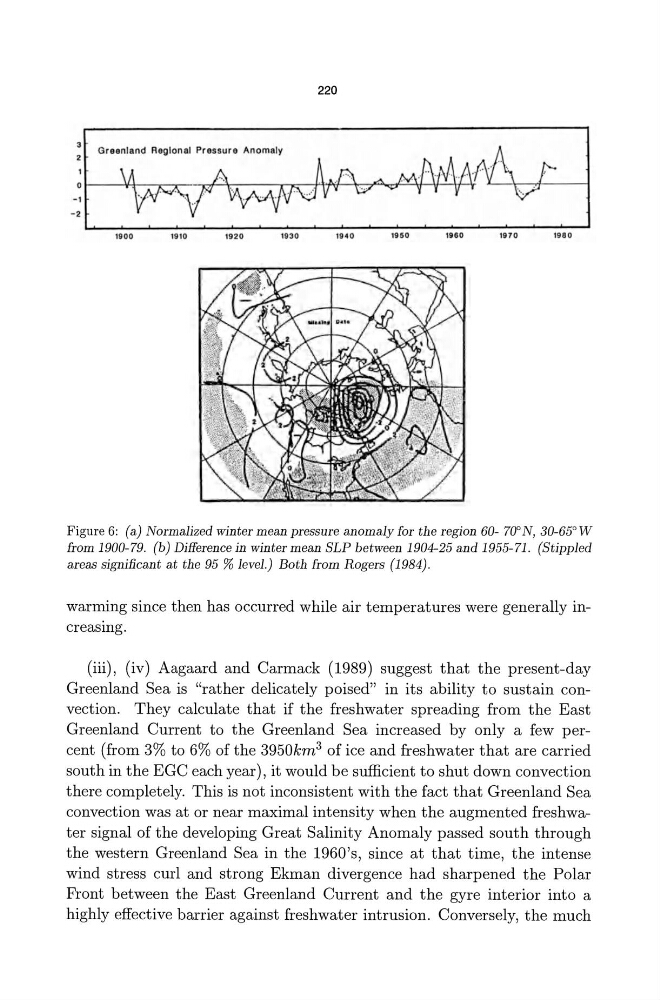
Figure 6: (a) Normalized winter mean pressure anomaly for the region 60- 7Cf'N, 30-65°W
from 1900-79. (b) Difference in winter mean SLP between 1904-25 and 1955-71 . (Stippled
areas significant at the 95 % level.) Both from Rogers (1984) .
warming since then has occurred while air temperatures were generally increasing.
(iii), (iv) Aagaard and Carmack (1989) suggest that the present-day
Greenland Sea is "rather delicately poised" in its ability to sustain convection. They calculate that if the freshwater spreading from the East
Greenland Current to the Greenland Sea increased by only a few percent (from 3% to 6% of the 3950km 3 of ice and freshwater that are carried
south in the EGC each year), it would be sufficient to shut down convection
there completely. This is not inconsistent with the fact that Greenland Sea
convection was at or near maximal intensity when the augmented freshwater signal of the developing Great Salinity Anomaly passed south through
the western Greenland Sea in the 1960's, since at that time, the intense
wind stress curl and strong Ekman divergence had sharpened the Polar
Front between the East Greenland Current and the gyre interior into a
highly effective barrier against freshwater intrusion. Conversely, the much
Greenland Regional Pressure Anomaly
4
· · · ··~
O~--~~-r-r--~-+.~---.~~~~~~~~v-~ · ' ~ · ~ "·r ··' · ·
,
".
-I
-2
1900
1910
1920
1930
1940
1950
l. eo
1970
1980
Figure 6: (a) Normalized winter mean pressure anomaly for the region 60- 7Cf'N, 30-65°W
from 1900-79. (b) Difference in winter mean SLP between 1904-25 and 1955-71 . (Stippled
areas significant at the 95 % level.) Both from Rogers (1984) .
warming since then has occurred while air temperatures were generally increasing.
(iii), (iv) Aagaard and Carmack (1989) suggest that the present-day
Greenland Sea is "rather delicately poised" in its ability to sustain convection. They calculate that if the freshwater spreading from the East
Greenland Current to the Greenland Sea increased by only a few percent (from 3% to 6% of the 3950km 3 of ice and freshwater that are carried
south in the EGC each year), it would be sufficient to shut down convection
there completely. This is not inconsistent with the fact that Greenland Sea
convection was at or near maximal intensity when the augmented freshwater signal of the developing Great Salinity Anomaly passed south through
the western Greenland Sea in the 1960's, since at that time, the intense
wind stress curl and strong Ekman divergence had sharpened the Polar
Front between the East Greenland Current and the gyre interior into a
highly effective barrier against freshwater intrusion. Conversely, the much