

Calcul intégral et champs de vecteurs
COURS
29
Henri Poincaré
,
mathématicienfrançais
(1854-1912)
Nousadmettrons le résultat suivant :
Théorème 2:Théorème de Poincaré
Tout champ de vecteurs de classe C
1
− →
V ( x , y ) = ( P ( x , y ) , Q ( x , y )) dont la
matrice jacobienne est symétrique
c’est-à-dire
∂P
∂y
=
∂Q
∂x
sur un domaine
U étoilé par rapportàun de ses points estu nc hamp de gradient, c’est-à-dire
qu’il existe une fonction f de classe C
2
de U dans R telleque :
∀(x, y) ∈ UP ( x , y ) =
∂ f
∂ x
et Q(x, y) =
∂f
∂y
On dit alors que f estu npotentiel scalaire du champ
− →
V et que ce champ
dérive d’un potentielscalaire.
Exemple:Considérons le champ de vecteurs défini sur U = R
2
\{O} par :
− →
V ( x , y ) =
− y
x 2 + y 2 ,
x
x 2 + y 2
On vérifie que :
∀(x, y) ∈ U
2
∂P
∂y
(x, y) =
∂Q
∂x
(x, y) =
y
2
− x
2
(x 2 + y 2 ) 2
O
y
x
Arc tan +
2
π
2
− π
2
+ π
U +
U −
3
π
o
π
y
x
Arc tan
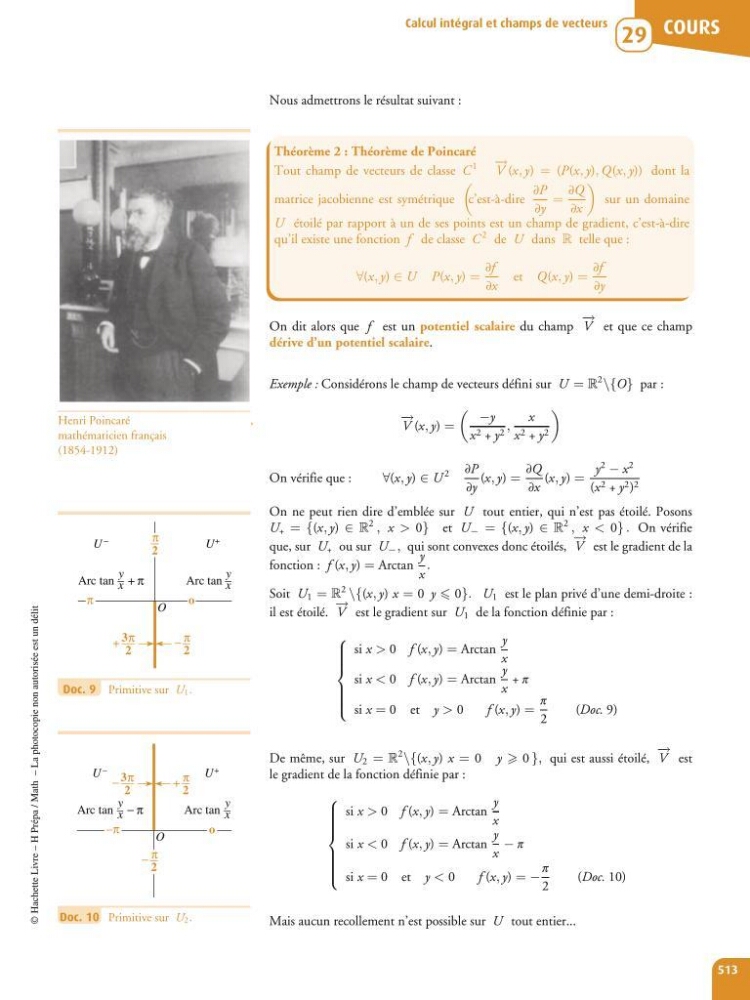
Doc. 9 Primitivesur U1.
On ne peut rien dire d’emblée sur U tout entier, qui n’est pas étoilé.P osons
U + = {(x, y) ∈ R
2
, x > 0} et U − = {(x, y) ∈ R
2
, x < 0} . On vérifie
que, sur U + ou sur U − , qui sont convexes donc étoilés,
− →
V est le gradient de la
fonction : f (x, y) = Arctan
y
x
.
Soit U 1 = R
2
\{(x, y) x = 0 y 0}. U 1 est le plan privé d’unedemi-droite :
il est étoilé.
− →
V est le gradient sur U 1 de la fonction définiepar :
⎧
⎪ ⎪ ⎪ ⎪ ⎨
⎪ ⎪ ⎪ ⎪ ⎩
si x > 0 f (x, y) = Arctan
y
x
si x < 0 f (x, y) = Arctan
y
x
+ π
si x = 0e ty > 0
f ( x , y ) =
π
2
( Doc. 9)
O
y
x
Arc tan −
2
+ π
2
−
−
π
U
+
U
−
3
π
o
π
y
x
Arc tan
2
π
−
Doc. 10 Primitivesur U2.
De même, sur U 2 = R
2
\{(x, y) x = 0 y 0 }, qui est aussi étoilé,
− →
V est
le gradient de la fonction définiepar :
⎧
⎪ ⎪ ⎪ ⎪ ⎪ ⎨
⎪ ⎪ ⎪ ⎪ ⎪ ⎩
si x > 0 f (x, y) = Arctan
y
x
si x < 0 f (x, y) = Arctan
y
x
− π
si x = 0e ty < 0
f ( x , y ) = −
π
2
( Doc. 10)
Mais aucunrecollement n’est possible sur U tout entier...
Hachette Livre–HPrépa /Math –Laphotocopie non autorisée est un délit
513
COURS
29
Henri Poincaré
,
mathématicienfrançais
(1854-1912)
Nousadmettrons le résultat suivant :
Théorème 2:Théorème de Poincaré
Tout champ de vecteurs de classe C
1
− →
V ( x , y ) = ( P ( x , y ) , Q ( x , y )) dont la
matrice jacobienne est symétrique
c’est-à-dire
∂P
∂y
=
∂Q
∂x
sur un domaine
U étoilé par rapportàun de ses points estu nc hamp de gradient, c’est-à-dire
qu’il existe une fonction f de classe C
2
de U dans R telleque :
∀(x, y) ∈ UP ( x , y ) =
∂ f
∂ x
et Q(x, y) =
∂f
∂y
On dit alors que f estu npotentiel scalaire du champ
− →
V et que ce champ
dérive d’un potentielscalaire.
Exemple:Considérons le champ de vecteurs défini sur U = R
2
\{O} par :
− →
V ( x , y ) =
− y
x 2 + y 2 ,
x
x 2 + y 2
On vérifie que :
∀(x, y) ∈ U
2
∂P
∂y
(x, y) =
∂Q
∂x
(x, y) =
y
2
− x
2
(x 2 + y 2 ) 2
O
y
x
Arc tan +
2
π
2
− π
2
+ π
U +
U −
3
π
o
π
y
x
Arc tan
Doc. 9 Primitivesur U1.
On ne peut rien dire d’emblée sur U tout entier, qui n’est pas étoilé.P osons
U + = {(x, y) ∈ R
2
, x > 0} et U − = {(x, y) ∈ R
2
, x < 0} . On vérifie
que, sur U + ou sur U − , qui sont convexes donc étoilés,
− →
V est le gradient de la
fonction : f (x, y) = Arctan
y
x
.
Soit U 1 = R
2
\{(x, y) x = 0 y 0}. U 1 est le plan privé d’unedemi-droite :
il est étoilé.
− →
V est le gradient sur U 1 de la fonction définiepar :
⎧
⎪ ⎪ ⎪ ⎪ ⎨
⎪ ⎪ ⎪ ⎪ ⎩
si x > 0 f (x, y) = Arctan
y
x
si x < 0 f (x, y) = Arctan
y
x
+ π
si x = 0e ty > 0
f ( x , y ) =
π
2
( Doc. 9)
O
y
x
Arc tan −
2
+ π
2
−
−
π
U
+
U
−
3
π
o
π
y
x
Arc tan
2
π
−
Doc. 10 Primitivesur U2.
De même, sur U 2 = R
2
\{(x, y) x = 0 y 0 }, qui est aussi étoilé,
− →
V est
le gradient de la fonction définiepar :
⎧
⎪ ⎪ ⎪ ⎪ ⎪ ⎨
⎪ ⎪ ⎪ ⎪ ⎪ ⎩
si x > 0 f (x, y) = Arctan
y
x
si x < 0 f (x, y) = Arctan
y
x
− π
si x = 0e ty < 0
f ( x , y ) = −
π
2
( Doc. 10)
Mais aucunrecollement n’est possible sur U tout entier...
Hachette Livre–HPrépa /Math –Laphotocopie non autorisée est un délit
513