

COURS 2
Fonctions usuelles
Dérivée
ch
Argch
y
x
1
1
0
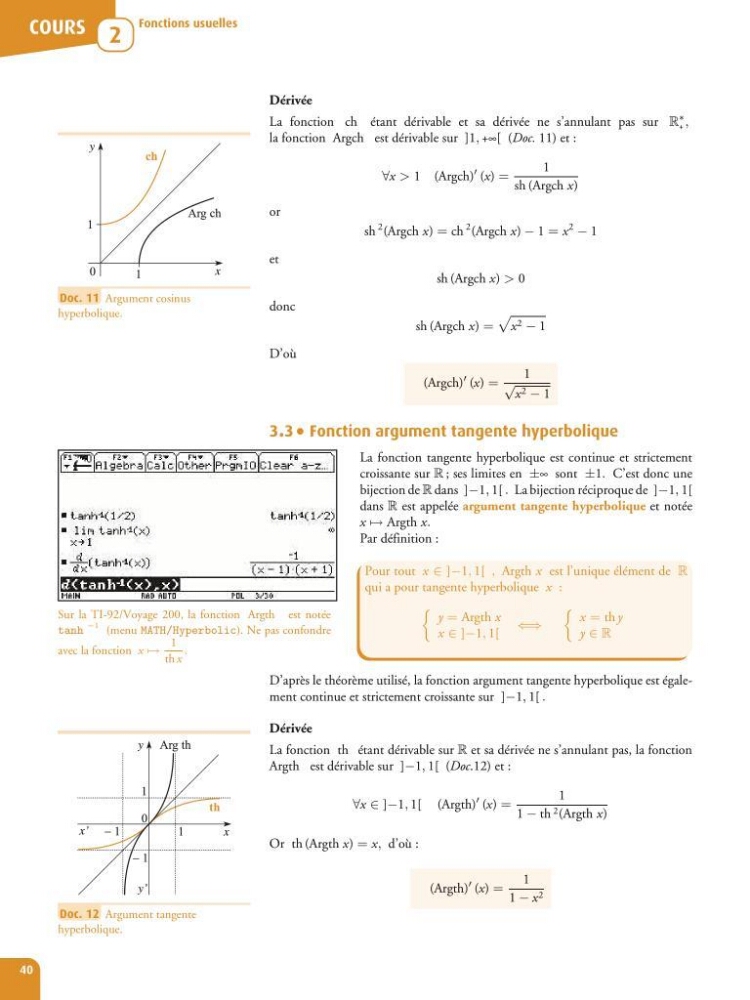
Doc. 11 Argument cosinus
hyperbolique.
La fonction ch étant dérivable et sa dérivée ne s’annulant pas sur R
∗
+ ,
la fonction Argche st dérivable sur ]1, +∞[( Doc. 11)et:
∀x>1( Argch)
(x) =
1
sh (Argch x)
or
sh
2
(Argch x) = ch
2
(Argch x) − 1 = x
2
− 1
et
sh (Argch x) > 0
donc
sh (Argch x) =
x 2 − 1
D’où
(Argch)
(x) =
1
√ x 2 − 1
3.3 • Fonction argument tangente hyperbolique
Sur la TI-92/Voyage 200, la fonction Argth est notée
tanh
−1 (menu MATH/Hyperbolic). Ne pas confondre
avec la fonction x →
1
th x
.
La fonction tangente hyperbolique est continuee ts trictement
croissante sur R ;ses limitesen ±∞ sont ±1. C’est donc une
bijectiondeRdans ]−1, 1[ . La bijectionréciproque de ]−1, 1[
dans R est appelée argument tangente hyperbolique et notée
x
→ Argth x.
Par définition :
Pour tout x ∈ ]−1, 1[ , Argth x est l’unique élément de R
qui apour tangente hyperbolique x :
y = Argth x
x ∈ ]−1, 1[
⇐⇒
x = th y
y ∈ R
D’aprèslethéorème utilisé, la fonction argument tangente hyperbolique est également continue et strictementcroissante sur ]−1, 1[ .
Dérivée
y
x
x'
y'
th
Argth
1
1
1
1
0
Doc. 12 Argument tangente
hyperbolique.
La fonction th étant dérivable sur R et sa dérivée ne s’annulant pas, la fonction
Argth estdérivable sur ]−1, 1[ (Doc.12)et:
∀x∈]−1,1[ (Argth)
(x) =
1
1 − th 2 (Argth x)
Or th (Argth x) = x, d’où :
(Argth)
(x) =
1
1 − x 2
40
Fonctions usuelles
Dérivée
ch
Argch
y
x
1
1
0
Doc. 11 Argument cosinus
hyperbolique.
La fonction ch étant dérivable et sa dérivée ne s’annulant pas sur R
∗
+ ,
la fonction Argche st dérivable sur ]1, +∞[( Doc. 11)et:
∀x>1( Argch)
(x) =
1
sh (Argch x)
or
sh
2
(Argch x) = ch
2
(Argch x) − 1 = x
2
− 1
et
sh (Argch x) > 0
donc
sh (Argch x) =
x 2 − 1
D’où
(Argch)
(x) =
1
√ x 2 − 1
3.3 • Fonction argument tangente hyperbolique
Sur la TI-92/Voyage 200, la fonction Argth est notée
tanh
−1 (menu MATH/Hyperbolic). Ne pas confondre
avec la fonction x →
1
th x
.
La fonction tangente hyperbolique est continuee ts trictement
croissante sur R ;ses limitesen ±∞ sont ±1. C’est donc une
bijectiondeRdans ]−1, 1[ . La bijectionréciproque de ]−1, 1[
dans R est appelée argument tangente hyperbolique et notée
x
→ Argth x.
Par définition :
Pour tout x ∈ ]−1, 1[ , Argth x est l’unique élément de R
qui apour tangente hyperbolique x :
y = Argth x
x ∈ ]−1, 1[
⇐⇒
x = th y
y ∈ R
D’aprèslethéorème utilisé, la fonction argument tangente hyperbolique est également continue et strictementcroissante sur ]−1, 1[ .
Dérivée
y
x
x'
y'
th
Argth
1
1
1
1
0
Doc. 12 Argument tangente
hyperbolique.
La fonction th étant dérivable sur R et sa dérivée ne s’annulant pas, la fonction
Argth estdérivable sur ]−1, 1[ (Doc.12)et:
∀x∈]−1,1[ (Argth)
(x) =
1
1 − th 2 (Argth x)
Or th (Argth x) = x, d’où :
(Argth)
(x) =
1
1 − x 2
40