

Géométrie élémentaire de l’espace
COURS
7
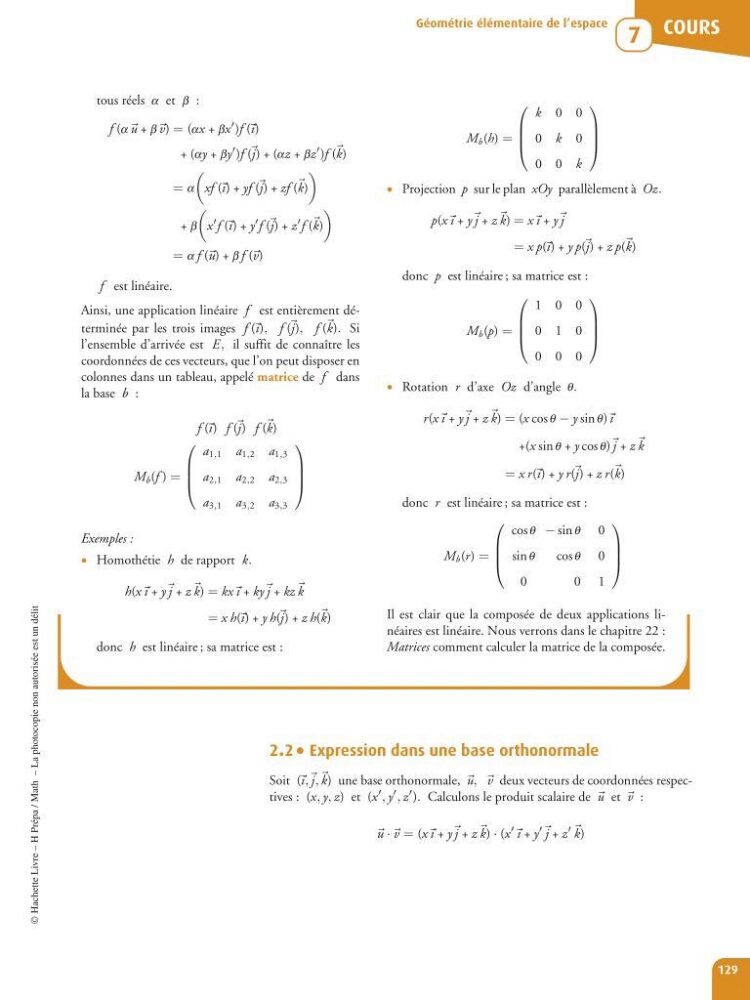
tous réels α et β :
f (α u + β v) = (αx + βx
)f ( i)
+(αy+βy
)f( j)+(αz+βz
)f( k)
=α
xf ( i)+yf ( j)+zf ( k)
+ β
x
f ( i)+y
f( j)+z
f( k)
=αf( u)+βf( v)
f est linéaire.
Ainsi, une application linéaire f est entièrement déterminée par lest rois images f ( i), f ( j), f ( k). Si
l’ensemble d’arrivée est E, il suffit de connaître les
coordonnées de ces vecteurs,que l’on peut disposer en
colonnes dans un tableau, appelé matrice de f dans
la base b :
f ( i) f ( j) f ( k)
M b (f ) =
⎛
⎜
⎜
⎝
a 1,1 a 1,2 a 1,3
a 2,1 a 2,2 a 2,3
a 3,1 a 3,2 a 3,3
⎞
⎟
⎟
⎠
Exemples :
• Homothétie h de rapport k.
h(x i + y j + z k) = kx i + ky j + kz k
= xh( i)+yh( j)+zh( k)
donc h estlinéaire ;samatrice est :
M b (h) =
⎛
⎜
⎜
⎝
k 00
0k0
00k
⎞
⎟
⎟
⎠
• Projection p sur le plan xOy parallèlementà Oz.
p(x i + y j + z k) = x i + y j
= xp( i)+yp( j)+zp( k)
donc p estlinéaire ;samatrice est :
M b (p) =
⎛
⎜
⎜
⎝
100
010
000
⎞
⎟
⎟
⎠
• Rotation r d’axe Oz d’angle θ.
r(x i + y j + z k) = (x cos θ − y sin θ) i
+(x sin θ + y cos θ) j + z k
= xr( i)+yr( j)+zr( k)
donc r estlinéaire ;samatrice est :
M b (r) =
⎛
⎜
⎜
⎝
cos θ − sin θ 0
sin θ
cos θ 0
00 1
⎞
⎟
⎟
⎠
Il est clair que la composée de deux applications linéaires estlinéaire. Nous verrons dans le chapitre 22 :
Matrices commentcalculer la matrice de la composée.
2.2 • Expression dans unebase orthonormale
Soit ( i, j, k)u ne base orthonormale, u,, vdeux vecteurs de coordonnées respectives :( x , y , z )e t( x
, y
, z
) .Calculons le produit scalaire de u et v :
u · v = (x i + y j + z k) · (x
i + y
j + z
k)
Hachette Livre–HPrépa /Math –Laphotocopie non autorisée est un délit
129
COURS
7
tous réels α et β :
f (α u + β v) = (αx + βx
)f ( i)
+(αy+βy
)f( j)+(αz+βz
)f( k)
=α
xf ( i)+yf ( j)+zf ( k)
+ β
x
f ( i)+y
f( j)+z
f( k)
=αf( u)+βf( v)
f est linéaire.
Ainsi, une application linéaire f est entièrement déterminée par lest rois images f ( i), f ( j), f ( k). Si
l’ensemble d’arrivée est E, il suffit de connaître les
coordonnées de ces vecteurs,que l’on peut disposer en
colonnes dans un tableau, appelé matrice de f dans
la base b :
f ( i) f ( j) f ( k)
M b (f ) =
⎛
⎜
⎜
⎝
a 1,1 a 1,2 a 1,3
a 2,1 a 2,2 a 2,3
a 3,1 a 3,2 a 3,3
⎞
⎟
⎟
⎠
Exemples :
• Homothétie h de rapport k.
h(x i + y j + z k) = kx i + ky j + kz k
= xh( i)+yh( j)+zh( k)
donc h estlinéaire ;samatrice est :
M b (h) =
⎛
⎜
⎜
⎝
k 00
0k0
00k
⎞
⎟
⎟
⎠
• Projection p sur le plan xOy parallèlementà Oz.
p(x i + y j + z k) = x i + y j
= xp( i)+yp( j)+zp( k)
donc p estlinéaire ;samatrice est :
M b (p) =
⎛
⎜
⎜
⎝
100
010
000
⎞
⎟
⎟
⎠
• Rotation r d’axe Oz d’angle θ.
r(x i + y j + z k) = (x cos θ − y sin θ) i
+(x sin θ + y cos θ) j + z k
= xr( i)+yr( j)+zr( k)
donc r estlinéaire ;samatrice est :
M b (r) =
⎛
⎜
⎜
⎝
cos θ − sin θ 0
sin θ
cos θ 0
00 1
⎞
⎟
⎟
⎠
Il est clair que la composée de deux applications linéaires estlinéaire. Nous verrons dans le chapitre 22 :
Matrices commentcalculer la matrice de la composée.
2.2 • Expression dans unebase orthonormale
Soit ( i, j, k)u ne base orthonormale, u,, vdeux vecteurs de coordonnées respectives :( x , y , z )e t( x
, y
, z
) .Calculons le produit scalaire de u et v :
u · v = (x i + y j + z k) · (x
i + y
j + z
k)
Hachette Livre–HPrépa /Math –Laphotocopie non autorisée est un délit
129