

3 Local Dielectric Constant Density Analysis of High-k Dielectric Nanomaterial
71
α
i
GeH 4
α
i
α
i
α
i
AsH 3
H 2 Se
HBr
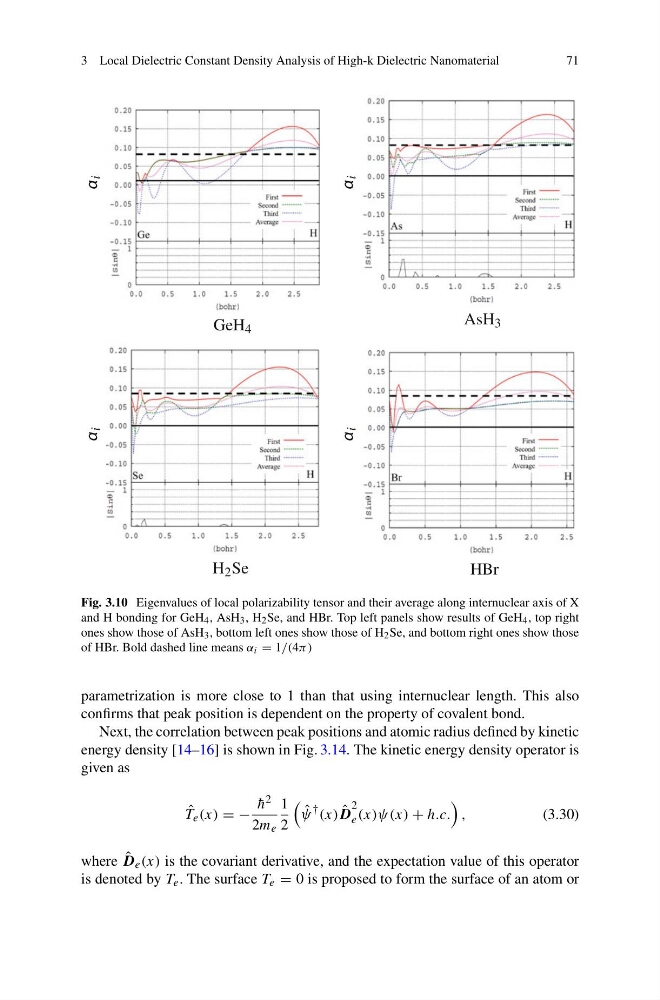
Fig. 3.10 Eigenvalues of local polarizability tensor and their average along internuclear axis of X
and H bonding for GeH 4 , AsH 3 , H 2 Se, and HBr. Top left panels show results of GeH 4 , top right
ones show those of AsH 3 , bottom left ones show those of H 2 Se, and bottom right ones show those
of HBr. Bold dashed line means α i = 1/(4π)
parametrization is more close to 1 than that using internuclear length. This also
confirms that peak position is dependent on the property of covalent bond.
Next, the correlation between peak positions and atomic radius defined by kinetic
energy density [14–16] is shown in Fig. 3.14. The kinetic energy density operator is
given as
ˆ
T e (x) = −
¯
h 2
2m e
1
2
ˆ
ψ
† (x) ˆ
D
2
e (x)ψ(x) + h.c.
,
(3.30)
where ˆ
D e (x) is the covariant derivative, and the expectation value of this operator
is denoted by T e . The surface T e = 0 is proposed to form the surface of an atom or
71
α
i
GeH 4
α
i
α
i
α
i
AsH 3
H 2 Se
HBr
Fig. 3.10 Eigenvalues of local polarizability tensor and their average along internuclear axis of X
and H bonding for GeH 4 , AsH 3 , H 2 Se, and HBr. Top left panels show results of GeH 4 , top right
ones show those of AsH 3 , bottom left ones show those of H 2 Se, and bottom right ones show those
of HBr. Bold dashed line means α i = 1/(4π)
parametrization is more close to 1 than that using internuclear length. This also
confirms that peak position is dependent on the property of covalent bond.
Next, the correlation between peak positions and atomic radius defined by kinetic
energy density [14–16] is shown in Fig. 3.14. The kinetic energy density operator is
given as
ˆ
T e (x) = −
¯
h 2
2m e
1
2
ˆ
ψ
† (x) ˆ
D
2
e (x)ψ(x) + h.c.
,
(3.30)
where ˆ
D e (x) is the covariant derivative, and the expectation value of this operator
is denoted by T e . The surface T e = 0 is proposed to form the surface of an atom or