

72
M. Senami and A. Fukushima
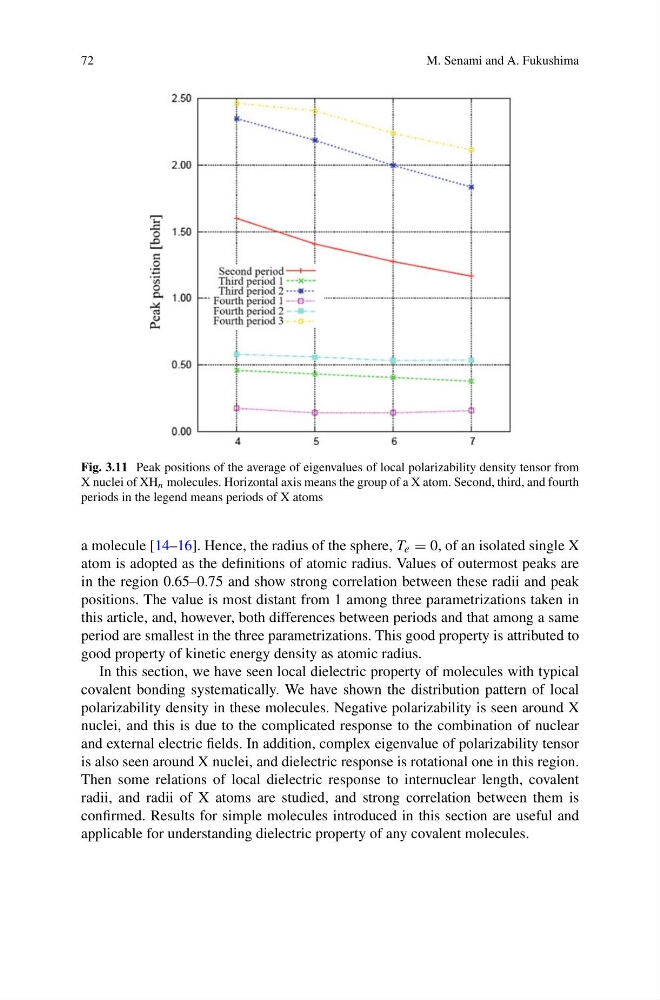
Fig. 3.11 Peak positions of the average of eigenvalues of local polarizability density tensor from
X nuclei of XH n molecules. Horizontal axis means the group of a X atom. Second, third, and fourth
periods in the legend means periods of X atoms
a molecule [14–16]. Hence, the radius of the sphere, T e = 0, of an isolated single X
atom is adopted as the definitions of atomic radius. Values of outermost peaks are
in the region 0.65–0.75 and show strong correlation between these radii and peak
positions. The value is most distant from 1 among three parametrizations taken in
this article, and, however, both differences between periods and that among a same
period are smallest in the three parametrizations. This good property is attributed to
good property of kinetic energy density as atomic radius.
In this section, we have seen local dielectric property of molecules with typical
covalent bonding systematically. We have shown the distribution pattern of local
polarizability density in these molecules. Negative polarizability is seen around X
nuclei, and this is due to the complicated response to the combination of nuclear
and external electric fields. In addition, complex eigenvalue of polarizability tensor
is also seen around X nuclei, and dielectric response is rotational one in this region.
Then some relations of local dielectric response to internuclear length, covalent
radii, and radii of X atoms are studied, and strong correlation between them is
confirmed. Results for simple molecules introduced in this section are useful and
applicable for understanding dielectric property of any covalent molecules.
M. Senami and A. Fukushima
Fig. 3.11 Peak positions of the average of eigenvalues of local polarizability density tensor from
X nuclei of XH n molecules. Horizontal axis means the group of a X atom. Second, third, and fourth
periods in the legend means periods of X atoms
a molecule [14–16]. Hence, the radius of the sphere, T e = 0, of an isolated single X
atom is adopted as the definitions of atomic radius. Values of outermost peaks are
in the region 0.65–0.75 and show strong correlation between these radii and peak
positions. The value is most distant from 1 among three parametrizations taken in
this article, and, however, both differences between periods and that among a same
period are smallest in the three parametrizations. This good property is attributed to
good property of kinetic energy density as atomic radius.
In this section, we have seen local dielectric property of molecules with typical
covalent bonding systematically. We have shown the distribution pattern of local
polarizability density in these molecules. Negative polarizability is seen around X
nuclei, and this is due to the complicated response to the combination of nuclear
and external electric fields. In addition, complex eigenvalue of polarizability tensor
is also seen around X nuclei, and dielectric response is rotational one in this region.
Then some relations of local dielectric response to internuclear length, covalent
radii, and radii of X atoms are studied, and strong correlation between them is
confirmed. Results for simple molecules introduced in this section are useful and
applicable for understanding dielectric property of any covalent molecules.