

64
M. Senami and A. Fukushima
Table 3.1 List of basis sets. The contraction and references are shown
Atom Basis set
Contraction
H
6-31G** [30, 31]
(4s,1p) – [2s,1p]
6-31++G** [30–32]
(5s,1p) – [3s,1p]
6-311G** [33]
(5s,1p) – [3s,1p]
6-311++G** [32, 33]
(6s,1p) – [4s,1p]
cc-pVDZ [34]
(4s,1p) – [2s,1p]
cc-pVTZ [34]
(5s,2p,1d) – [3s,2p,1d]
cc-pVQZ [34]
(6s,3p,2d,1f) – [4s,3p,2d,1f]
cc-pV6Z (K.A. Peterson, D.E. Woon,
T.H. Dunning Jr., unpublished)
(10s,5p,4d,3f,2g,1h) – [6s,5p,4d,3f,2g,1h]
Hf
LANL2DZ [35–37]
(5s,6p,3d) – [3s,3p,2d]
LANL2TZ [35–38]
(5s,5p,3d) – [5s,5p,3d]
Def2-SVP [39, 40]
(7s,6p,5d,1f) – [6s,3p,2d,1f]
Def2-TZVP [39, 40]
(9s,7p,5d,1f) – [6s,4p,3d,1f]
Def2-QZVP [39, 40]
(10s,8p,6d,3f,1g) – [7s,5p,4d,3f,1g]
cc-pVDZ-PP [41]
(8s,7p,6d,1f) – [4s,4p,3d,1f]
aug-cc-pVDZ-PP [41]
(9s,8p,7d,2f) – [5s,5p,4d,2f]
0
0.1
0.2
0.3
0.4
0.5
0.6
0.7
0.8
0.9
1
0 0.5 1 1.5 2 2.5 3 3.5 4 4.5 5
(
1,analytic −
1 )/
1,analytic
(bohr)
6−31G**
6−31++G**
6−311G**
6−311++G**
cc−pVDZ
cc−pVTZ
cc−pVQZ
cc−pV6Z
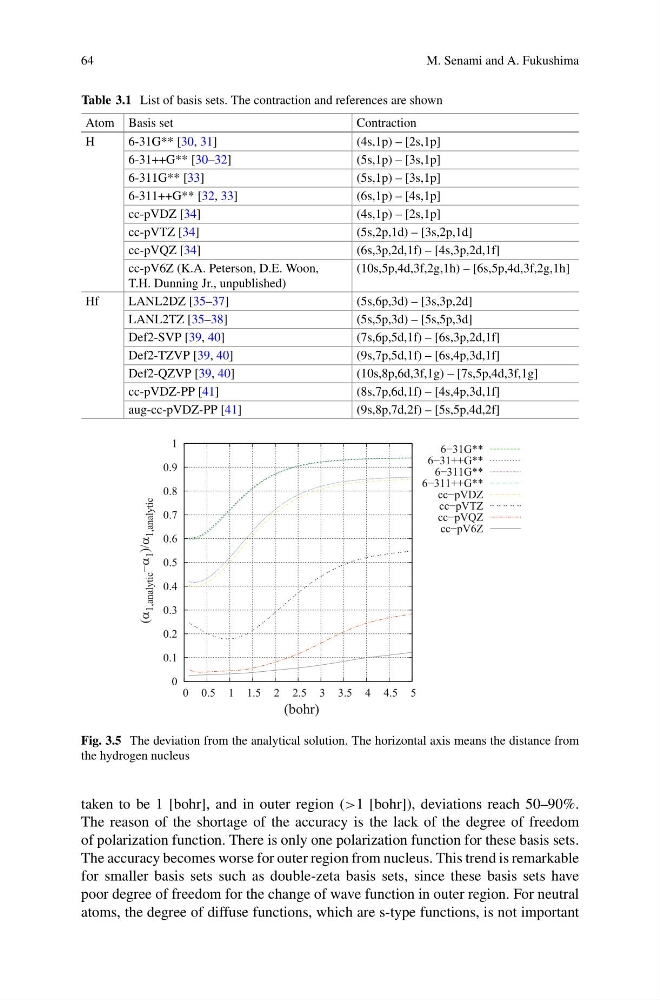
Fig. 3.5 The deviation from the analytical solution. The horizontal axis means the distance from
the hydrogen nucleus
taken to be 1 [bohr], and in outer region (>1 [bohr]), deviations reach 50–90%.
The reason of the shortage of the accuracy is the lack of the degree of freedom
of polarization function. There is only one polarization function for these basis sets.
The accuracy becomes worse for outer region from nucleus. This trend is remarkable
for smaller basis sets such as double-zeta basis sets, since these basis sets have
poor degree of freedom for the change of wave function in outer region. For neutral
atoms, the degree of diffuse functions, which are s-type functions, is not important
M. Senami and A. Fukushima
Table 3.1 List of basis sets. The contraction and references are shown
Atom Basis set
Contraction
H
6-31G** [30, 31]
(4s,1p) – [2s,1p]
6-31++G** [30–32]
(5s,1p) – [3s,1p]
6-311G** [33]
(5s,1p) – [3s,1p]
6-311++G** [32, 33]
(6s,1p) – [4s,1p]
cc-pVDZ [34]
(4s,1p) – [2s,1p]
cc-pVTZ [34]
(5s,2p,1d) – [3s,2p,1d]
cc-pVQZ [34]
(6s,3p,2d,1f) – [4s,3p,2d,1f]
cc-pV6Z (K.A. Peterson, D.E. Woon,
T.H. Dunning Jr., unpublished)
(10s,5p,4d,3f,2g,1h) – [6s,5p,4d,3f,2g,1h]
Hf
LANL2DZ [35–37]
(5s,6p,3d) – [3s,3p,2d]
LANL2TZ [35–38]
(5s,5p,3d) – [5s,5p,3d]
Def2-SVP [39, 40]
(7s,6p,5d,1f) – [6s,3p,2d,1f]
Def2-TZVP [39, 40]
(9s,7p,5d,1f) – [6s,4p,3d,1f]
Def2-QZVP [39, 40]
(10s,8p,6d,3f,1g) – [7s,5p,4d,3f,1g]
cc-pVDZ-PP [41]
(8s,7p,6d,1f) – [4s,4p,3d,1f]
aug-cc-pVDZ-PP [41]
(9s,8p,7d,2f) – [5s,5p,4d,2f]
0
0.1
0.2
0.3
0.4
0.5
0.6
0.7
0.8
0.9
1
0 0.5 1 1.5 2 2.5 3 3.5 4 4.5 5
(
1,analytic −
1 )/
1,analytic
(bohr)
6−31G**
6−31++G**
6−311G**
6−311++G**
cc−pVDZ
cc−pVTZ
cc−pVQZ
cc−pV6Z
Fig. 3.5 The deviation from the analytical solution. The horizontal axis means the distance from
the hydrogen nucleus
taken to be 1 [bohr], and in outer region (>1 [bohr]), deviations reach 50–90%.
The reason of the shortage of the accuracy is the lack of the degree of freedom
of polarization function. There is only one polarization function for these basis sets.
The accuracy becomes worse for outer region from nucleus. This trend is remarkable
for smaller basis sets such as double-zeta basis sets, since these basis sets have
poor degree of freedom for the change of wave function in outer region. For neutral
atoms, the degree of diffuse functions, which are s-type functions, is not important