

3 Local Dielectric Constant Density Analysis of High-k Dielectric Nanomaterial
63
Results in this section are useful for the comprehension of local dielectric
response property in hafnium dioxide discussed in the next section.
3.3.1 Dependence of Local Polarizability on Choice of Basis
Set
In this section, local dielectric response property of single atom and ion is discussed
for the purpose of clarification of basis set dependence. First, the strong basis set
dependence of local polarizability density is shown for hydrogen atom, where an
analytical solution of Schrödinger equation is known.
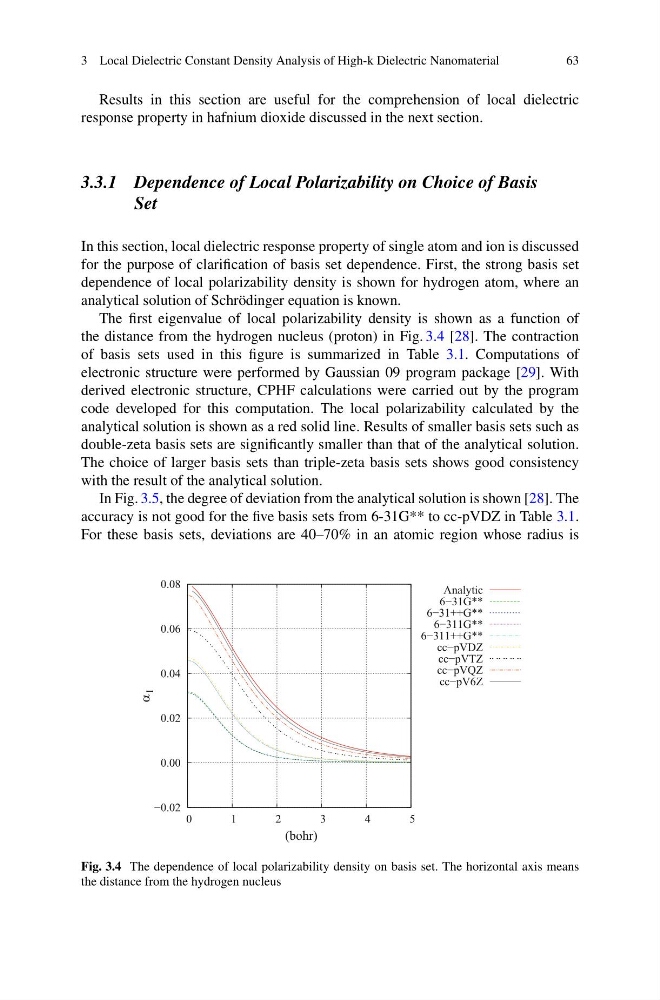
The first eigenvalue of local polarizability density is shown as a function of
the distance from the hydrogen nucleus (proton) in Fig. 3.4 [28]. The contraction
of basis sets used in this figure is summarized in Table 3.1. Computations of
electronic structure were performed by Gaussian 09 program package [29]. With
derived electronic structure, CPHF calculations were carried out by the program
code developed for this computation. The local polarizability calculated by the
analytical solution is shown as a red solid line. Results of smaller basis sets such as
double-zeta basis sets are significantly smaller than that of the analytical solution.
The choice of larger basis sets than triple-zeta basis sets shows good consistency
with the result of the analytical solution.
In Fig. 3.5, the degree of deviation from the analytical solution is shown [28]. The
accuracy is not good for the five basis sets from 6-31G** to cc-pVDZ in Table 3.1.
For these basis sets, deviations are 40–70% in an atomic region whose radius is
−0.02
0.00
0.02
0.04
0.06
0.08
0
1
2
3
4
5
1
(bohr)
Analytic
6−31G**
6−31++G**
6−311G**
6−311++G**
cc−pVDZ
cc−pVTZ
cc−pVQZ
cc−pV6Z
Fig. 3.4 The dependence of local polarizability density on basis set. The horizontal axis means
the distance from the hydrogen nucleus
63
Results in this section are useful for the comprehension of local dielectric
response property in hafnium dioxide discussed in the next section.
3.3.1 Dependence of Local Polarizability on Choice of Basis
Set
In this section, local dielectric response property of single atom and ion is discussed
for the purpose of clarification of basis set dependence. First, the strong basis set
dependence of local polarizability density is shown for hydrogen atom, where an
analytical solution of Schrödinger equation is known.
The first eigenvalue of local polarizability density is shown as a function of
the distance from the hydrogen nucleus (proton) in Fig. 3.4 [28]. The contraction
of basis sets used in this figure is summarized in Table 3.1. Computations of
electronic structure were performed by Gaussian 09 program package [29]. With
derived electronic structure, CPHF calculations were carried out by the program
code developed for this computation. The local polarizability calculated by the
analytical solution is shown as a red solid line. Results of smaller basis sets such as
double-zeta basis sets are significantly smaller than that of the analytical solution.
The choice of larger basis sets than triple-zeta basis sets shows good consistency
with the result of the analytical solution.
In Fig. 3.5, the degree of deviation from the analytical solution is shown [28]. The
accuracy is not good for the five basis sets from 6-31G** to cc-pVDZ in Table 3.1.
For these basis sets, deviations are 40–70% in an atomic region whose radius is
−0.02
0.00
0.02
0.04
0.06
0.08
0
1
2
3
4
5
1
(bohr)
Analytic
6−31G**
6−31++G**
6−311G**
6−311++G**
cc−pVDZ
cc−pVTZ
cc−pVQZ
cc−pV6Z
Fig. 3.4 The dependence of local polarizability density on basis set. The horizontal axis means
the distance from the hydrogen nucleus