

62
M. Senami and A. Fukushima
λ j h
(1j)
= λ j D 0 ej, (j = x, y, z)
(3.26)
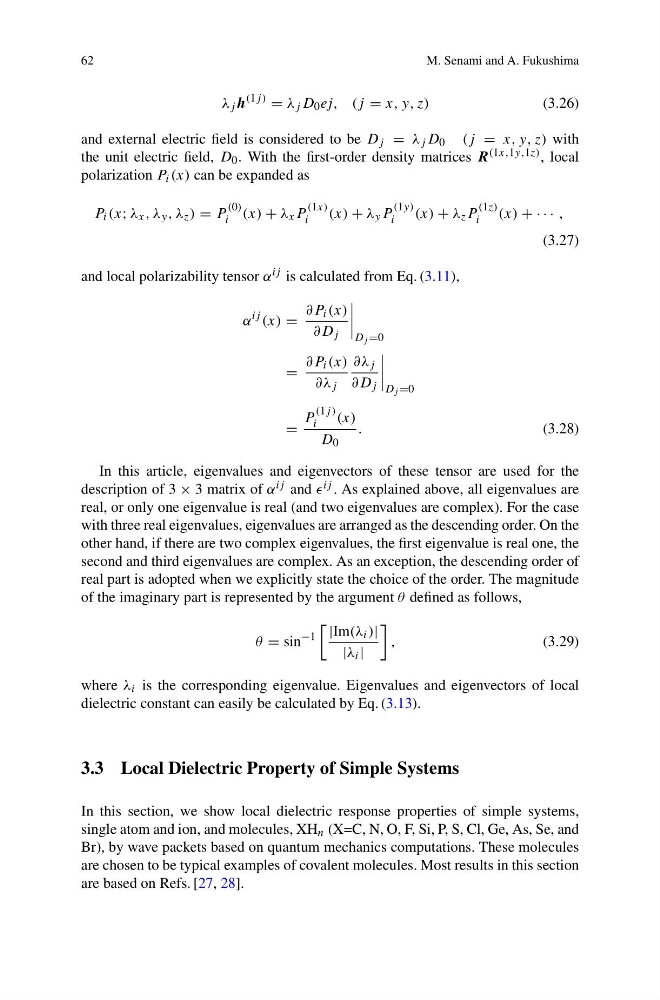
and external electric field is considered to be D j = λ j D 0 (j = x, y, z) with
the unit electric field, D 0 . With the first-order density matrices R (1x,1y,1z) , local
polarization P i (x) can be expanded as
P i (x; λ x , λ y , λ z ) = P
(0)
i (x) + λ x P
(1x)
i
(x) + λ y P
(1y)
i
(x) + λ z P
(1z)
i
(x) + · · · ,
(3.27)
and local polarizability tensor α ij is calculated from Eq. (3.11),
α
ij (x) =
∂P i (x)
∂D j
D j =0
=
∂P i (x)
∂λ j
∂λ j
∂D j
D j =0
=
P
(1j)
i
(x)
D 0
.
(3.28)
In this article, eigenvalues and eigenvectors of these tensor are used for the
description of 3 × 3 matrix of α ij and ij . As explained above, all eigenvalues are
real, or only one eigenvalue is real (and two eigenvalues are complex). For the case
with three real eigenvalues, eigenvalues are arranged as the descending order. On the
other hand, if there are two complex eigenvalues, the first eigenvalue is real one, the
second and third eigenvalues are complex. As an exception, the descending order of
real part is adopted when we explicitly state the choice of the order. The magnitude
of the imaginary part is represented by the argument θ defined as follows,
θ = sin
−1
|Im(λ i )|
|λ i |
,
(3.29)
where λ i is the corresponding eigenvalue. Eigenvalues and eigenvectors of local
dielectric constant can easily be calculated by Eq. (3.13).
3.3 Local Dielectric Property of Simple Systems
In this section, we show local dielectric response properties of simple systems,
single atom and ion, and molecules, XH n (X=C, N, O, F, Si, P, S, Cl, Ge, As, Se, and
Br), by wave packets based on quantum mechanics computations. These molecules
are chosen to be typical examples of covalent molecules. Most results in this section
are based on Refs. [27, 28].
M. Senami and A. Fukushima
λ j h
(1j)
= λ j D 0 ej, (j = x, y, z)
(3.26)
and external electric field is considered to be D j = λ j D 0 (j = x, y, z) with
the unit electric field, D 0 . With the first-order density matrices R (1x,1y,1z) , local
polarization P i (x) can be expanded as
P i (x; λ x , λ y , λ z ) = P
(0)
i (x) + λ x P
(1x)
i
(x) + λ y P
(1y)
i
(x) + λ z P
(1z)
i
(x) + · · · ,
(3.27)
and local polarizability tensor α ij is calculated from Eq. (3.11),
α
ij (x) =
∂P i (x)
∂D j
D j =0
=
∂P i (x)
∂λ j
∂λ j
∂D j
D j =0
=
P
(1j)
i
(x)
D 0
.
(3.28)
In this article, eigenvalues and eigenvectors of these tensor are used for the
description of 3 × 3 matrix of α ij and ij . As explained above, all eigenvalues are
real, or only one eigenvalue is real (and two eigenvalues are complex). For the case
with three real eigenvalues, eigenvalues are arranged as the descending order. On the
other hand, if there are two complex eigenvalues, the first eigenvalue is real one, the
second and third eigenvalues are complex. As an exception, the descending order of
real part is adopted when we explicitly state the choice of the order. The magnitude
of the imaginary part is represented by the argument θ defined as follows,
θ = sin
−1
|Im(λ i )|
|λ i |
,
(3.29)
where λ i is the corresponding eigenvalue. Eigenvalues and eigenvectors of local
dielectric constant can easily be calculated by Eq. (3.13).
3.3 Local Dielectric Property of Simple Systems
In this section, we show local dielectric response properties of simple systems,
single atom and ion, and molecules, XH n (X=C, N, O, F, Si, P, S, Cl, Ge, As, Se, and
Br), by wave packets based on quantum mechanics computations. These molecules
are chosen to be typical examples of covalent molecules. Most results in this section
are based on Refs. [27, 28].