

3 Local Dielectric Constant Density Analysis of High-k Dielectric Nanomaterial
65
for the representation of local polarizability density from the comparison between
the results of 6-31G** (6-311G**) and 6-31++G** (6-311++G**). The deviation of
cc-pVQZ basis set is less than 10 % within 2 [bohr] from the nucleus. The difference
between results of cc-pVQZ and cc-pV6Z basis sets is not large, and hence
quadruple-zeta basis sets may be the best choice in viewpoints of computational
cost and accuracy for hydrogen atom. However, this may be overestimated for other
atoms. We consider that this accuracy is heavily dependent on the degree of freedom
of nonzero angular momentum orbitals, that is, p, d, f, . . . , types functions, since any
s-type function is spherically symmetric and cannot be polarized against electric
field. Hence, we consider that smaller basis sets, such as triple-zeta basis sets, are
accurate enough to represent the distribution of local polarizability density for atoms
with larger atomic number, since basis sets for atoms with large atomic number have
the large number of nonzero angular momentum orbitals even for double-zeta basis
sets. It is important that this conjecture is confirmed by numerical computations,
and, however, this confirmation for neutral single atoms has not been published as
far as we know.
In atoms or condensed matter, electrons in some atoms are moved to other
regions, so that chemical bonding is formed, such as covalent bond and ionic bond.
Particularly, charge transfer between donor and acceptor is larger in ionic bond.
Hafnium dioxide discussed in the next section is known to have ionic bond. Hence,
next, the basis set dependence of local polarizability is explained for cation, Hf 4+ ,
where we assumed simple picture of Hf 4+ and O 2− in HfO 2 .
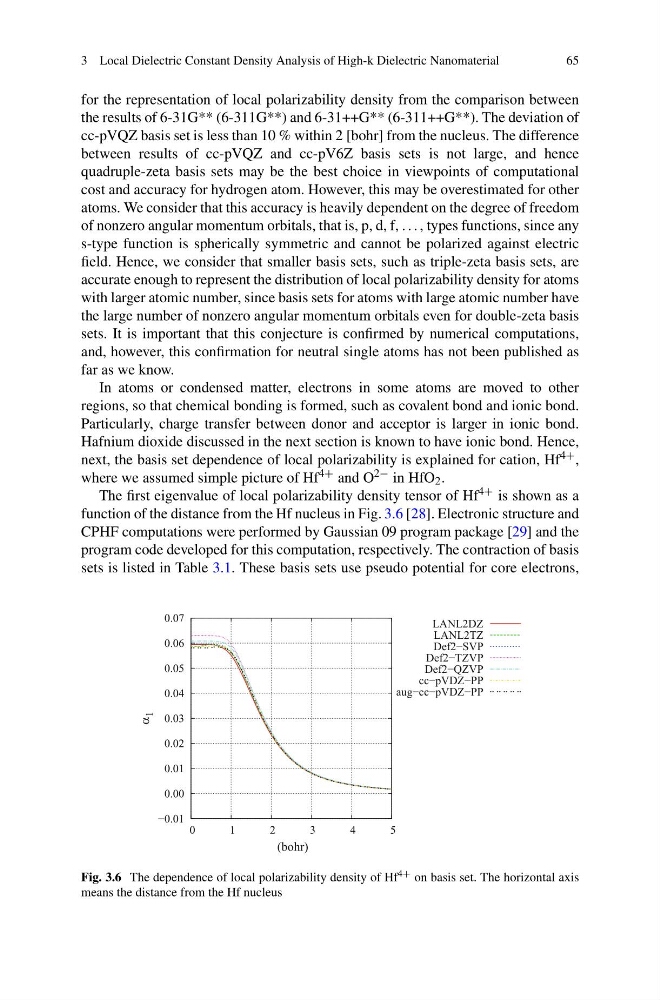
The first eigenvalue of local polarizability density tensor of Hf 4+ is shown as a
function of the distance from the Hf nucleus in Fig. 3.6 [28]. Electronic structure and
CPHF computations were performed by Gaussian 09 program package [29] and the
program code developed for this computation, respectively. The contraction of basis
sets is listed in Table 3.1. These basis sets use pseudo potential for core electrons,
−0.01
0.00
0.01
0.02
0.03
0.04
0.05
0.06
0.07
0
1
2
3
4
5
1
(bohr)
LANL2DZ
LANL2TZ
Def2−SVP
Def2−TZVP
Def2−QZVP
cc−pVDZ−PP
aug−cc−pVDZ−PP
Fig. 3.6 The dependence of local polarizability density of Hf 4+ on basis set. The horizontal axis
means the distance from the Hf nucleus
65
for the representation of local polarizability density from the comparison between
the results of 6-31G** (6-311G**) and 6-31++G** (6-311++G**). The deviation of
cc-pVQZ basis set is less than 10 % within 2 [bohr] from the nucleus. The difference
between results of cc-pVQZ and cc-pV6Z basis sets is not large, and hence
quadruple-zeta basis sets may be the best choice in viewpoints of computational
cost and accuracy for hydrogen atom. However, this may be overestimated for other
atoms. We consider that this accuracy is heavily dependent on the degree of freedom
of nonzero angular momentum orbitals, that is, p, d, f, . . . , types functions, since any
s-type function is spherically symmetric and cannot be polarized against electric
field. Hence, we consider that smaller basis sets, such as triple-zeta basis sets, are
accurate enough to represent the distribution of local polarizability density for atoms
with larger atomic number, since basis sets for atoms with large atomic number have
the large number of nonzero angular momentum orbitals even for double-zeta basis
sets. It is important that this conjecture is confirmed by numerical computations,
and, however, this confirmation for neutral single atoms has not been published as
far as we know.
In atoms or condensed matter, electrons in some atoms are moved to other
regions, so that chemical bonding is formed, such as covalent bond and ionic bond.
Particularly, charge transfer between donor and acceptor is larger in ionic bond.
Hafnium dioxide discussed in the next section is known to have ionic bond. Hence,
next, the basis set dependence of local polarizability is explained for cation, Hf 4+ ,
where we assumed simple picture of Hf 4+ and O 2− in HfO 2 .
The first eigenvalue of local polarizability density tensor of Hf 4+ is shown as a
function of the distance from the Hf nucleus in Fig. 3.6 [28]. Electronic structure and
CPHF computations were performed by Gaussian 09 program package [29] and the
program code developed for this computation, respectively. The contraction of basis
sets is listed in Table 3.1. These basis sets use pseudo potential for core electrons,
−0.01
0.00
0.01
0.02
0.03
0.04
0.05
0.06
0.07
0
1
2
3
4
5
1
(bohr)
LANL2DZ
LANL2TZ
Def2−SVP
Def2−TZVP
Def2−QZVP
cc−pVDZ−PP
aug−cc−pVDZ−PP
Fig. 3.6 The dependence of local polarizability density of Hf 4+ on basis set. The horizontal axis
means the distance from the Hf nucleus