

58
M. Senami and A. Fukushima
ˆ
A A,M (x) =
1
c
A,M
d
3 s
ˆ
j T (u, s)
|r − s|
,
(3.3)
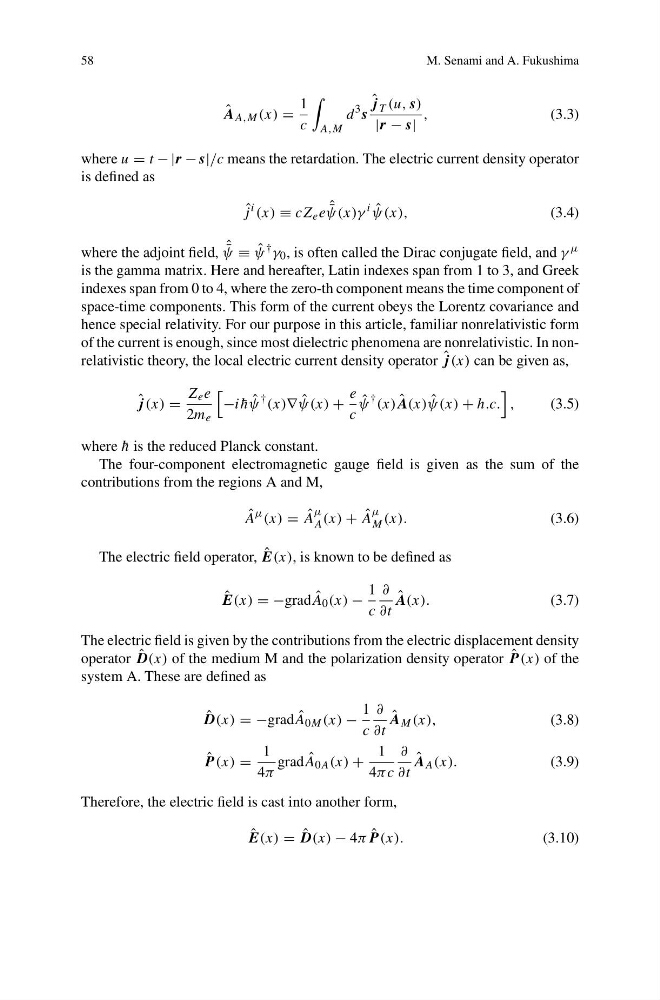
where u = t − |r − s|/c means the retardation. The electric current density operator
is defined as
ˆ
j
i (x) ≡ cZ e e ˆ ¯
ψ(x)γ
i ˆ
ψ(x),
(3.4)
where the adjoint field, ˆ ¯
ψ ≡ ˆ
ψ † γ 0 , is often called the Dirac conjugate field, and γ μ
is the gamma matrix. Here and hereafter, Latin indexes span from 1 to 3, and Greek
indexes span from 0 to 4, where the zero-th component means the time component of
space-time components. This form of the current obeys the Lorentz covariance and
hence special relativity. For our purpose in this article, familiar nonrelativistic form
of the current is enough, since most dielectric phenomena are nonrelativistic. In nonrelativistic theory, the local electric current density operator ˆ
j (x) can be given as,
ˆ
j (x) =
Z e e
2m e
−i ¯
h ˆ
ψ
† (x)∇ ˆ
ψ(x) +
e
c
ˆ
ψ
† (x) ˆ
A(x) ˆ
ψ(x) + h.c.
,
(3.5)
where ¯
h is the reduced Planck constant.
The four-component electromagnetic gauge field is given as the sum of the
contributions from the regions A and M,
ˆ
A
μ (x) = ˆ
A
μ
A (x) + ˆ
A
μ
M (x).
(3.6)
The electric field operator, ˆ
E(x), is known to be defined as
ˆ
E(x) = −grad ˆ
A 0 (x) −
1
c
∂
∂t
ˆ
A(x).
(3.7)
The electric field is given by the contributions from the electric displacement density
operator ˆ
D(x) of the medium M and the polarization density operator ˆ
P (x) of the
system A. These are defined as
ˆ
D(x) = −grad ˆ
A 0M (x) −
1
c
∂
∂t
ˆ
A M (x),
(3.8)
ˆ
P (x) =
1
4π
grad ˆ
A 0A (x) +
1
4πc
∂
∂t
ˆ
A A (x).
(3.9)
Therefore, the electric field is cast into another form,
ˆ
E(x) = ˆ
D(x) − 4π ˆ
P (x).
(3.10)
M. Senami and A. Fukushima
ˆ
A A,M (x) =
1
c
A,M
d
3 s
ˆ
j T (u, s)
|r − s|
,
(3.3)
where u = t − |r − s|/c means the retardation. The electric current density operator
is defined as
ˆ
j
i (x) ≡ cZ e e ˆ ¯
ψ(x)γ
i ˆ
ψ(x),
(3.4)
where the adjoint field, ˆ ¯
ψ ≡ ˆ
ψ † γ 0 , is often called the Dirac conjugate field, and γ μ
is the gamma matrix. Here and hereafter, Latin indexes span from 1 to 3, and Greek
indexes span from 0 to 4, where the zero-th component means the time component of
space-time components. This form of the current obeys the Lorentz covariance and
hence special relativity. For our purpose in this article, familiar nonrelativistic form
of the current is enough, since most dielectric phenomena are nonrelativistic. In nonrelativistic theory, the local electric current density operator ˆ
j (x) can be given as,
ˆ
j (x) =
Z e e
2m e
−i ¯
h ˆ
ψ
† (x)∇ ˆ
ψ(x) +
e
c
ˆ
ψ
† (x) ˆ
A(x) ˆ
ψ(x) + h.c.
,
(3.5)
where ¯
h is the reduced Planck constant.
The four-component electromagnetic gauge field is given as the sum of the
contributions from the regions A and M,
ˆ
A
μ (x) = ˆ
A
μ
A (x) + ˆ
A
μ
M (x).
(3.6)
The electric field operator, ˆ
E(x), is known to be defined as
ˆ
E(x) = −grad ˆ
A 0 (x) −
1
c
∂
∂t
ˆ
A(x).
(3.7)
The electric field is given by the contributions from the electric displacement density
operator ˆ
D(x) of the medium M and the polarization density operator ˆ
P (x) of the
system A. These are defined as
ˆ
D(x) = −grad ˆ
A 0M (x) −
1
c
∂
∂t
ˆ
A M (x),
(3.8)
ˆ
P (x) =
1
4π
grad ˆ
A 0A (x) +
1
4πc
∂
∂t
ˆ
A A (x).
(3.9)
Therefore, the electric field is cast into another form,
ˆ
E(x) = ˆ
D(x) − 4π ˆ
P (x).
(3.10)