

3 Local Dielectric Constant Density Analysis of High-k Dielectric Nanomaterial
59
The electric displacement ˆ
D(x) is considered to be external electric field for the
system A. In the original definition [15], ˆ
A
μ
radiation is separately defined in Eq. (3.6),
and hence ˆ
A
μ
radiation is explicitly added in this expression (3.10).
In this relation, the polarization of the system A is considered to be linear
response to ˆ
D(x),
ˆ
P
i (x) = ˆ
α
ij (x) ˆ
D
j (x),
(3.11)
where ˆ
α ij (x) is the polarizability density tensor operator, which is 3 × 3 matrix. In
this expression, ˆ
α ij is allowed to have time dependence, since ˆ
α ij is known to have
dependence of frequency of electric field as well as dielectric constant.
The dielectric constant density tensor operator ˆ
ij (x) is the relation between
ˆ
D(x) and ˆ
E(x), and the definition is given as
ˆ
D
i (x) = ˆ
ij (x) ˆ
E
j (x).
(3.12)
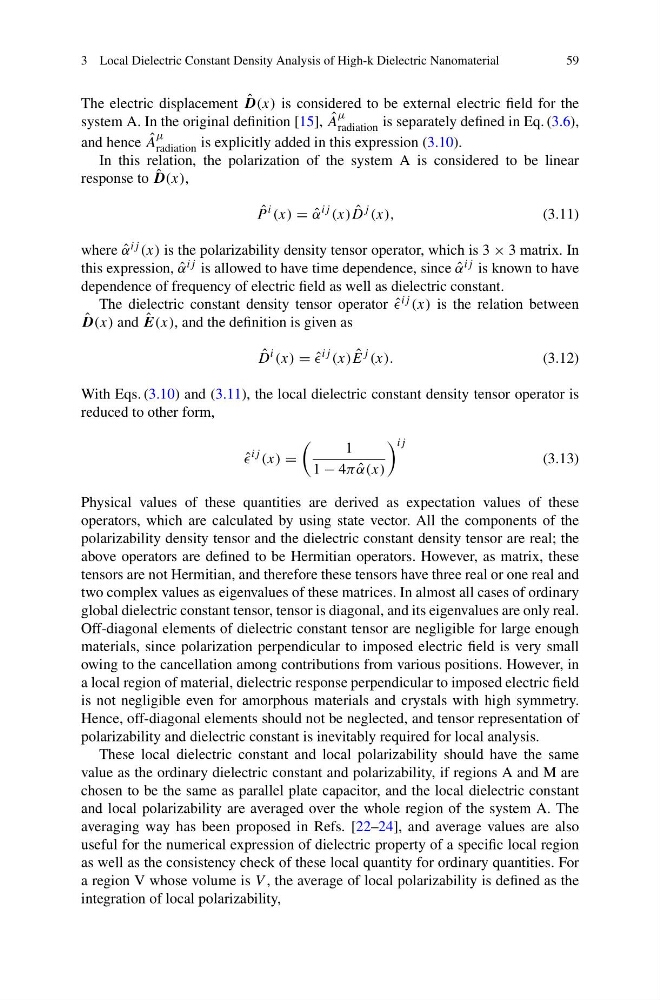
With Eqs. (3.10) and (3.11), the local dielectric constant density tensor operator is
reduced to other form,
ˆ
ij (x) =
1
1 − 4π ˆ
α(x)
ij
(3.13)
Physical values of these quantities are derived as expectation values of these
operators, which are calculated by using state vector. All the components of the
polarizability density tensor and the dielectric constant density tensor are real; the
above operators are defined to be Hermitian operators. However, as matrix, these
tensors are not Hermitian, and therefore these tensors have three real or one real and
two complex values as eigenvalues of these matrices. In almost all cases of ordinary
global dielectric constant tensor, tensor is diagonal, and its eigenvalues are only real.
Off-diagonal elements of dielectric constant tensor are negligible for large enough
materials, since polarization perpendicular to imposed electric field is very small
owing to the cancellation among contributions from various positions. However, in
a local region of material, dielectric response perpendicular to imposed electric field
is not negligible even for amorphous materials and crystals with high symmetry.
Hence, off-diagonal elements should not be neglected, and tensor representation of
polarizability and dielectric constant is inevitably required for local analysis.
These local dielectric constant and local polarizability should have the same
value as the ordinary dielectric constant and polarizability, if regions A and M are
chosen to be the same as parallel plate capacitor, and the local dielectric constant
and local polarizability are averaged over the whole region of the system A. The
averaging way has been proposed in Refs. [22–24], and average values are also
useful for the numerical expression of dielectric property of a specific local region
as well as the consistency check of these local quantity for ordinary quantities. For
a region V whose volume is V , the average of local polarizability is defined as the
integration of local polarizability,
59
The electric displacement ˆ
D(x) is considered to be external electric field for the
system A. In the original definition [15], ˆ
A
μ
radiation is separately defined in Eq. (3.6),
and hence ˆ
A
μ
radiation is explicitly added in this expression (3.10).
In this relation, the polarization of the system A is considered to be linear
response to ˆ
D(x),
ˆ
P
i (x) = ˆ
α
ij (x) ˆ
D
j (x),
(3.11)
where ˆ
α ij (x) is the polarizability density tensor operator, which is 3 × 3 matrix. In
this expression, ˆ
α ij is allowed to have time dependence, since ˆ
α ij is known to have
dependence of frequency of electric field as well as dielectric constant.
The dielectric constant density tensor operator ˆ
ij (x) is the relation between
ˆ
D(x) and ˆ
E(x), and the definition is given as
ˆ
D
i (x) = ˆ
ij (x) ˆ
E
j (x).
(3.12)
With Eqs. (3.10) and (3.11), the local dielectric constant density tensor operator is
reduced to other form,
ˆ
ij (x) =
1
1 − 4π ˆ
α(x)
ij
(3.13)
Physical values of these quantities are derived as expectation values of these
operators, which are calculated by using state vector. All the components of the
polarizability density tensor and the dielectric constant density tensor are real; the
above operators are defined to be Hermitian operators. However, as matrix, these
tensors are not Hermitian, and therefore these tensors have three real or one real and
two complex values as eigenvalues of these matrices. In almost all cases of ordinary
global dielectric constant tensor, tensor is diagonal, and its eigenvalues are only real.
Off-diagonal elements of dielectric constant tensor are negligible for large enough
materials, since polarization perpendicular to imposed electric field is very small
owing to the cancellation among contributions from various positions. However, in
a local region of material, dielectric response perpendicular to imposed electric field
is not negligible even for amorphous materials and crystals with high symmetry.
Hence, off-diagonal elements should not be neglected, and tensor representation of
polarizability and dielectric constant is inevitably required for local analysis.
These local dielectric constant and local polarizability should have the same
value as the ordinary dielectric constant and polarizability, if regions A and M are
chosen to be the same as parallel plate capacitor, and the local dielectric constant
and local polarizability are averaged over the whole region of the system A. The
averaging way has been proposed in Refs. [22–24], and average values are also
useful for the numerical expression of dielectric property of a specific local region
as well as the consistency check of these local quantity for ordinary quantities. For
a region V whose volume is V , the average of local polarizability is defined as the
integration of local polarizability,