

3 Local Dielectric Constant Density Analysis of High-k Dielectric Nanomaterial
57
incorporation of La atoms to HfO 2 on the dielectric properties. The last two sections
are devoted to the summary of this article and perspective of local dielectric constant
and polarizability.
3.2 Theory
In this section, the formalism of dielectric constant density operator is reviewed
[14–16]. This operator can parametrize local dielectric constant, which is given as
the expectation value of this operator. The ordinary notion of the dielectric constant
is based on a concept of a capacitor sandwiched between parallel plates. For a local
region in nanosize condensed matter, parallel plates could not be inserted in matter.
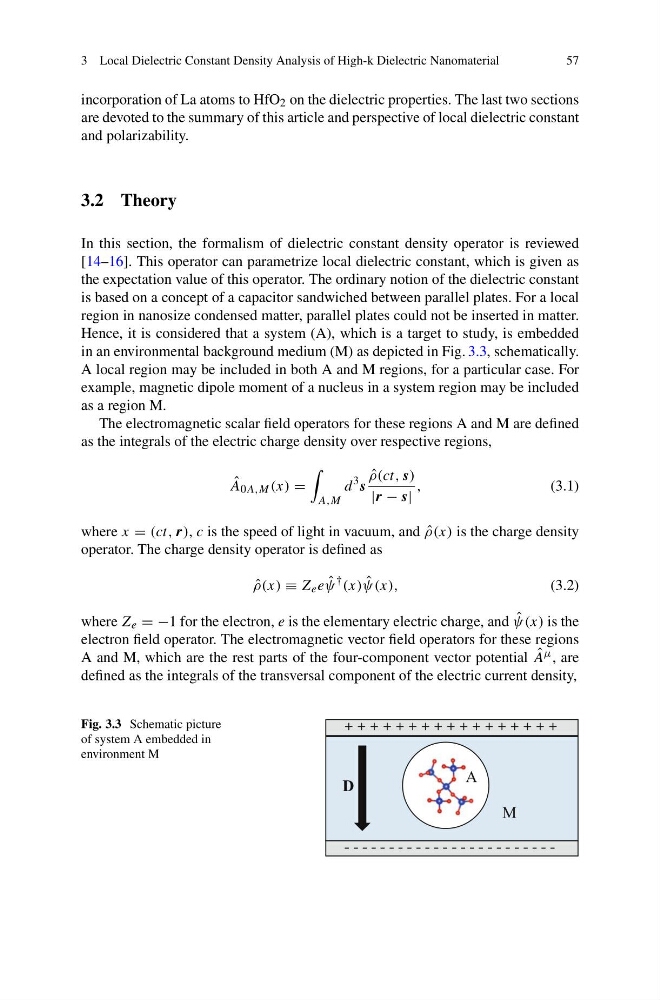
Hence, it is considered that a system (A), which is a target to study, is embedded
in an environmental background medium (M) as depicted in Fig. 3.3, schematically.
A local region may be included in both A and M regions, for a particular case. For
example, magnetic dipole moment of a nucleus in a system region may be included
as a region M.
The electromagnetic scalar field operators for these regions A and M are defined
as the integrals of the electric charge density over respective regions,
ˆ
A 0A,M (x) =
A,M
d
3 s
ˆ
ρ(ct, s)
|r − s|
,
(3.1)
where x = (ct, r), c is the speed of light in vacuum, and ˆ
ρ(x) is the charge density
operator. The charge density operator is defined as
ˆ
ρ(x) ≡ Z e e ˆ
ψ
† (x) ˆ
ψ(x),
(3.2)
where Z e = −1 for the electron, e is the elementary electric charge, and ˆ
ψ(x) is the
electron field operator. The electromagnetic vector field operators for these regions
A and M, which are the rest parts of the four-component vector potential ˆ
A μ , are
defined as the integrals of the transversal component of the electric current density,
Fig. 3.3 Schematic picture
of system A embedded in
environment M
57
incorporation of La atoms to HfO 2 on the dielectric properties. The last two sections
are devoted to the summary of this article and perspective of local dielectric constant
and polarizability.
3.2 Theory
In this section, the formalism of dielectric constant density operator is reviewed
[14–16]. This operator can parametrize local dielectric constant, which is given as
the expectation value of this operator. The ordinary notion of the dielectric constant
is based on a concept of a capacitor sandwiched between parallel plates. For a local
region in nanosize condensed matter, parallel plates could not be inserted in matter.
Hence, it is considered that a system (A), which is a target to study, is embedded
in an environmental background medium (M) as depicted in Fig. 3.3, schematically.
A local region may be included in both A and M regions, for a particular case. For
example, magnetic dipole moment of a nucleus in a system region may be included
as a region M.
The electromagnetic scalar field operators for these regions A and M are defined
as the integrals of the electric charge density over respective regions,
ˆ
A 0A,M (x) =
A,M
d
3 s
ˆ
ρ(ct, s)
|r − s|
,
(3.1)
where x = (ct, r), c is the speed of light in vacuum, and ˆ
ρ(x) is the charge density
operator. The charge density operator is defined as
ˆ
ρ(x) ≡ Z e e ˆ
ψ
† (x) ˆ
ψ(x),
(3.2)
where Z e = −1 for the electron, e is the elementary electric charge, and ˆ
ψ(x) is the
electron field operator. The electromagnetic vector field operators for these regions
A and M, which are the rest parts of the four-component vector potential ˆ
A μ , are
defined as the integrals of the transversal component of the electric current density,
Fig. 3.3 Schematic picture
of system A embedded in
environment M