

2 Quantum Chemistry in Perovskite Fluoride and Hydride: Nanoscale. . .
41
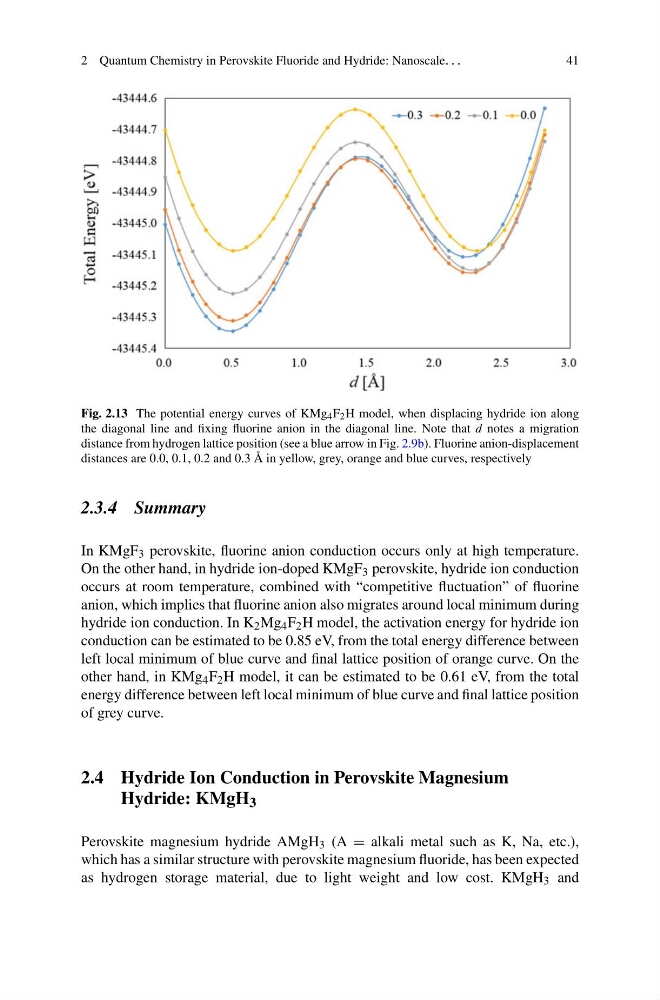
Fig. 2.13 The potential energy curves of KMg 4 F 2 H model, when displacing hydride ion along
the diagonal line and fixing fluorine anion in the diagonal line. Note that d notes a migration
distance from hydrogen lattice position (see a blue arrow in Fig. 2.9b). Fluorine anion-displacement
distances are 0.0, 0.1, 0.2 and 0.3 Å in yellow, grey, orange and blue curves, respectively
2.3.4 Summary
In KMgF 3 perovskite, fluorine anion conduction occurs only at high temperature.
On the other hand, in hydride ion-doped KMgF 3 perovskite, hydride ion conduction
occurs at room temperature, combined with “competitive fluctuation” of fluorine
anion, which implies that fluorine anion also migrates around local minimum during
hydride ion conduction. In K 2 Mg 4 F 2 H model, the activation energy for hydride ion
conduction can be estimated to be 0.85 eV, from the total energy difference between
left local minimum of blue curve and final lattice position of orange curve. On the
other hand, in KMg 4 F 2 H model, it can be estimated to be 0.61 eV, from the total
energy difference between left local minimum of blue curve and final lattice position
of grey curve.
2.4 Hydride Ion Conduction in Perovskite Magnesium
Hydride: KMgH 3
Perovskite magnesium hydride AMgH 3 (A = alkali metal such as K, Na, etc.),
which has a similar structure with perovskite magnesium fluoride, has been expected
as hydrogen storage material, due to light weight and low cost. KMgH 3 and
41
Fig. 2.13 The potential energy curves of KMg 4 F 2 H model, when displacing hydride ion along
the diagonal line and fixing fluorine anion in the diagonal line. Note that d notes a migration
distance from hydrogen lattice position (see a blue arrow in Fig. 2.9b). Fluorine anion-displacement
distances are 0.0, 0.1, 0.2 and 0.3 Å in yellow, grey, orange and blue curves, respectively
2.3.4 Summary
In KMgF 3 perovskite, fluorine anion conduction occurs only at high temperature.
On the other hand, in hydride ion-doped KMgF 3 perovskite, hydride ion conduction
occurs at room temperature, combined with “competitive fluctuation” of fluorine
anion, which implies that fluorine anion also migrates around local minimum during
hydride ion conduction. In K 2 Mg 4 F 2 H model, the activation energy for hydride ion
conduction can be estimated to be 0.85 eV, from the total energy difference between
left local minimum of blue curve and final lattice position of orange curve. On the
other hand, in KMg 4 F 2 H model, it can be estimated to be 0.61 eV, from the total
energy difference between left local minimum of blue curve and final lattice position
of grey curve.
2.4 Hydride Ion Conduction in Perovskite Magnesium
Hydride: KMgH 3
Perovskite magnesium hydride AMgH 3 (A = alkali metal such as K, Na, etc.),
which has a similar structure with perovskite magnesium fluoride, has been expected
as hydrogen storage material, due to light weight and low cost. KMgH 3 and