

42
T. Onishi
NaMgH 3 perovskites have cubic and GdFeO 3 -type structures, respectively [15, 16].
The experimental lattice parameter of KMgH 3 perovskite is 4.023 Å [16]. Though
perovskite hydrides are synthesized over 500 K [35], hydrogen molecule is released
over 673 K [35–37]. Perovskite hydride cannot be hence utilized for alternative
electrolyte of present SOFC. In previous DFT calculations for perovskite hydrides,
structural stability, formation enthalpy and luminescence were discussed [16, 38–
42]. Here we explore a possibility of hydride ion conduction in KMgH 3 perovskite
at low temperature, from the viewpoints of energetics and bonding.
2.4.1 Calculation Models
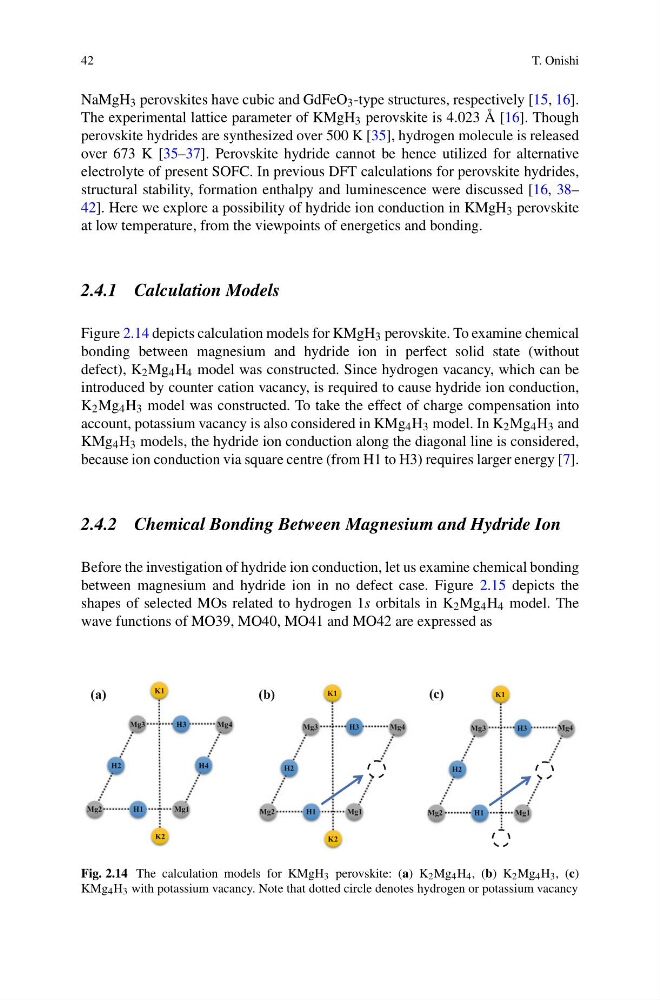
Figure 2.14 depicts calculation models for KMgH 3 perovskite. To examine chemical
bonding between magnesium and hydride ion in perfect solid state (without
defect), K 2 Mg 4 H 4 model was constructed. Since hydrogen vacancy, which can be
introduced by counter cation vacancy, is required to cause hydride ion conduction,
K 2 Mg 4 H 3 model was constructed. To take the effect of charge compensation into
account, potassium vacancy is also considered in KMg 4 H 3 model. In K 2 Mg 4 H 3 and
KMg 4 H 3 models, the hydride ion conduction along the diagonal line is considered,
because ion conduction via square centre (from H1 to H3) requires larger energy [7].
2.4.2 Chemical Bonding Between Magnesium and Hydride Ion
Before the investigation of hydride ion conduction, let us examine chemical bonding
between magnesium and hydride ion in no defect case. Figure 2.15 depicts the
shapes of selected MOs related to hydrogen 1s orbitals in K 2 Mg 4 H 4 model. The
wave functions of MO39, MO40, MO41 and MO42 are expressed as
(a)
(b)
K1
K2
H1
Mg1
Mg2
Mg4
Mg3
H2
H3
H4
K1
K2
H1
Mg1
Mg2
Mg4
Mg3
H2
H3
(c)
K1
H1
Mg1
Mg2
Mg3
H2
H3
Mg4
Fig. 2.14 The calculation models for KMgH 3 perovskite: (a) K 2 Mg 4 H 4 , (b) K 2 Mg 4 H 3 , (c)
KMg 4 H 3 with potassium vacancy. Note that dotted circle denotes hydrogen or potassium vacancy
T. Onishi
NaMgH 3 perovskites have cubic and GdFeO 3 -type structures, respectively [15, 16].
The experimental lattice parameter of KMgH 3 perovskite is 4.023 Å [16]. Though
perovskite hydrides are synthesized over 500 K [35], hydrogen molecule is released
over 673 K [35–37]. Perovskite hydride cannot be hence utilized for alternative
electrolyte of present SOFC. In previous DFT calculations for perovskite hydrides,
structural stability, formation enthalpy and luminescence were discussed [16, 38–
42]. Here we explore a possibility of hydride ion conduction in KMgH 3 perovskite
at low temperature, from the viewpoints of energetics and bonding.
2.4.1 Calculation Models
Figure 2.14 depicts calculation models for KMgH 3 perovskite. To examine chemical
bonding between magnesium and hydride ion in perfect solid state (without
defect), K 2 Mg 4 H 4 model was constructed. Since hydrogen vacancy, which can be
introduced by counter cation vacancy, is required to cause hydride ion conduction,
K 2 Mg 4 H 3 model was constructed. To take the effect of charge compensation into
account, potassium vacancy is also considered in KMg 4 H 3 model. In K 2 Mg 4 H 3 and
KMg 4 H 3 models, the hydride ion conduction along the diagonal line is considered,
because ion conduction via square centre (from H1 to H3) requires larger energy [7].
2.4.2 Chemical Bonding Between Magnesium and Hydride Ion
Before the investigation of hydride ion conduction, let us examine chemical bonding
between magnesium and hydride ion in no defect case. Figure 2.15 depicts the
shapes of selected MOs related to hydrogen 1s orbitals in K 2 Mg 4 H 4 model. The
wave functions of MO39, MO40, MO41 and MO42 are expressed as
(a)
(b)
K1
K2
H1
Mg1
Mg2
Mg4
Mg3
H2
H3
H4
K1
K2
H1
Mg1
Mg2
Mg4
Mg3
H2
H3
(c)
K1
H1
Mg1
Mg2
Mg3
H2
H3
Mg4
Fig. 2.14 The calculation models for KMgH 3 perovskite: (a) K 2 Mg 4 H 4 , (b) K 2 Mg 4 H 3 , (c)
KMg 4 H 3 with potassium vacancy. Note that dotted circle denotes hydrogen or potassium vacancy