

534
G. Hanna and A. Sergi
Table 14.1 The values of the
transition filtering parameters
used in the simulations. All
values are in units of 10 −22 J
α ↔ β E min
αβ
E αβ κ αβ
1↔2
0.00182
9.3
–
1↔3
0.255
15.53 8
1↔4
3.117
20.57 12
1↔5
5.103
26.55 20
1↔6
6.327
35.72 23
2↔3
0.00035
6.19 –
2↔4
0.229
11.27 8
2↔5
3.117
17.27 12
2↔6
4.826
26.42 20
3↔4
0.0004
5.02 –
3↔5
0.181
11.01 8
3↔6
3.119
20.19 12
4↔5
0.000577
5.76 –
4↔6
0.234
15.15 8
5↔6
0.00119
8.98 –
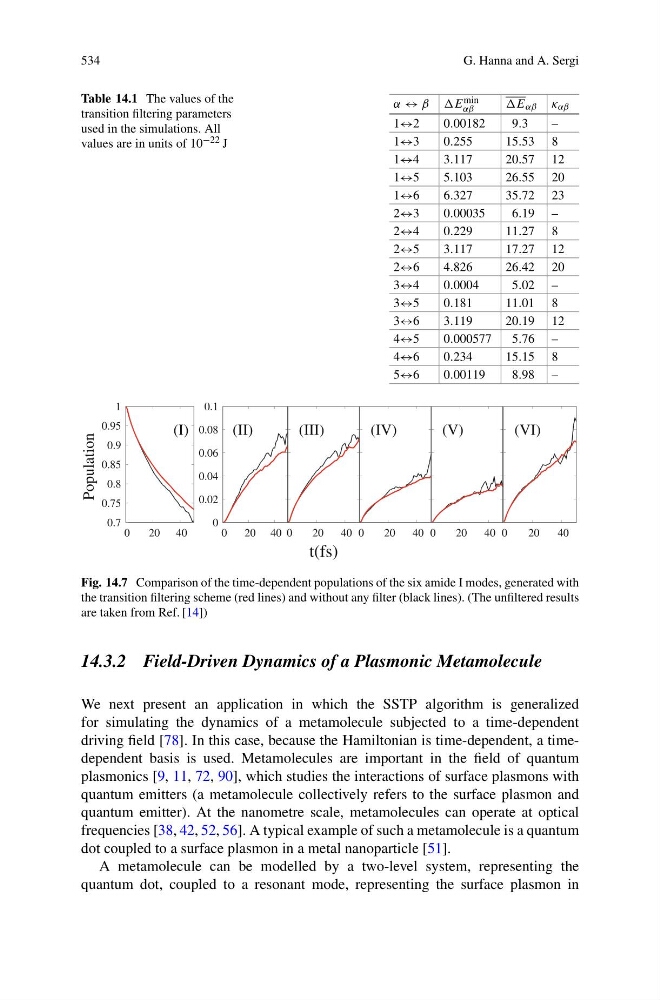
Fig. 14.7 Comparison of the time-dependent populations of the six amide I modes, generated with
the transition filtering scheme (red lines) and without any filter (black lines). (The unfiltered results
are taken from Ref. [14])
14.3.2 Field-Driven Dynamics of a Plasmonic Metamolecule
We next present an application in which the SSTP algorithm is generalized
for simulating the dynamics of a metamolecule subjected to a time-dependent
driving field [78]. In this case, because the Hamiltonian is time-dependent, a timedependent basis is used. Metamolecules are important in the field of quantum
plasmonics [9, 11, 72, 90], which studies the interactions of surface plasmons with
quantum emitters (a metamolecule collectively refers to the surface plasmon and
quantum emitter). At the nanometre scale, metamolecules can operate at optical
frequencies [38, 42, 52, 56]. A typical example of such a metamolecule is a quantum
dot coupled to a surface plasmon in a metal nanoparticle [51].
A metamolecule can be modelled by a two-level system, representing the
quantum dot, coupled to a resonant mode, representing the surface plasmon in
G. Hanna and A. Sergi
Table 14.1 The values of the
transition filtering parameters
used in the simulations. All
values are in units of 10 −22 J
α ↔ β E min
αβ
E αβ κ αβ
1↔2
0.00182
9.3
–
1↔3
0.255
15.53 8
1↔4
3.117
20.57 12
1↔5
5.103
26.55 20
1↔6
6.327
35.72 23
2↔3
0.00035
6.19 –
2↔4
0.229
11.27 8
2↔5
3.117
17.27 12
2↔6
4.826
26.42 20
3↔4
0.0004
5.02 –
3↔5
0.181
11.01 8
3↔6
3.119
20.19 12
4↔5
0.000577
5.76 –
4↔6
0.234
15.15 8
5↔6
0.00119
8.98 –
Fig. 14.7 Comparison of the time-dependent populations of the six amide I modes, generated with
the transition filtering scheme (red lines) and without any filter (black lines). (The unfiltered results
are taken from Ref. [14])
14.3.2 Field-Driven Dynamics of a Plasmonic Metamolecule
We next present an application in which the SSTP algorithm is generalized
for simulating the dynamics of a metamolecule subjected to a time-dependent
driving field [78]. In this case, because the Hamiltonian is time-dependent, a timedependent basis is used. Metamolecules are important in the field of quantum
plasmonics [9, 11, 72, 90], which studies the interactions of surface plasmons with
quantum emitters (a metamolecule collectively refers to the surface plasmon and
quantum emitter). At the nanometre scale, metamolecules can operate at optical
frequencies [38, 42, 52, 56]. A typical example of such a metamolecule is a quantum
dot coupled to a surface plasmon in a metal nanoparticle [51].
A metamolecule can be modelled by a two-level system, representing the
quantum dot, coupled to a resonant mode, representing the surface plasmon in