

14 Simulating Quantum Dynamics in Classical Nanoscale Environments
535
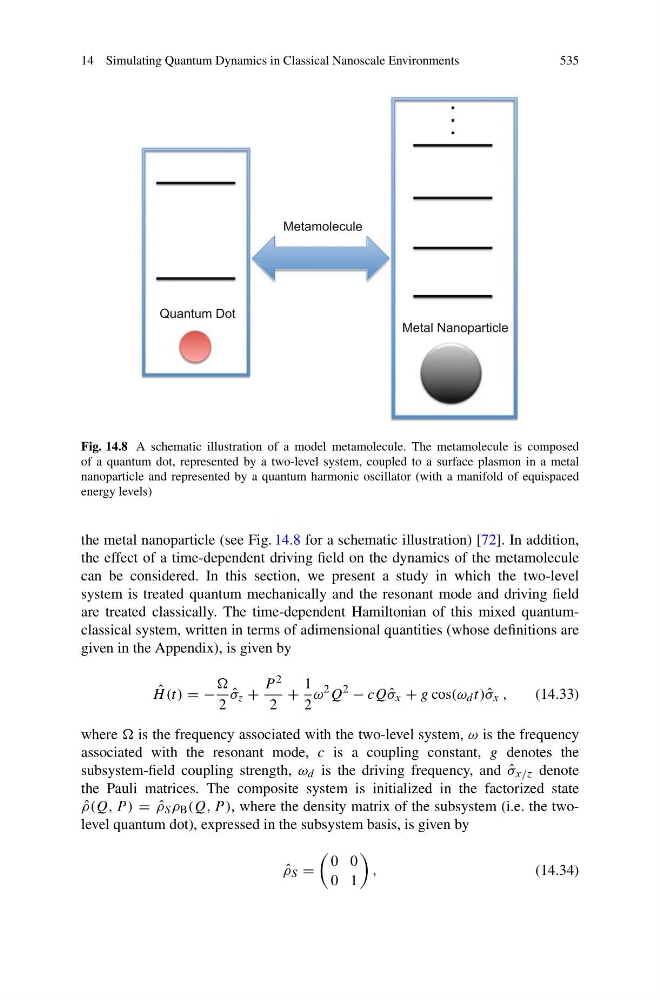
Fig. 14.8 A schematic illustration of a model metamolecule. The metamolecule is composed
of a quantum dot, represented by a two-level system, coupled to a surface plasmon in a metal
nanoparticle and represented by a quantum harmonic oscillator (with a manifold of equispaced
energy levels)
the metal nanoparticle (see Fig. 14.8 for a schematic illustration) [72]. In addition,
the effect of a time-dependent driving field on the dynamics of the metamolecule
can be considered. In this section, we present a study in which the two-level
system is treated quantum mechanically and the resonant mode and driving field
are treated classically. The time-dependent Hamiltonian of this mixed quantumclassical system, written in terms of adimensional quantities (whose definitions are
given in the Appendix), is given by
ˆ
H (t) = −
2
ˆ
σ z +
P 2
2
+
1
2
ω
2 Q
2
− cQ ˆ
σ x + g cos(ω d t) ˆ
σ x ,
(14.33)
where is the frequency associated with the two-level system, ω is the frequency
associated with the resonant mode, c is a coupling constant, g denotes the
subsystem-field coupling strength, ω d is the driving frequency, and ˆ
σ x/z denote
the Pauli matrices. The composite system is initialized in the factorized state
ˆ
ρ(Q, P ) = ˆ
ρ S ρ B (Q, P ), where the density matrix of the subsystem (i.e. the twolevel quantum dot), expressed in the subsystem basis, is given by
ˆ
ρ S =
0 0
0 1
,
(14.34)
535
Fig. 14.8 A schematic illustration of a model metamolecule. The metamolecule is composed
of a quantum dot, represented by a two-level system, coupled to a surface plasmon in a metal
nanoparticle and represented by a quantum harmonic oscillator (with a manifold of equispaced
energy levels)
the metal nanoparticle (see Fig. 14.8 for a schematic illustration) [72]. In addition,
the effect of a time-dependent driving field on the dynamics of the metamolecule
can be considered. In this section, we present a study in which the two-level
system is treated quantum mechanically and the resonant mode and driving field
are treated classically. The time-dependent Hamiltonian of this mixed quantumclassical system, written in terms of adimensional quantities (whose definitions are
given in the Appendix), is given by
ˆ
H (t) = −
2
ˆ
σ z +
P 2
2
+
1
2
ω
2 Q
2
− cQ ˆ
σ x + g cos(ω d t) ˆ
σ x ,
(14.33)
where is the frequency associated with the two-level system, ω is the frequency
associated with the resonant mode, c is a coupling constant, g denotes the
subsystem-field coupling strength, ω d is the driving frequency, and ˆ
σ x/z denote
the Pauli matrices. The composite system is initialized in the factorized state
ˆ
ρ(Q, P ) = ˆ
ρ S ρ B (Q, P ), where the density matrix of the subsystem (i.e. the twolevel quantum dot), expressed in the subsystem basis, is given by
ˆ
ρ S =
0 0
0 1
,
(14.34)