

2 Quantum Chemistry in Perovskite Fluoride and Hydride: Nanoscale. . .
37
formation. In MO48 at local minimum and MO45 at local maximum, hydrogen 1s
orbital overlaps with fluorine 2p orbitals. From chemical bonding rule, it is found
that covalent bonding related to hydride ion is also formed.
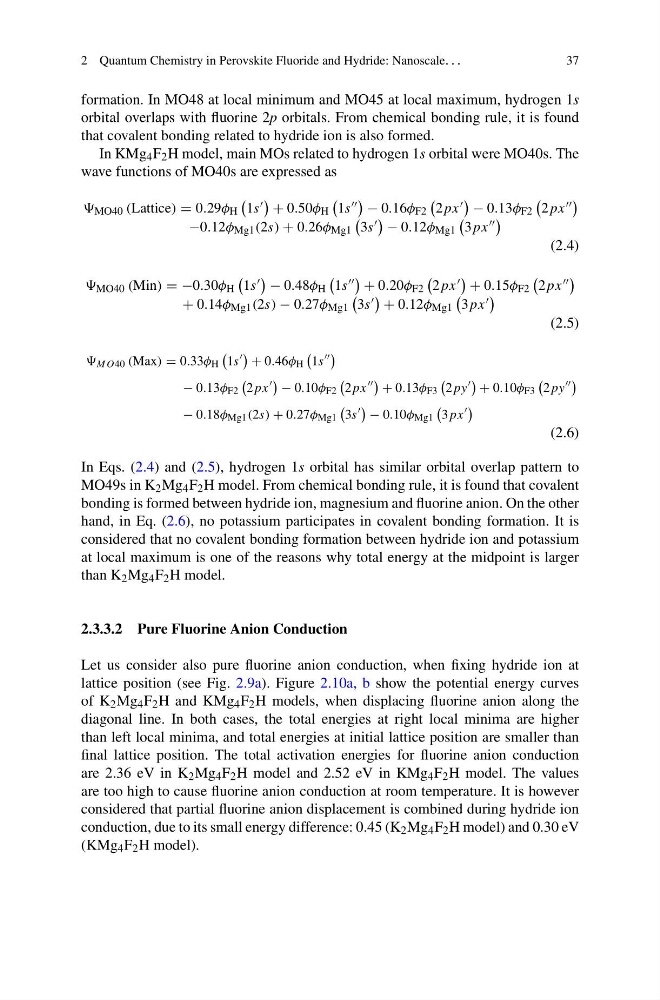
In KMg 4 F 2 H model, main MOs related to hydrogen 1s orbital were MO40s. The
wave functions of MO40s are expressed as
MO40 (Lattice) = 0.29φ H
1s + 0.50φ H
1s − 0.16φ F2
2px − 0.13φ F2
2px
−0.12φ Mg1 (2s) + 0.26φ Mg1
3s − 0.12φ Mg1
3px
(2.4)
MO40 (Min) = −0.30φ H
1s − 0.48φ H
1s + 0.20φ F2
2px + 0.15φ F2
2px
+ 0.14φ Mg1 (2s) − 0.27φ Mg1
3s + 0.12φ Mg1
3px
(2.5)
MO40 (Max) = 0.33φ H
1s
+ 0.46φ H
1s
− 0.13φ F2
2px
− 0.10φ F2
2px
+ 0.13φ F3
2py
+ 0.10φ F3
2py
− 0.18φ Mg1 (2s) + 0.27φ Mg1
3s
− 0.10φ Mg1
3px
(2.6)
In Eqs. (2.4) and (2.5), hydrogen 1s orbital has similar orbital overlap pattern to
MO49s in K 2 Mg 4 F 2 H model. From chemical bonding rule, it is found that covalent
bonding is formed between hydride ion, magnesium and fluorine anion. On the other
hand, in Eq. (2.6), no potassium participates in covalent bonding formation. It is
considered that no covalent bonding formation between hydride ion and potassium
at local maximum is one of the reasons why total energy at the midpoint is larger
than K 2 Mg 4 F 2 H model.
2.3.3.2 Pure Fluorine Anion Conduction
Let us consider also pure fluorine anion conduction, when fixing hydride ion at
lattice position (see Fig. 2.9a). Figure 2.10a, b show the potential energy curves
of K 2 Mg 4 F 2 H and KMg 4 F 2 H models, when displacing fluorine anion along the
diagonal line. In both cases, the total energies at right local minima are higher
than left local minima, and total energies at initial lattice position are smaller than
final lattice position. The total activation energies for fluorine anion conduction
are 2.36 eV in K 2 Mg 4 F 2 H model and 2.52 eV in KMg 4 F 2 H model. The values
are too high to cause fluorine anion conduction at room temperature. It is however
considered that partial fluorine anion displacement is combined during hydride ion
conduction, due to its small energy difference: 0.45 (K 2 Mg 4 F 2 H model) and 0.30 eV
(KMg 4 F 2 H model).
37
formation. In MO48 at local minimum and MO45 at local maximum, hydrogen 1s
orbital overlaps with fluorine 2p orbitals. From chemical bonding rule, it is found
that covalent bonding related to hydride ion is also formed.
In KMg 4 F 2 H model, main MOs related to hydrogen 1s orbital were MO40s. The
wave functions of MO40s are expressed as
MO40 (Lattice) = 0.29φ H
1s + 0.50φ H
1s − 0.16φ F2
2px − 0.13φ F2
2px
−0.12φ Mg1 (2s) + 0.26φ Mg1
3s − 0.12φ Mg1
3px
(2.4)
MO40 (Min) = −0.30φ H
1s − 0.48φ H
1s + 0.20φ F2
2px + 0.15φ F2
2px
+ 0.14φ Mg1 (2s) − 0.27φ Mg1
3s + 0.12φ Mg1
3px
(2.5)
MO40 (Max) = 0.33φ H
1s
+ 0.46φ H
1s
− 0.13φ F2
2px
− 0.10φ F2
2px
+ 0.13φ F3
2py
+ 0.10φ F3
2py
− 0.18φ Mg1 (2s) + 0.27φ Mg1
3s
− 0.10φ Mg1
3px
(2.6)
In Eqs. (2.4) and (2.5), hydrogen 1s orbital has similar orbital overlap pattern to
MO49s in K 2 Mg 4 F 2 H model. From chemical bonding rule, it is found that covalent
bonding is formed between hydride ion, magnesium and fluorine anion. On the other
hand, in Eq. (2.6), no potassium participates in covalent bonding formation. It is
considered that no covalent bonding formation between hydride ion and potassium
at local maximum is one of the reasons why total energy at the midpoint is larger
than K 2 Mg 4 F 2 H model.
2.3.3.2 Pure Fluorine Anion Conduction
Let us consider also pure fluorine anion conduction, when fixing hydride ion at
lattice position (see Fig. 2.9a). Figure 2.10a, b show the potential energy curves
of K 2 Mg 4 F 2 H and KMg 4 F 2 H models, when displacing fluorine anion along the
diagonal line. In both cases, the total energies at right local minima are higher
than left local minima, and total energies at initial lattice position are smaller than
final lattice position. The total activation energies for fluorine anion conduction
are 2.36 eV in K 2 Mg 4 F 2 H model and 2.52 eV in KMg 4 F 2 H model. The values
are too high to cause fluorine anion conduction at room temperature. It is however
considered that partial fluorine anion displacement is combined during hydride ion
conduction, due to its small energy difference: 0.45 (K 2 Mg 4 F 2 H model) and 0.30 eV
(KMg 4 F 2 H model).