

36
T. Onishi
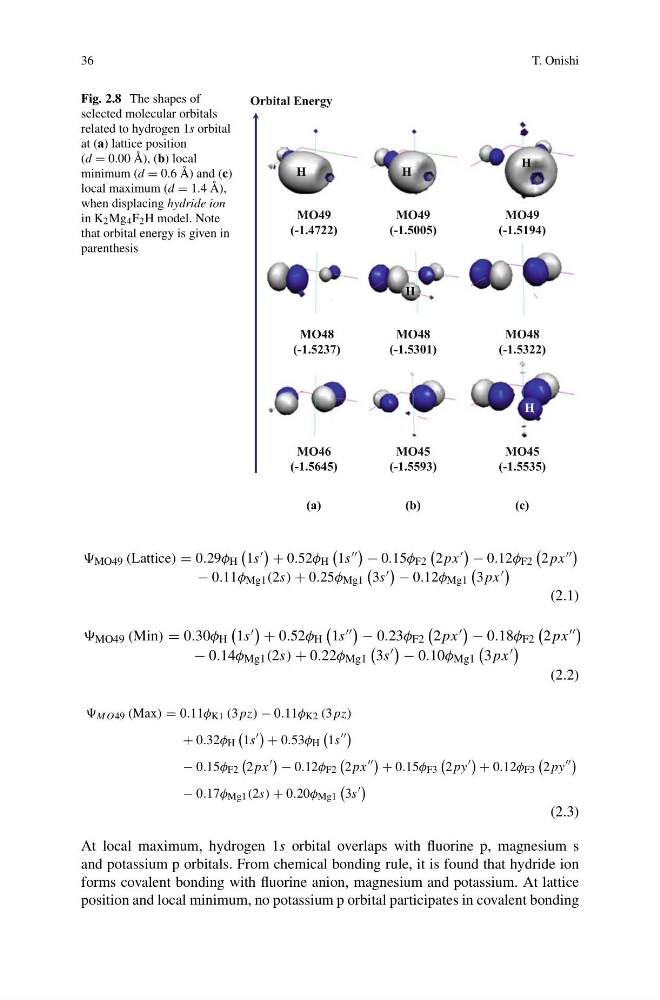
Fig. 2.8 The shapes of
selected molecular orbitals
related to hydrogen 1s orbital
at (a) lattice position
(d = 0.00 Å), (b) local
minimum (d = 0.6 Å) and (c)
local maximum (d = 1.4 Å),
when displacing hydride ion
in K 2 Mg 4 F 2 H model. Note
that orbital energy is given in
parenthesis
Orbital Energy
(a)
MO46
(-1.5645)
MO48
(-1.5237)
MO49
(-1.4722)
H
(b)
MO45
(-1.5593)
MO48
(-1.5301)
MO49
(-1.5005)
H
H
(c)
MO48
(-1.5322)
MO49
(-1.5194)
MO45
(-1.5535)
H
H
MO49 (Lattice) = 0.29φ H
1s + 0.52φ H
1s − 0.15φ F2
2px − 0.12φ F2
2px
− 0.11φ Mg1 (2s) + 0.25φ Mg1
3s − 0.12φ Mg1
3px
(2.1)
MO49 (Min) = 0.30φ H
1s + 0.52φ H
1s − 0.23φ F2
2px − 0.18φ F2
2px
− 0.14φ Mg1 (2s) + 0.22φ Mg1
3s − 0.10φ Mg1
3px
(2.2)
MO49 (Max) = 0.11φ K1 (3pz) − 0.11φ K2 (3pz)
+ 0.32φ H
1s
+ 0.53φ H
1s
− 0.15φ F2
2px
− 0.12φ F2
2px
+ 0.15φ F3
2py
+ 0.12φ F3
2py
− 0.17φ Mg1 (2s) + 0.20φ Mg1
3s
(2.3)
At local maximum, hydrogen 1s orbital overlaps with fluorine p, magnesium s
and potassium p orbitals. From chemical bonding rule, it is found that hydride ion
forms covalent bonding with fluorine anion, magnesium and potassium. At lattice
position and local minimum, no potassium p orbital participates in covalent bonding
T. Onishi
Fig. 2.8 The shapes of
selected molecular orbitals
related to hydrogen 1s orbital
at (a) lattice position
(d = 0.00 Å), (b) local
minimum (d = 0.6 Å) and (c)
local maximum (d = 1.4 Å),
when displacing hydride ion
in K 2 Mg 4 F 2 H model. Note
that orbital energy is given in
parenthesis
Orbital Energy
(a)
MO46
(-1.5645)
MO48
(-1.5237)
MO49
(-1.4722)
H
(b)
MO45
(-1.5593)
MO48
(-1.5301)
MO49
(-1.5005)
H
H
(c)
MO48
(-1.5322)
MO49
(-1.5194)
MO45
(-1.5535)
H
H
MO49 (Lattice) = 0.29φ H
1s + 0.52φ H
1s − 0.15φ F2
2px − 0.12φ F2
2px
− 0.11φ Mg1 (2s) + 0.25φ Mg1
3s − 0.12φ Mg1
3px
(2.1)
MO49 (Min) = 0.30φ H
1s + 0.52φ H
1s − 0.23φ F2
2px − 0.18φ F2
2px
− 0.14φ Mg1 (2s) + 0.22φ Mg1
3s − 0.10φ Mg1
3px
(2.2)
MO49 (Max) = 0.11φ K1 (3pz) − 0.11φ K2 (3pz)
+ 0.32φ H
1s
+ 0.53φ H
1s
− 0.15φ F2
2px
− 0.12φ F2
2px
+ 0.15φ F3
2py
+ 0.12φ F3
2py
− 0.17φ Mg1 (2s) + 0.20φ Mg1
3s
(2.3)
At local maximum, hydrogen 1s orbital overlaps with fluorine p, magnesium s
and potassium p orbitals. From chemical bonding rule, it is found that hydride ion
forms covalent bonding with fluorine anion, magnesium and potassium. At lattice
position and local minimum, no potassium p orbital participates in covalent bonding