

13 If Truncated Wave Functions of Excited State Energy Saddle Points Are. . .
485
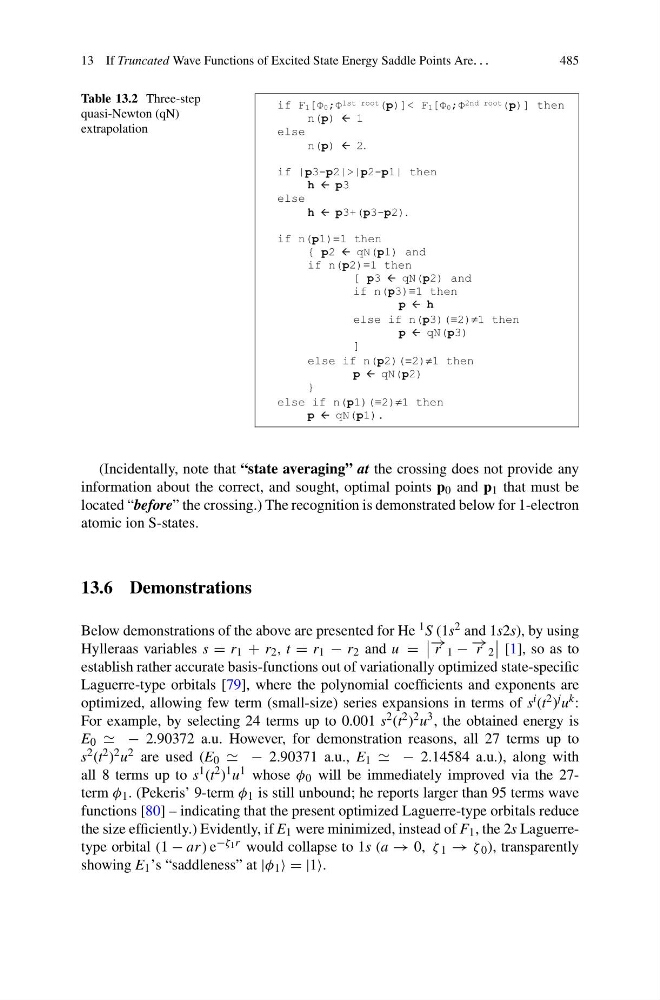
Table 13.2 Three-step
quasi-Newton (qN)
extrapolation
if F1[Φ0;Φ 1st root (p)]< F1[Φ0;Φ 2nd root (p)] then
n(p) 1
else
n(p) 2.
if |p3-p2|>|p2-p1| then
h p3
else
h p3+(p3-p2).
if n(p1)≡1 then
{ p2 qN(p1) and
if n(p2)≡1 then
[ p3 qN(p2) and
if n(p3)≡1 then
p h
else if n(p3)(≡2)¹1 then
p qN(p3)
]
else if n(p2)(≡2)¹1 then
p qN(p2)
}
else if n(p1)(≡2)¹1 then
p qN(p1).
(Incidentally, note that “state averaging” at the crossing does not provide any
information about the correct, and sought, optimal points p 0 and p 1 that must be
located “before” the crossing.) The recognition is demonstrated below for 1-electron
atomic ion S-states.
13.6 Demonstrations
Below demonstrations of the above are presented for He 1 S (1s 2 and 1s2s), by using
Hylleraas variables s = r 1 + r 2 , t = r 1 − r 2 and u =
− → r 1 − − → r 2
[1], so as to
establish rather accurate basis-functions out of variationally optimized state-specific
Laguerre-type orbitals [79], where the polynomial coefficients and exponents are
optimized, allowing few term (small-size) series expansions in terms of s i (t 2 ) j u k :
For example, by selecting 24 terms up to 0.001 s 2 (t 2 ) 2 u 3 , the obtained energy is
E 0 − 2.90372 a.u. However, for demonstration reasons, all 27 terms up to
s 2 (t 2 ) 2 u 2 are used (E 0 − 2.90371 a.u., E 1 − 2.14584 a.u.), along with
all 8 terms up to s 1 (t 2 ) 1 u 1 whose φ 0 will be immediately improved via the 27term φ 1 . (Pekeris’ 9-term φ 1 is still unbound; he reports larger than 95 terms wave
functions [80] – indicating that the present optimized Laguerre-type orbitals reduce
the size efficiently.) Evidently, if E 1 were minimized, instead of F 1 , the 2s Laguerretype orbital (1 − ar) e −ζ 1 r would collapse to 1s (a → 0, ζ 1 → ζ 0 ), transparently
showing E 1 ’s “saddleness” at |φ 1 = |1.
485
Table 13.2 Three-step
quasi-Newton (qN)
extrapolation
if F1[Φ0;Φ 1st root (p)]< F1[Φ0;Φ 2nd root (p)] then
n(p) 1
else
n(p) 2.
if |p3-p2|>|p2-p1| then
h p3
else
h p3+(p3-p2).
if n(p1)≡1 then
{ p2 qN(p1) and
if n(p2)≡1 then
[ p3 qN(p2) and
if n(p3)≡1 then
p h
else if n(p3)(≡2)¹1 then
p qN(p3)
]
else if n(p2)(≡2)¹1 then
p qN(p2)
}
else if n(p1)(≡2)¹1 then
p qN(p1).
(Incidentally, note that “state averaging” at the crossing does not provide any
information about the correct, and sought, optimal points p 0 and p 1 that must be
located “before” the crossing.) The recognition is demonstrated below for 1-electron
atomic ion S-states.
13.6 Demonstrations
Below demonstrations of the above are presented for He 1 S (1s 2 and 1s2s), by using
Hylleraas variables s = r 1 + r 2 , t = r 1 − r 2 and u =
− → r 1 − − → r 2
[1], so as to
establish rather accurate basis-functions out of variationally optimized state-specific
Laguerre-type orbitals [79], where the polynomial coefficients and exponents are
optimized, allowing few term (small-size) series expansions in terms of s i (t 2 ) j u k :
For example, by selecting 24 terms up to 0.001 s 2 (t 2 ) 2 u 3 , the obtained energy is
E 0 − 2.90372 a.u. However, for demonstration reasons, all 27 terms up to
s 2 (t 2 ) 2 u 2 are used (E 0 − 2.90371 a.u., E 1 − 2.14584 a.u.), along with
all 8 terms up to s 1 (t 2 ) 1 u 1 whose φ 0 will be immediately improved via the 27term φ 1 . (Pekeris’ 9-term φ 1 is still unbound; he reports larger than 95 terms wave
functions [80] – indicating that the present optimized Laguerre-type orbitals reduce
the size efficiently.) Evidently, if E 1 were minimized, instead of F 1 , the 2s Laguerretype orbital (1 − ar) e −ζ 1 r would collapse to 1s (a → 0, ζ 1 → ζ 0 ), transparently
showing E 1 ’s “saddleness” at |φ 1 = |1.