

468
N. C. Bacalis
a normalized trial approximant φ n , by orthogonalizing the trial function φ n to all
lower exact ψ i , i < n (if they were known), that would nullify all coefficients in L,
i| φ n =0, and would leave only the remaining term U to be minimized.
However, when, in the absence of the exact eigenfunctions, ψ n , we have only
normalized approximants φ n (expanded in truncated bases, e.g., Gaussians), we
cannot use orthogonalization to a known φ 0 , approximant of ψ 0 , not even to
approach the 1st excited state ψ 1 : Because, if (most probably) the – known –
normalized approximant φ 0 is not exactly orthogonal to the – unknown – ψ 1 , the
orthogonal to φ 0 subspace (call this subspace {\ 0 }) does not contain ψ 1 (see
Fig. 13.2). Therefore, ψ 1 cannot be found orthogonally to the normalized approximant φ 0 . So, the best achievement of a normalized trial φ 1 varied orthogonally
to φ 0 (i.e. belonging to the subspace {\ 0 }) is to be closest to ψ 1 in the subspace
{\ 0 }, i.e. with the largest overlap 1| φ 1 . At the closest, here called φ
+
1 , it has no
other components out of the 2D space of {φ 0 , ψ 1 } (because any other components
would diminish the largest overlap 1| φ 1 ), i.e. φ
+
1 is the Gram-Schmidt orthogonal
to φ 0 in the 2D space of {φ 0 , ψ 1 }:
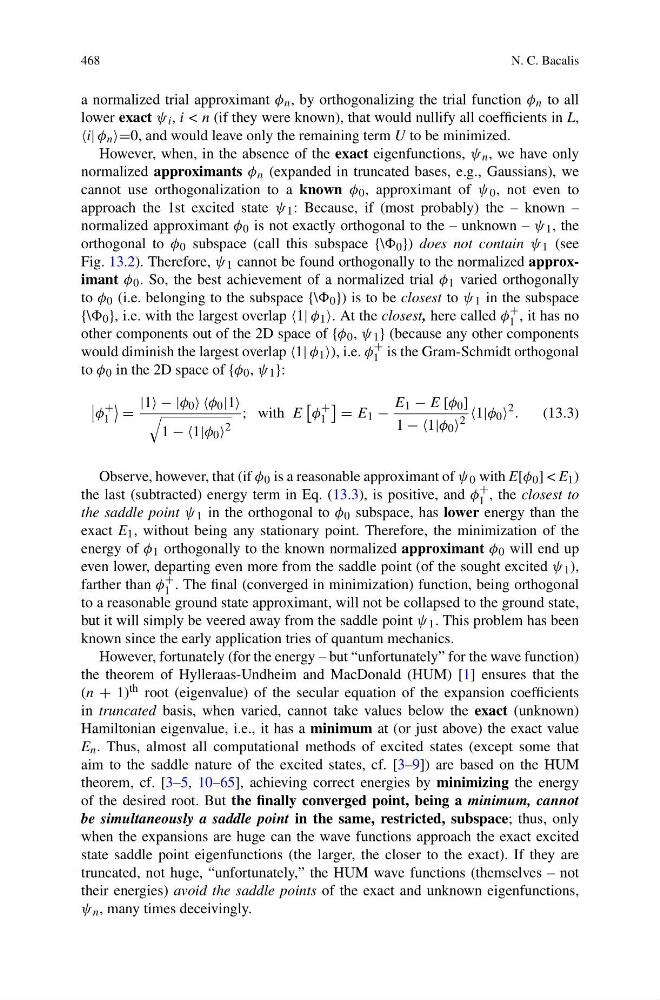
φ
+
1
=
|1 − |φ 0 φ 0 |1
1 − 1|φ 0 2
; with E
φ
+
1
= E 1 −
E 1 − E [φ 0 ]
1 − 1|φ 0 2 1|φ 0
2 .
(13.3)
Observe, however, that (if φ 0 is a reasonable approximant of ψ 0 with E[φ 0 ] < E 1 )
the last (subtracted) energy term in Eq. (13.3), is positive, and φ
+
1 , the closest to
the saddle point ψ 1 in the orthogonal to φ 0 subspace, has lower energy than the
exact E 1 , without being any stationary point. Therefore, the minimization of the
energy of φ 1 orthogonally to the known normalized approximant φ 0 will end up
even lower, departing even more from the saddle point (of the sought excited ψ 1 ),
farther than φ
+
1 . The final (converged in minimization) function, being orthogonal
to a reasonable ground state approximant, will not be collapsed to the ground state,
but it will simply be veered away from the saddle point ψ 1 . This problem has been
known since the early application tries of quantum mechanics.
However, fortunately (for the energy – but “unfortunately” for the wave function)
the theorem of Hylleraas-Undheim and MacDonald (HUM) [1] ensures that the
(n + 1) th root (eigenvalue) of the secular equation of the expansion coefficients
in truncated basis, when varied, cannot take values below the exact (unknown)
Hamiltonian eigenvalue, i.e., it has a minimum at (or just above) the exact value
E n . Thus, almost all computational methods of excited states (except some that
aim to the saddle nature of the excited states, cf. [3–9]) are based on the HUM
theorem, cf. [3–5, 10–65], achieving correct energies by minimizing the energy
of the desired root. But the finally converged point, being a minimum, cannot
be simultaneously a saddle point in the same, restricted, subspace; thus, only
when the expansions are huge can the wave functions approach the exact excited
state saddle point eigenfunctions (the larger, the closer to the exact). If they are
truncated, not huge, “unfortunately,” the HUM wave functions (themselves – not
their energies) avoid the saddle points of the exact and unknown eigenfunctions,
ψ n , many times deceivingly.
N. C. Bacalis
a normalized trial approximant φ n , by orthogonalizing the trial function φ n to all
lower exact ψ i , i < n (if they were known), that would nullify all coefficients in L,
i| φ n =0, and would leave only the remaining term U to be minimized.
However, when, in the absence of the exact eigenfunctions, ψ n , we have only
normalized approximants φ n (expanded in truncated bases, e.g., Gaussians), we
cannot use orthogonalization to a known φ 0 , approximant of ψ 0 , not even to
approach the 1st excited state ψ 1 : Because, if (most probably) the – known –
normalized approximant φ 0 is not exactly orthogonal to the – unknown – ψ 1 , the
orthogonal to φ 0 subspace (call this subspace {\ 0 }) does not contain ψ 1 (see
Fig. 13.2). Therefore, ψ 1 cannot be found orthogonally to the normalized approximant φ 0 . So, the best achievement of a normalized trial φ 1 varied orthogonally
to φ 0 (i.e. belonging to the subspace {\ 0 }) is to be closest to ψ 1 in the subspace
{\ 0 }, i.e. with the largest overlap 1| φ 1 . At the closest, here called φ
+
1 , it has no
other components out of the 2D space of {φ 0 , ψ 1 } (because any other components
would diminish the largest overlap 1| φ 1 ), i.e. φ
+
1 is the Gram-Schmidt orthogonal
to φ 0 in the 2D space of {φ 0 , ψ 1 }:
φ
+
1
=
|1 − |φ 0 φ 0 |1
1 − 1|φ 0 2
; with E
φ
+
1
= E 1 −
E 1 − E [φ 0 ]
1 − 1|φ 0 2 1|φ 0
2 .
(13.3)
Observe, however, that (if φ 0 is a reasonable approximant of ψ 0 with E[φ 0 ] < E 1 )
the last (subtracted) energy term in Eq. (13.3), is positive, and φ
+
1 , the closest to
the saddle point ψ 1 in the orthogonal to φ 0 subspace, has lower energy than the
exact E 1 , without being any stationary point. Therefore, the minimization of the
energy of φ 1 orthogonally to the known normalized approximant φ 0 will end up
even lower, departing even more from the saddle point (of the sought excited ψ 1 ),
farther than φ
+
1 . The final (converged in minimization) function, being orthogonal
to a reasonable ground state approximant, will not be collapsed to the ground state,
but it will simply be veered away from the saddle point ψ 1 . This problem has been
known since the early application tries of quantum mechanics.
However, fortunately (for the energy – but “unfortunately” for the wave function)
the theorem of Hylleraas-Undheim and MacDonald (HUM) [1] ensures that the
(n + 1) th root (eigenvalue) of the secular equation of the expansion coefficients
in truncated basis, when varied, cannot take values below the exact (unknown)
Hamiltonian eigenvalue, i.e., it has a minimum at (or just above) the exact value
E n . Thus, almost all computational methods of excited states (except some that
aim to the saddle nature of the excited states, cf. [3–9]) are based on the HUM
theorem, cf. [3–5, 10–65], achieving correct energies by minimizing the energy
of the desired root. But the finally converged point, being a minimum, cannot
be simultaneously a saddle point in the same, restricted, subspace; thus, only
when the expansions are huge can the wave functions approach the exact excited
state saddle point eigenfunctions (the larger, the closer to the exact). If they are
truncated, not huge, “unfortunately,” the HUM wave functions (themselves – not
their energies) avoid the saddle points of the exact and unknown eigenfunctions,
ψ n , many times deceivingly.