

13 If Truncated Wave Functions of Excited State Energy Saddle Points Are. . .
469
-1.0
-1.0
-0.5
-0.5
0.0
1.0
0.0
0.0
0.5
0.5
0.5
1.0
=(!)E 1
1.0
+
+
E
E 2
E[
E[
E[
: “ Closest ”
VPES
VPES
HUM
HUM
Min
Min
> E 1
]
]
]
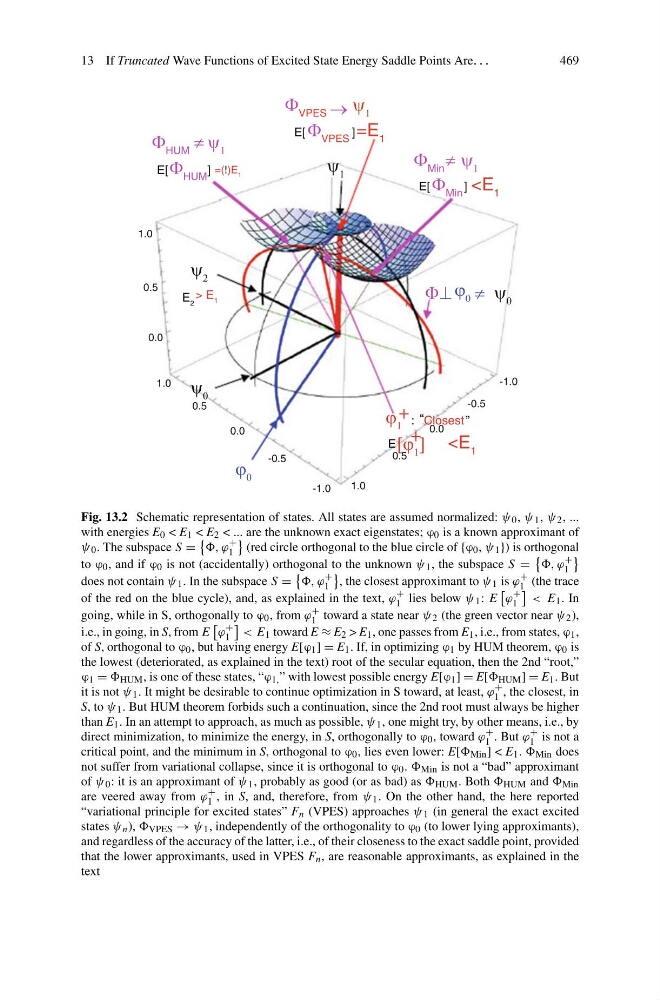
Fig. 13.2 Schematic representation of states. All states are assumed normalized: ψ 0 , ψ 1 , ψ 2 , ...
with energies E 0 < E 1 < E 2 < ... are the unknown exact eigenstates; ϕ 0 is a known approximant of
ψ 0 . The subspace S =
, ϕ
+
1
(red circle orthogonal to the blue circle of {ϕ 0 , ψ 1 }) is orthogonal
to ϕ 0 , and if ϕ 0 is not (accidentally) orthogonal to the unknown ψ 1 , the subspace S =
ϕ
+
1
does not contain ψ 1 . In the subspace S =
ϕ
+
1
, the closest approximant to ψ 1 is ϕ
+
1 (the trace
of the red on the blue cycle), and, as explained in the text, ϕ
+
1 lies below ψ 1 : E
ϕ
+
1
< E 1 . In
going, while in S, orthogonally to ϕ 0 , from ϕ
+
1 toward a state near ψ 2 (the green vector near ψ 2 ),
i.e., in going, in S, from E
ϕ
+
1
< E 1 toward E ≈ E 2 > E 1 , one passes from E 1 , i.e., from states, ϕ 1 ,
of S, orthogonal to ϕ 0 , but having energy E[ϕ 1 ] = E 1 . If, in optimizing ϕ 1 by HUM theorem, ϕ 0 is
the lowest (deteriorated, as explained in the text) root of the secular equation, then the 2nd “root,”
ϕ 1 = HUM , is one of these states, “ϕ 1, ” with lowest possible energy E[ϕ 1 ] = E[ HUM ] = E 1 . But
it is not ψ 1 . It might be desirable to continue optimization in S toward, at least, ϕ
+
1 , the closest, in
S, to ψ 1 . But HUM theorem forbids such a continuation, since the 2nd root must always be higher
than E 1 . In an attempt to approach, as much as possible, ψ 1 , one might try, by other means, i.e., by
direct minimization, to minimize the energy, in S, orthogonally to ϕ 0 , toward ϕ
+
1 . But ϕ
+
1 is not a
critical point, and the minimum in S, orthogonal to ϕ 0 , lies even lower: E[ Min ] < E 1 . Min does
not suffer from variational collapse, since it is orthogonal to ϕ 0 . Min is not a “bad” approximant
of ψ 0 : it is an approximant of ψ 1 , probably as good (or as bad) as HUM . Both HUM and Min
are veered away from ϕ
+
1 , in S, and, therefore, from ψ 1 . On the other hand, the here reported
“variational principle for excited states” F n (VPES) approaches ψ 1 (in general the exact excited
states ψ n ), VPES → ψ 1 , independently of the orthogonality to ϕ 0 (to lower lying approximants),
and regardless of the accuracy of the latter, i.e., of their closeness to the exact saddle point, provided
that the lower approximants, used in VPES F n , are reasonable approximants, as explained in the
text
469
-1.0
-1.0
-0.5
-0.5
0.0
1.0
0.0
0.0
0.5
0.5
0.5
1.0
=(!)E 1
1.0
+
+
E
E 2
E[
E[
E[
: “ Closest ”
VPES
VPES
HUM
HUM
Min
Min
> E 1
]
]
]
Fig. 13.2 Schematic representation of states. All states are assumed normalized: ψ 0 , ψ 1 , ψ 2 , ...
with energies E 0 < E 1 < E 2 < ... are the unknown exact eigenstates; ϕ 0 is a known approximant of
ψ 0 . The subspace S =
, ϕ
+
1
(red circle orthogonal to the blue circle of {ϕ 0 , ψ 1 }) is orthogonal
to ϕ 0 , and if ϕ 0 is not (accidentally) orthogonal to the unknown ψ 1 , the subspace S =
ϕ
+
1
does not contain ψ 1 . In the subspace S =
ϕ
+
1
, the closest approximant to ψ 1 is ϕ
+
1 (the trace
of the red on the blue cycle), and, as explained in the text, ϕ
+
1 lies below ψ 1 : E
ϕ
+
1
< E 1 . In
going, while in S, orthogonally to ϕ 0 , from ϕ
+
1 toward a state near ψ 2 (the green vector near ψ 2 ),
i.e., in going, in S, from E
ϕ
+
1
< E 1 toward E ≈ E 2 > E 1 , one passes from E 1 , i.e., from states, ϕ 1 ,
of S, orthogonal to ϕ 0 , but having energy E[ϕ 1 ] = E 1 . If, in optimizing ϕ 1 by HUM theorem, ϕ 0 is
the lowest (deteriorated, as explained in the text) root of the secular equation, then the 2nd “root,”
ϕ 1 = HUM , is one of these states, “ϕ 1, ” with lowest possible energy E[ϕ 1 ] = E[ HUM ] = E 1 . But
it is not ψ 1 . It might be desirable to continue optimization in S toward, at least, ϕ
+
1 , the closest, in
S, to ψ 1 . But HUM theorem forbids such a continuation, since the 2nd root must always be higher
than E 1 . In an attempt to approach, as much as possible, ψ 1 , one might try, by other means, i.e., by
direct minimization, to minimize the energy, in S, orthogonally to ϕ 0 , toward ϕ
+
1 . But ϕ
+
1 is not a
critical point, and the minimum in S, orthogonal to ϕ 0 , lies even lower: E[ Min ] < E 1 . Min does
not suffer from variational collapse, since it is orthogonal to ϕ 0 . Min is not a “bad” approximant
of ψ 0 : it is an approximant of ψ 1 , probably as good (or as bad) as HUM . Both HUM and Min
are veered away from ϕ
+
1 , in S, and, therefore, from ψ 1 . On the other hand, the here reported
“variational principle for excited states” F n (VPES) approaches ψ 1 (in general the exact excited
states ψ n ), VPES → ψ 1 , independently of the orthogonality to ϕ 0 (to lower lying approximants),
and regardless of the accuracy of the latter, i.e., of their closeness to the exact saddle point, provided
that the lower approximants, used in VPES F n , are reasonable approximants, as explained in the
text