

13 If Truncated Wave Functions of Excited State Energy Saddle Points Are. . .
467
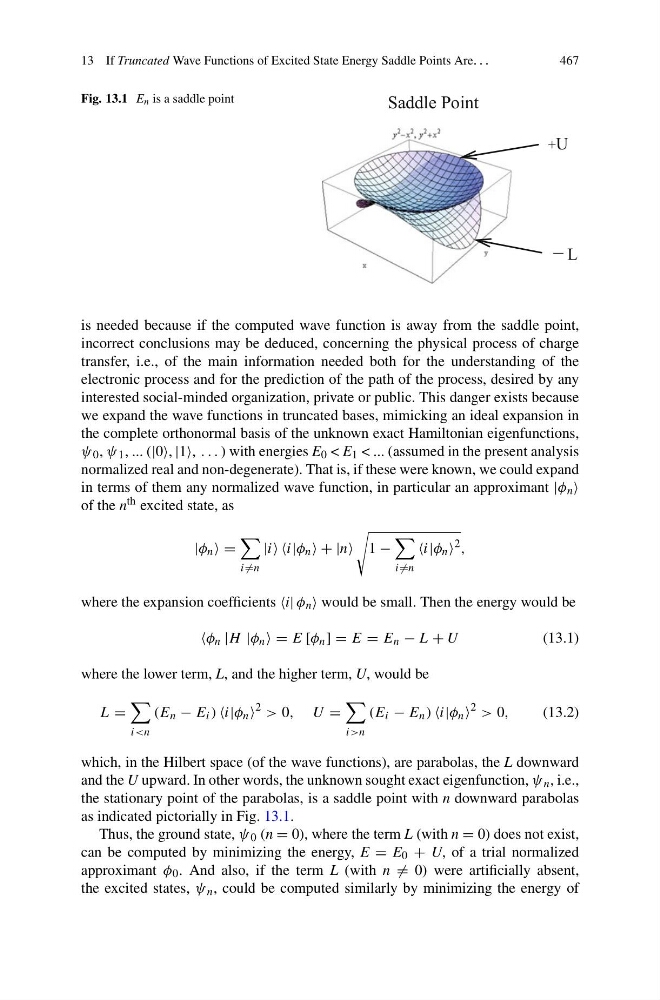
Fig. 13.1 E n is a saddle point
Saddle Point
− L
+U
is needed because if the computed wave function is away from the saddle point,
incorrect conclusions may be deduced, concerning the physical process of charge
transfer, i.e., of the main information needed both for the understanding of the
electronic process and for the prediction of the path of the process, desired by any
interested social-minded organization, private or public. This danger exists because
we expand the wave functions in truncated bases, mimicking an ideal expansion in
the complete orthonormal basis of the unknown exact Hamiltonian eigenfunctions,
ψ 0 , ψ 1 , ... (|0, |1, . . . ) with energies E 0 < E 1 < ... (assumed in the present analysis
normalized real and non-degenerate). That is, if these were known, we could expand
in terms of them any normalized wave function, in particular an approximant |φ n
of the n th excited state, as
|φ n =
i =n
|i i|φ n + |n
1 −
i =n
i|φ n 2 ,
where the expansion coefficients i| φ n would be small. Then the energy would be
φ n |H |φ n = E [φ n ] = E = E n − L + U
(13.1)
where the lower term, L, and the higher term, U, would be
L =
i
2 > 0, U =
i>n
(E i − E n ) i|φ n
2 > 0,
(13.2)
which, in the Hilbert space (of the wave functions), are parabolas, the L downward
and the U upward. In other words, the unknown sought exact eigenfunction, ψ n , i.e.,
the stationary point of the parabolas, is a saddle point with n downward parabolas
as indicated pictorially in Fig. 13.1.
Thus, the ground state, ψ 0 (n = 0), where the term L (with n = 0) does not exist,
can be computed by minimizing the energy, E = E 0 + U, of a trial normalized
approximant φ 0 . And also, if the term L (with n = 0) were artificially absent,
the excited states, ψ n , could be computed similarly by minimizing the energy of
467
Fig. 13.1 E n is a saddle point
Saddle Point
− L
+U
is needed because if the computed wave function is away from the saddle point,
incorrect conclusions may be deduced, concerning the physical process of charge
transfer, i.e., of the main information needed both for the understanding of the
electronic process and for the prediction of the path of the process, desired by any
interested social-minded organization, private or public. This danger exists because
we expand the wave functions in truncated bases, mimicking an ideal expansion in
the complete orthonormal basis of the unknown exact Hamiltonian eigenfunctions,
ψ 0 , ψ 1 , ... (|0, |1, . . . ) with energies E 0 < E 1 < ... (assumed in the present analysis
normalized real and non-degenerate). That is, if these were known, we could expand
in terms of them any normalized wave function, in particular an approximant |φ n
of the n th excited state, as
|φ n =
i =n
|i i|φ n + |n
1 −
i =n
i|φ n 2 ,
where the expansion coefficients i| φ n would be small. Then the energy would be
φ n |H |φ n = E [φ n ] = E = E n − L + U
(13.1)
where the lower term, L, and the higher term, U, would be
L =
i
2 > 0, U =
i>n
(E i − E n ) i|φ n
2 > 0,
(13.2)
which, in the Hilbert space (of the wave functions), are parabolas, the L downward
and the U upward. In other words, the unknown sought exact eigenfunction, ψ n , i.e.,
the stationary point of the parabolas, is a saddle point with n downward parabolas
as indicated pictorially in Fig. 13.1.
Thus, the ground state, ψ 0 (n = 0), where the term L (with n = 0) does not exist,
can be computed by minimizing the energy, E = E 0 + U, of a trial normalized
approximant φ 0 . And also, if the term L (with n = 0) were artificially absent,
the excited states, ψ n , could be computed similarly by minimizing the energy of