

436
H. Kobayashi
12.2.3.4 Anisotropic Rotational Diffusion
When simulating ESR spectra at higher temperatures (at which the molecular
motions of radicals in the 1D nanochannels are increased), it is assumed that the
rotational axis of each organic radical can be defined by polar and azimuthal angles,
θ and φ, respectively, in the principal axis system of the g tensor for each radical
[27]. As noted, the Chili program within the EasySpin package allows ESR spectra
in the slow-motion regime to be generated [46, 47]. These simulations are based on
solving the stochastic Liouville equation on the basis of rotational eigenfunctions.
In the case of a molecule that undergoes numerous collisions that cause small
random angular reorientations, the resultant anisotropic rotational motion is a
Markov process [45]. If is defined as the Euler angle for a tumbling molecular axis
with respect to a fixed laboratory axis system, the probability of finding the molecule
in direction at time t is defined as P(, t). In a Markov process, the probability of
being in state 1 at time t, if in state 2 at time t-Δt, is both independent of the
value at any time earlier than t-Δt and dependent only on Δt rather than t. As such,
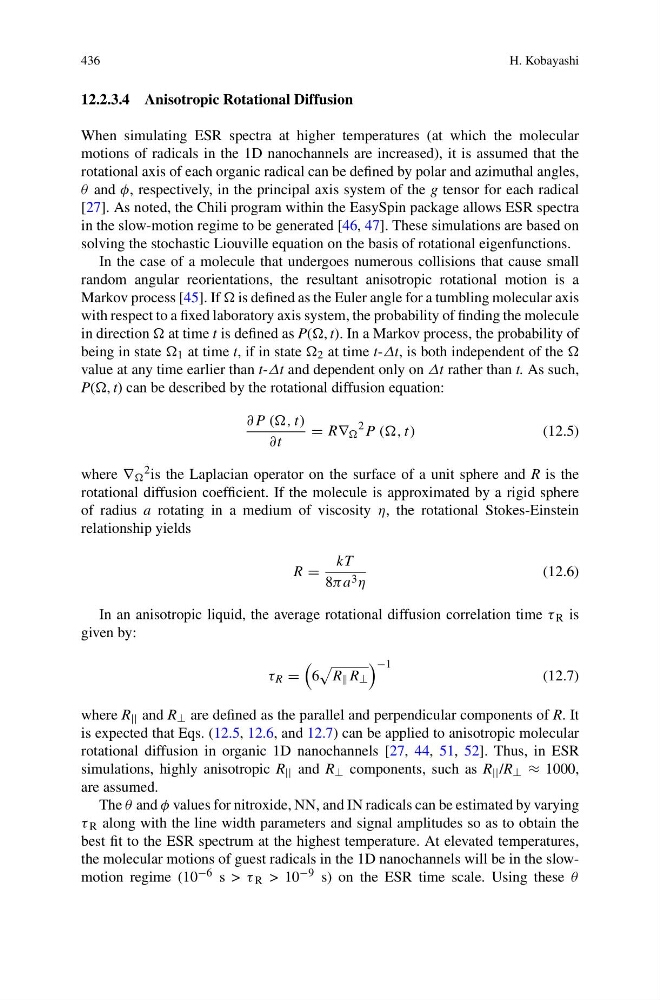
P(, t) can be described by the rotational diffusion equation:
∂P (, t)
∂t
= R∇
2 P (, t)
(12.5)
where ∇
2 is the Laplacian operator on the surface of a unit sphere and R is the
rotational diffusion coefficient. If the molecule is approximated by a rigid sphere
of radius a rotating in a medium of viscosity η, the rotational Stokes-Einstein
relationship yields
R =
kT
8πa 3 η
(12.6)
In an anisotropic liquid, the average rotational diffusion correlation time τ R is
given by:
τ R =
6
R R ⊥
−1
(12.7)
where R || and R ⊥ are defined as the parallel and perpendicular components of R. It
is expected that Eqs. (12.5, 12.6, and 12.7) can be applied to anisotropic molecular
rotational diffusion in organic 1D nanochannels [27, 44, 51, 52]. Thus, in ESR
simulations, highly anisotropic R || and R ⊥ components, such as R || /R ⊥ ≈ 1000,
are assumed.
The θ and φ values for nitroxide, NN, and IN radicals can be estimated by varying
τ R along with the line width parameters and signal amplitudes so as to obtain the
best fit to the ESR spectrum at the highest temperature. At elevated temperatures,
the molecular motions of guest radicals in the 1D nanochannels will be in the slowmotion regime (10 −6 s > τ R > 10 −9 s) on the ESR time scale. Using these θ
H. Kobayashi
12.2.3.4 Anisotropic Rotational Diffusion
When simulating ESR spectra at higher temperatures (at which the molecular
motions of radicals in the 1D nanochannels are increased), it is assumed that the
rotational axis of each organic radical can be defined by polar and azimuthal angles,
θ and φ, respectively, in the principal axis system of the g tensor for each radical
[27]. As noted, the Chili program within the EasySpin package allows ESR spectra
in the slow-motion regime to be generated [46, 47]. These simulations are based on
solving the stochastic Liouville equation on the basis of rotational eigenfunctions.
In the case of a molecule that undergoes numerous collisions that cause small
random angular reorientations, the resultant anisotropic rotational motion is a
Markov process [45]. If is defined as the Euler angle for a tumbling molecular axis
with respect to a fixed laboratory axis system, the probability of finding the molecule
in direction at time t is defined as P(, t). In a Markov process, the probability of
being in state 1 at time t, if in state 2 at time t-Δt, is both independent of the
value at any time earlier than t-Δt and dependent only on Δt rather than t. As such,
P(, t) can be described by the rotational diffusion equation:
∂P (, t)
∂t
= R∇
2 P (, t)
(12.5)
where ∇
2 is the Laplacian operator on the surface of a unit sphere and R is the
rotational diffusion coefficient. If the molecule is approximated by a rigid sphere
of radius a rotating in a medium of viscosity η, the rotational Stokes-Einstein
relationship yields
R =
kT
8πa 3 η
(12.6)
In an anisotropic liquid, the average rotational diffusion correlation time τ R is
given by:
τ R =
6
R R ⊥
−1
(12.7)
where R || and R ⊥ are defined as the parallel and perpendicular components of R. It
is expected that Eqs. (12.5, 12.6, and 12.7) can be applied to anisotropic molecular
rotational diffusion in organic 1D nanochannels [27, 44, 51, 52]. Thus, in ESR
simulations, highly anisotropic R || and R ⊥ components, such as R || /R ⊥ ≈ 1000,
are assumed.
The θ and φ values for nitroxide, NN, and IN radicals can be estimated by varying
τ R along with the line width parameters and signal amplitudes so as to obtain the
best fit to the ESR spectrum at the highest temperature. At elevated temperatures,
the molecular motions of guest radicals in the 1D nanochannels will be in the slowmotion regime (10 −6 s > τ R > 10 −9 s) on the ESR time scale. Using these θ