

12 Inter-spin Interactions of Organic Radical Chains in Organic 1D. . .
437
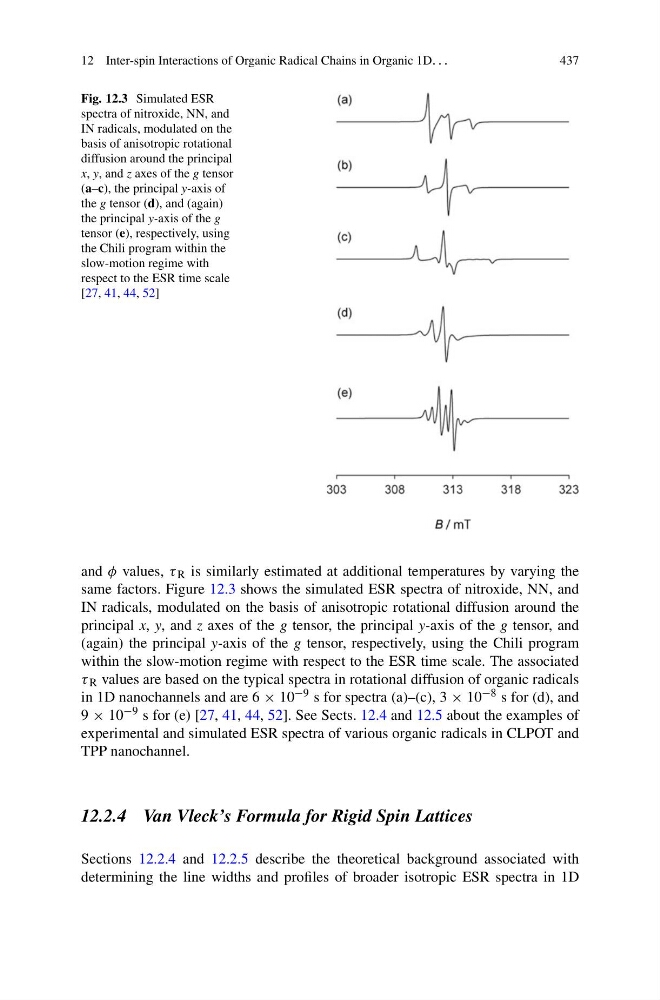
Fig. 12.3 Simulated ESR
spectra of nitroxide, NN, and
IN radicals, modulated on the
basis of anisotropic rotational
diffusion around the principal
x, y, and z axes of the g tensor
(a–c), the principal y-axis of
the g tensor (d), and (again)
the principal y-axis of the g
tensor (e), respectively, using
the Chili program within the
slow-motion regime with
respect to the ESR time scale
[27, 41, 44, 52]
and φ values, τ R is similarly estimated at additional temperatures by varying the
same factors. Figure 12.3 shows the simulated ESR spectra of nitroxide, NN, and
IN radicals, modulated on the basis of anisotropic rotational diffusion around the
principal x, y, and z axes of the g tensor, the principal y-axis of the g tensor, and
(again) the principal y-axis of the g tensor, respectively, using the Chili program
within the slow-motion regime with respect to the ESR time scale. The associated
τ R values are based on the typical spectra in rotational diffusion of organic radicals
in 1D nanochannels and are 6 × 10 −9 s for spectra (a)–(c), 3 × 10 −8 s for (d), and
9 × 10 −9 s for (e) [27, 41, 44, 52]. See Sects. 12.4 and 12.5 about the examples of
experimental and simulated ESR spectra of various organic radicals in CLPOT and
TPP nanochannel.
12.2.4 Van Vleck’s Formula for Rigid Spin Lattices
Sections 12.2.4 and 12.2.5 describe the theoretical background associated with
determining the line widths and profiles of broader isotropic ESR spectra in 1D
437
Fig. 12.3 Simulated ESR
spectra of nitroxide, NN, and
IN radicals, modulated on the
basis of anisotropic rotational
diffusion around the principal
x, y, and z axes of the g tensor
(a–c), the principal y-axis of
the g tensor (d), and (again)
the principal y-axis of the g
tensor (e), respectively, using
the Chili program within the
slow-motion regime with
respect to the ESR time scale
[27, 41, 44, 52]
and φ values, τ R is similarly estimated at additional temperatures by varying the
same factors. Figure 12.3 shows the simulated ESR spectra of nitroxide, NN, and
IN radicals, modulated on the basis of anisotropic rotational diffusion around the
principal x, y, and z axes of the g tensor, the principal y-axis of the g tensor, and
(again) the principal y-axis of the g tensor, respectively, using the Chili program
within the slow-motion regime with respect to the ESR time scale. The associated
τ R values are based on the typical spectra in rotational diffusion of organic radicals
in 1D nanochannels and are 6 × 10 −9 s for spectra (a)–(c), 3 × 10 −8 s for (d), and
9 × 10 −9 s for (e) [27, 41, 44, 52]. See Sects. 12.4 and 12.5 about the examples of
experimental and simulated ESR spectra of various organic radicals in CLPOT and
TPP nanochannel.
12.2.4 Van Vleck’s Formula for Rigid Spin Lattices
Sections 12.2.4 and 12.2.5 describe the theoretical background associated with
determining the line widths and profiles of broader isotropic ESR spectra in 1D