

12 Inter-spin Interactions of Organic Radical Chains in Organic 1D. . .
435
Table 12.3 Tensor components of the g and A tensors for various organic radicals in the various
states. Spacer molecules are abbreviated in each state
State of
radicals
g xx
g yy
g zz
A 1xx (/A 2xx )/ mT A 1yy (/A 2yy )/ mT A 1zz (/A 2zz )/ mT
TEMPO in
TPP a
2.0100 2.0070 2.0024 0.60
0.55
3.35
DTBN in
TMCB b
2.0088 2.0062 2.0027 0.76
0.60
3.18
DTBN in
TPP c
2.0090 2.0062 2.0022 0.50
0.50
3.48
TEMPOL
in TPP d
2.0092 2.0061 2.0026 0.83
0.30
3.33
TEMPO in
CLPOT e
2.0102 2.0062 2.0023 0.73
0.60
3.35
MeOTEMPO in
CLPOT f
2.0098 2.0062 2.0024 0.56
0.43
3.43
PhNN in
rigid Duco
Cement g
2.0127 2.0068 2.0028 0.52
0.52
1.80
PhNN in
CLPOT h
2.0118 2.0075 2.0031 0.34
0.12
1.74
PhNN in
TPP i
2.0107 2.0086 2.0031 0.01
0.01
2.13
p-NPNN in
CLPOT h
2.0116 2.0076 2.0030 0.32
0.16
1.77
PhIN
glassy
toluene j
2.00932 2.00604 2.00222 –
–
2.32/1.28
PhIN in
TPP i
2.0103 2.0050 2.0028 0.02/0.01
0.01/0.02
2.36/1.16
TMBC tetramethyl-1,3-cyclobutanedione
a Ref. [40]. b Ref. [64]. c Ref. [41]. d Ref. [43]. e Ref. [51]. f Ref. [52]. g Ref. [66]. h Ref. [27]. i Ref.
[44]. j Ref. [67]
[66]. This occurs because the g xx and g yy components are larger than the g zz
component and because the A xx
NN and A yy
NN components are much smaller than
the A 1zz
NN component. In the case of PhIN results in Fig. 12.2c, the seven major
hyperfine interaction lines associated with inequivalent nitrogen atoms having
different hyperfine coupling constants (typically, A 1zz
IN ∼ 2A 2zz
IN ) are included.
The peak heights of these lines are proportional to the peak intensities obtained
from analyses in dilute solution. Here, lines 1, 2, 5, 6, and 7 are well-resolved, and
the spectrum between lines 3 and 4 is more complicated [44]. These results are due
to the g xx and g yy components, which are large relative to the g zz components, and
to the A 1xx
IN , A 1yy
IN , A 2xx
IN , and A 2yy
IN components, all of which are much smaller
than the A 1zz
IN or A 2zz
IN components. The principal axis components of the g and A
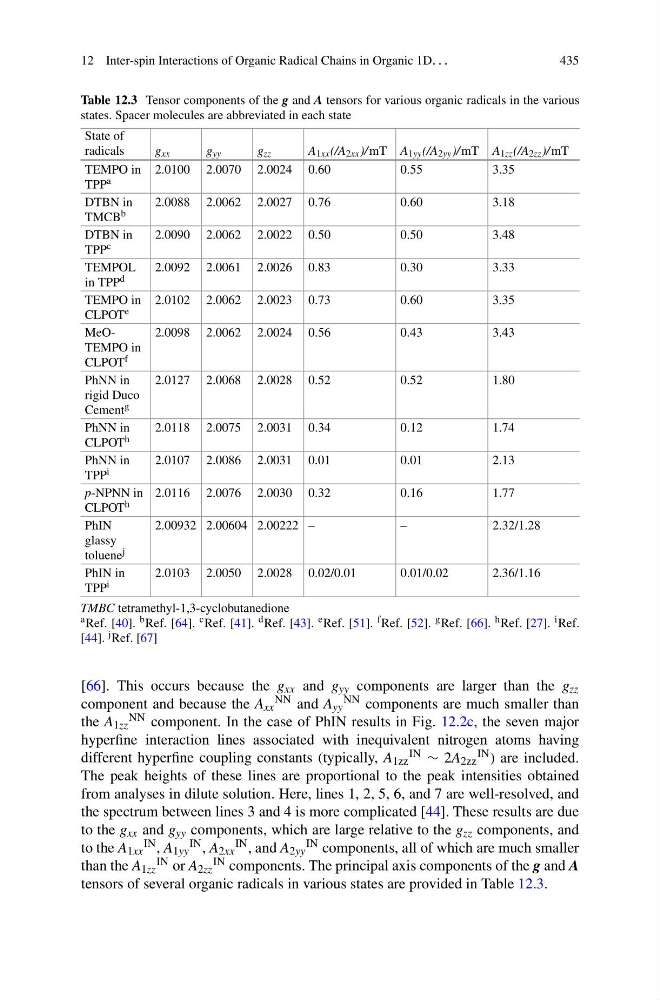
tensors of several organic radicals in various states are provided in Table 12.3.
435
Table 12.3 Tensor components of the g and A tensors for various organic radicals in the various
states. Spacer molecules are abbreviated in each state
State of
radicals
g xx
g yy
g zz
A 1xx (/A 2xx )/ mT A 1yy (/A 2yy )/ mT A 1zz (/A 2zz )/ mT
TEMPO in
TPP a
2.0100 2.0070 2.0024 0.60
0.55
3.35
DTBN in
TMCB b
2.0088 2.0062 2.0027 0.76
0.60
3.18
DTBN in
TPP c
2.0090 2.0062 2.0022 0.50
0.50
3.48
TEMPOL
in TPP d
2.0092 2.0061 2.0026 0.83
0.30
3.33
TEMPO in
CLPOT e
2.0102 2.0062 2.0023 0.73
0.60
3.35
MeOTEMPO in
CLPOT f
2.0098 2.0062 2.0024 0.56
0.43
3.43
PhNN in
rigid Duco
Cement g
2.0127 2.0068 2.0028 0.52
0.52
1.80
PhNN in
CLPOT h
2.0118 2.0075 2.0031 0.34
0.12
1.74
PhNN in
TPP i
2.0107 2.0086 2.0031 0.01
0.01
2.13
p-NPNN in
CLPOT h
2.0116 2.0076 2.0030 0.32
0.16
1.77
PhIN
glassy
toluene j
2.00932 2.00604 2.00222 –
–
2.32/1.28
PhIN in
TPP i
2.0103 2.0050 2.0028 0.02/0.01
0.01/0.02
2.36/1.16
TMBC tetramethyl-1,3-cyclobutanedione
a Ref. [40]. b Ref. [64]. c Ref. [41]. d Ref. [43]. e Ref. [51]. f Ref. [52]. g Ref. [66]. h Ref. [27]. i Ref.
[44]. j Ref. [67]
[66]. This occurs because the g xx and g yy components are larger than the g zz
component and because the A xx
NN and A yy
NN components are much smaller than
the A 1zz
NN component. In the case of PhIN results in Fig. 12.2c, the seven major
hyperfine interaction lines associated with inequivalent nitrogen atoms having
different hyperfine coupling constants (typically, A 1zz
IN ∼ 2A 2zz
IN ) are included.
The peak heights of these lines are proportional to the peak intensities obtained
from analyses in dilute solution. Here, lines 1, 2, 5, 6, and 7 are well-resolved, and
the spectrum between lines 3 and 4 is more complicated [44]. These results are due
to the g xx and g yy components, which are large relative to the g zz components, and
to the A 1xx
IN , A 1yy
IN , A 2xx
IN , and A 2yy
IN components, all of which are much smaller
than the A 1zz
IN or A 2zz
IN components. The principal axis components of the g and A
tensors of several organic radicals in various states are provided in Table 12.3.