

414
T. Okura and K. Yamashita
0
1
2
4
3
σ / mS•cm −1
0
100
200
300
400
500
T / °C
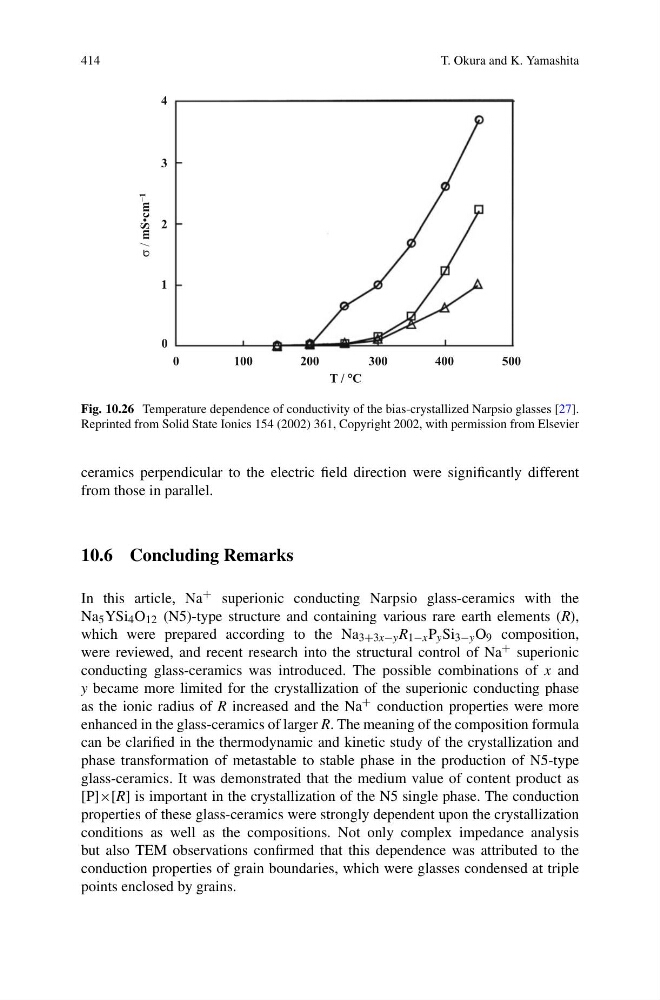
Fig. 10.26 Temperature dependence of conductivity of the bias-crystallized Narpsio glasses [27].
Reprinted from Solid State Ionics 154 (2002) 361, Copyright 2002, with permission from Elsevier
ceramics perpendicular to the electric field direction were significantly different
from those in parallel.
10.6 Concluding Remarks
In this article, Na + superionic conducting Narpsio glass-ceramics with the
Na 5 YSi 4 O 12 (N5)-type structure and containing various rare earth elements (R),
which were prepared according to the Na 3+3x−y R 1−x P y Si 3−y O 9 composition,
were reviewed, and recent research into the structural control of Na + superionic
conducting glass-ceramics was introduced. The possible combinations of x and
y became more limited for the crystallization of the superionic conducting phase
as the ionic radius of R increased and the Na + conduction properties were more
enhanced in the glass-ceramics of larger R. The meaning of the composition formula
can be clarified in the thermodynamic and kinetic study of the crystallization and
phase transformation of metastable to stable phase in the production of N5-type
glass-ceramics. It was demonstrated that the medium value of content product as
[P]×[R] is important in the crystallization of the N5 single phase. The conduction
properties of these glass-ceramics were strongly dependent upon the crystallization
conditions as well as the compositions. Not only complex impedance analysis
but also TEM observations confirmed that this dependence was attributed to the
conduction properties of grain boundaries, which were glasses condensed at triple
points enclosed by grains.
T. Okura and K. Yamashita
0
1
2
4
3
σ / mS•cm −1
0
100
200
300
400
500
T / °C
Fig. 10.26 Temperature dependence of conductivity of the bias-crystallized Narpsio glasses [27].
Reprinted from Solid State Ionics 154 (2002) 361, Copyright 2002, with permission from Elsevier
ceramics perpendicular to the electric field direction were significantly different
from those in parallel.
10.6 Concluding Remarks
In this article, Na + superionic conducting Narpsio glass-ceramics with the
Na 5 YSi 4 O 12 (N5)-type structure and containing various rare earth elements (R),
which were prepared according to the Na 3+3x−y R 1−x P y Si 3−y O 9 composition,
were reviewed, and recent research into the structural control of Na + superionic
conducting glass-ceramics was introduced. The possible combinations of x and
y became more limited for the crystallization of the superionic conducting phase
as the ionic radius of R increased and the Na + conduction properties were more
enhanced in the glass-ceramics of larger R. The meaning of the composition formula
can be clarified in the thermodynamic and kinetic study of the crystallization and
phase transformation of metastable to stable phase in the production of N5-type
glass-ceramics. It was demonstrated that the medium value of content product as
[P]×[R] is important in the crystallization of the N5 single phase. The conduction
properties of these glass-ceramics were strongly dependent upon the crystallization
conditions as well as the compositions. Not only complex impedance analysis
but also TEM observations confirmed that this dependence was attributed to the
conduction properties of grain boundaries, which were glasses condensed at triple
points enclosed by grains.