

10 New Na + Superionic Conductor Narpsio Glass-Ceramics
413
-6
-8
-6
-2
0
-4
2
1.2
1.4
1000•T −1 / K −1
ln
T / S•cm −1
•K −1
1.6
1.8
2.0
2.2
2.4
450 400 350 300
250
200
150
T / C
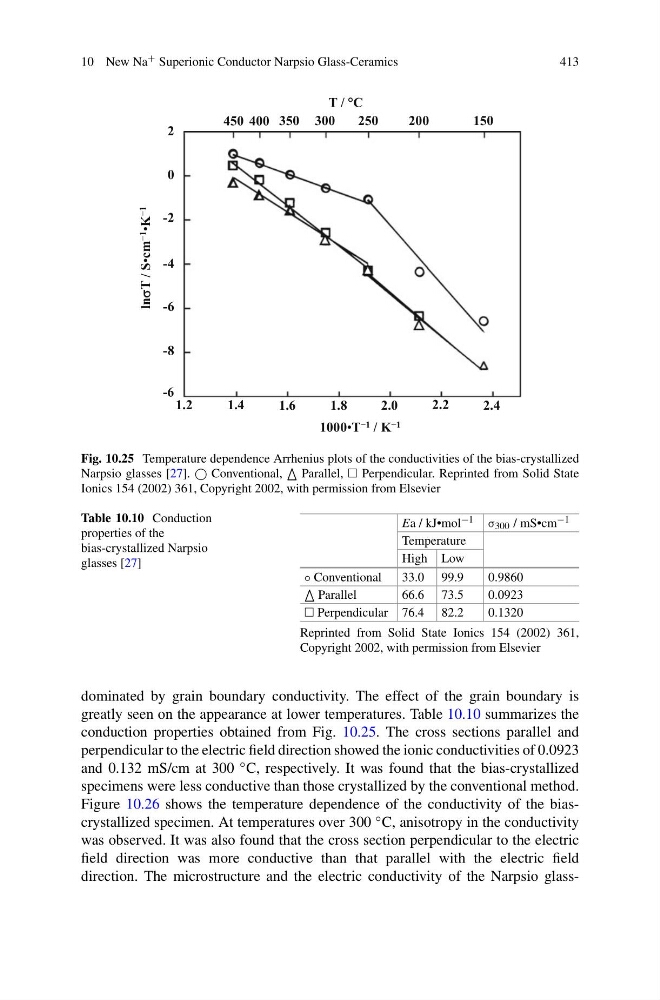
Fig. 10.25 Temperature dependence Arrhenius plots of the conductivities of the bias-crystallized
Narpsio glasses [27]. Conventional,
Parallel, Perpendicular. Reprinted from Solid State
Ionics 154 (2002) 361, Copyright 2002, with permission from Elsevier
Table 10.10 Conduction
properties of the
bias-crystallized Narpsio
glasses [27]
Ea / kJ•mol −1 σ 300 / mS•cm −1
Temperature
High Low
◦ Conventional
33.0 99.9
0.9860
Parallel
66.6 73.5
0.0923
Perpendicular 76.4 82.2
0.1320
Reprinted from Solid State Ionics 154 (2002) 361,
Copyright 2002, with permission from Elsevier
dominated by grain boundary conductivity. The effect of the grain boundary is
greatly seen on the appearance at lower temperatures. Table 10.10 summarizes the
conduction properties obtained from Fig. 10.25. The cross sections parallel and
perpendicular to the electric field direction showed the ionic conductivities of 0.0923
and 0.132 mS/cm at 300 ◦ C, respectively. It was found that the bias-crystallized
specimens were less conductive than those crystallized by the conventional method.
Figure 10.26 shows the temperature dependence of the conductivity of the biascrystallized specimen. At temperatures over 300 ◦ C, anisotropy in the conductivity
was observed. It was also found that the cross section perpendicular to the electric
field direction was more conductive than that parallel with the electric field
direction. The microstructure and the electric conductivity of the Narpsio glass-
413
-6
-8
-6
-2
0
-4
2
1.2
1.4
1000•T −1 / K −1
ln
T / S•cm −1
•K −1
1.6
1.8
2.0
2.2
2.4
450 400 350 300
250
200
150
T / C
Fig. 10.25 Temperature dependence Arrhenius plots of the conductivities of the bias-crystallized
Narpsio glasses [27]. Conventional,
Parallel, Perpendicular. Reprinted from Solid State
Ionics 154 (2002) 361, Copyright 2002, with permission from Elsevier
Table 10.10 Conduction
properties of the
bias-crystallized Narpsio
glasses [27]
Ea / kJ•mol −1 σ 300 / mS•cm −1
Temperature
High Low
◦ Conventional
33.0 99.9
0.9860
Parallel
66.6 73.5
0.0923
Perpendicular 76.4 82.2
0.1320
Reprinted from Solid State Ionics 154 (2002) 361,
Copyright 2002, with permission from Elsevier
dominated by grain boundary conductivity. The effect of the grain boundary is
greatly seen on the appearance at lower temperatures. Table 10.10 summarizes the
conduction properties obtained from Fig. 10.25. The cross sections parallel and
perpendicular to the electric field direction showed the ionic conductivities of 0.0923
and 0.132 mS/cm at 300 ◦ C, respectively. It was found that the bias-crystallized
specimens were less conductive than those crystallized by the conventional method.
Figure 10.26 shows the temperature dependence of the conductivity of the biascrystallized specimen. At temperatures over 300 ◦ C, anisotropy in the conductivity
was observed. It was also found that the cross section perpendicular to the electric
field direction was more conductive than that parallel with the electric field
direction. The microstructure and the electric conductivity of the Narpsio glass-