

10 New Na + Superionic Conductor Narpsio Glass-Ceramics
415
The Narpsio conductors exhibit great potential and are one of the most important
groups of solid electrolytes, not only because they are practically useful for
application in advanced batteries but also because they are three-dimensional
ionic conductors with a 12-(SiO 4 ) 4− -tetrahedra-containing skeleton structure from
which, or by analogy with which, various solid electrolyte materials can be derived.
In addition, various modified Narpsio glass-ceramics have been synthesized by
replacing R with Sc, Y, In, La, Nd, Sm, Eu, Gd, Dy, Er, or Yb and/or by substituting
tetravalent (Ti 4+ , Ge 4+ , Te 4+ ), trivalent (B 3+ , Al 3+ , Ga 3+ ), pentavalent (V 5+ ),
and hexavalent (Mo 6+ ) ions for P or Si. In this review, the results of Na + ion
implantation as a material processing technique to introduce a large number of
mobile Na + ions were presented. A large enhancement in electrical conductivity
was observed in the Narpsio glass-ceramics by ion implantation of Na + ions.
Such glass-making processing is favorable for the fabrication of differently shaped
electrolytes, and the microstructures of glass-ceramic electrolytes can be controlled
through variation of the crystallization conditions. We have successfully produced
anisotropic glass-ceramic conductors by bias crystallization of the glasses in an
electric field. The microstructure and the conduction properties were dependent on
the current direction in the crystallization process.
10.7 Future Prospects
The Narpsio family has great potential. It is a solid solution in the Na 2 O-R 2 O 3 -
P 2 O 5 -SiO 2 system and is expected to develop a variety of modified Narpsios. Our
main work has recently been focused on the synthesis of various glass-ceramics
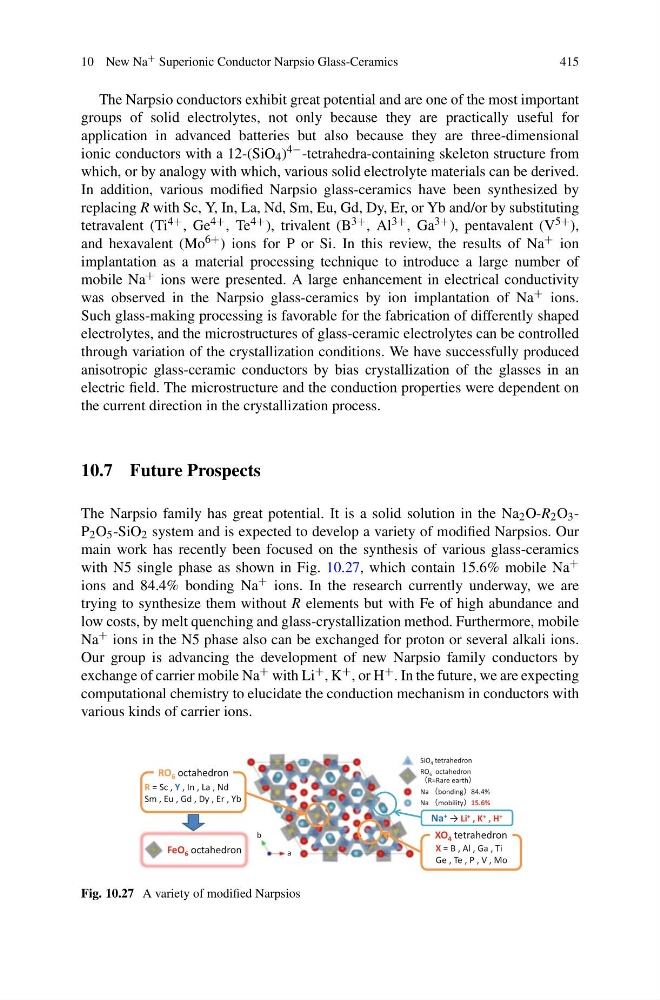
with N5 single phase as shown in Fig. 10.27, which contain 15.6% mobile Na +
ions and 84.4% bonding Na + ions. In the research currently underway, we are
trying to synthesize them without R elements but with Fe of high abundance and
low costs, by melt quenching and glass-crystallization method. Furthermore, mobile
Na + ions in the N5 phase also can be exchanged for proton or several alkali ions.
Our group is advancing the development of new Narpsio family conductors by
exchange of carrier mobile Na + with Li + , K + , or H + . In the future, we are expecting
computational chemistry to elucidate the conduction mechanism in conductors with
various kinds of carrier ions.
FeO 6 octahedron
a
b
RO 6 octahedron
قR=Rare earthك
Na قbonding%4.48ك
Na قmobility%6.51ك
SiO 4 tetrahedron
RO 6 octahedron
XO 4 tetrahedron
Li
Na + → Li + , K + , H +
R = Sc , Y , In , La , Nd
Sm , Eu , Gd , Dy , Er , Yb
X = B , Al , Ga , Ti
Ge , Te , P , V , Mo
Fig. 10.27 A variety of modified Narpsios
415
The Narpsio conductors exhibit great potential and are one of the most important
groups of solid electrolytes, not only because they are practically useful for
application in advanced batteries but also because they are three-dimensional
ionic conductors with a 12-(SiO 4 ) 4− -tetrahedra-containing skeleton structure from
which, or by analogy with which, various solid electrolyte materials can be derived.
In addition, various modified Narpsio glass-ceramics have been synthesized by
replacing R with Sc, Y, In, La, Nd, Sm, Eu, Gd, Dy, Er, or Yb and/or by substituting
tetravalent (Ti 4+ , Ge 4+ , Te 4+ ), trivalent (B 3+ , Al 3+ , Ga 3+ ), pentavalent (V 5+ ),
and hexavalent (Mo 6+ ) ions for P or Si. In this review, the results of Na + ion
implantation as a material processing technique to introduce a large number of
mobile Na + ions were presented. A large enhancement in electrical conductivity
was observed in the Narpsio glass-ceramics by ion implantation of Na + ions.
Such glass-making processing is favorable for the fabrication of differently shaped
electrolytes, and the microstructures of glass-ceramic electrolytes can be controlled
through variation of the crystallization conditions. We have successfully produced
anisotropic glass-ceramic conductors by bias crystallization of the glasses in an
electric field. The microstructure and the conduction properties were dependent on
the current direction in the crystallization process.
10.7 Future Prospects
The Narpsio family has great potential. It is a solid solution in the Na 2 O-R 2 O 3 -
P 2 O 5 -SiO 2 system and is expected to develop a variety of modified Narpsios. Our
main work has recently been focused on the synthesis of various glass-ceramics
with N5 single phase as shown in Fig. 10.27, which contain 15.6% mobile Na +
ions and 84.4% bonding Na + ions. In the research currently underway, we are
trying to synthesize them without R elements but with Fe of high abundance and
low costs, by melt quenching and glass-crystallization method. Furthermore, mobile
Na + ions in the N5 phase also can be exchanged for proton or several alkali ions.
Our group is advancing the development of new Narpsio family conductors by
exchange of carrier mobile Na + with Li + , K + , or H + . In the future, we are expecting
computational chemistry to elucidate the conduction mechanism in conductors with
various kinds of carrier ions.
FeO 6 octahedron
a
b
RO 6 octahedron
قR=Rare earthك
Na قbonding%4.48ك
Na قmobility%6.51ك
SiO 4 tetrahedron
RO 6 octahedron
XO 4 tetrahedron
Li
Na + → Li + , K + , H +
R = Sc , Y , In , La , Nd
Sm , Eu , Gd , Dy , Er , Yb
X = B , Al , Ga , Ti
Ge , Te , P , V , Mo
Fig. 10.27 A variety of modified Narpsios