

10 New Na + Superionic Conductor Narpsio Glass-Ceramics
409
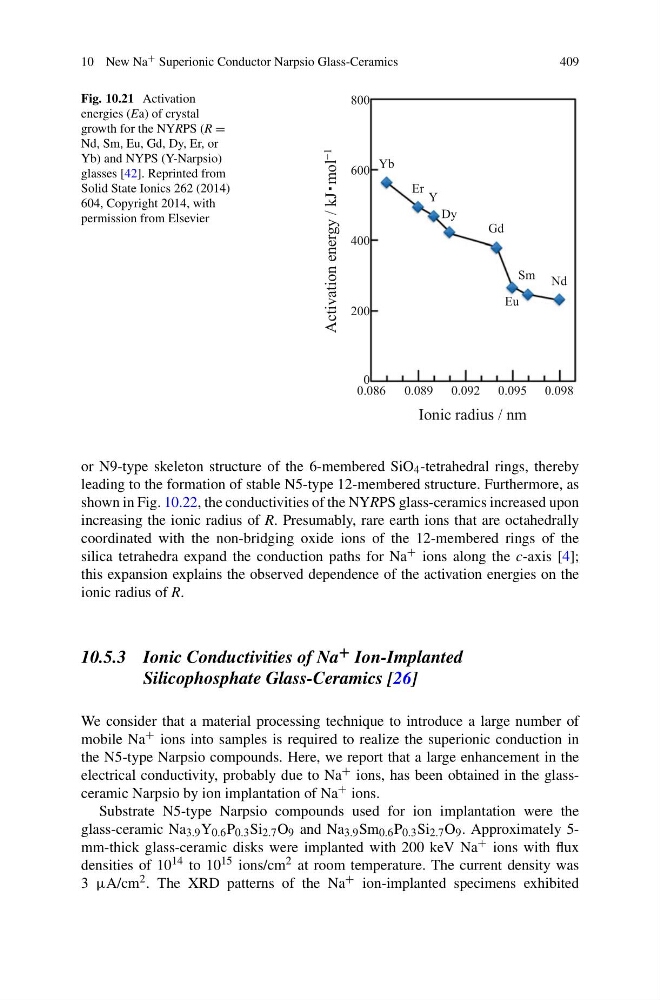
Fig. 10.21 Activation
energies (Ea) of crystal
growth for the NYRPS (R =
Nd, Sm, Eu, Gd, Dy, Er, or
Yb) and NYPS (Y-Narpsio)
glasses [42]. Reprinted from
Solid State Ionics 262 (2014)
604, Copyright 2014, with
permission from Elsevier
Activation energy / kJ䞉mol −1
Ionic radius / nm
0.086 0.089 0.092 0.095 0.098
800
400
200
0
Sm
Gd
Y
Er
Yb
Dy
Eu
Nd
600
or N9-type skeleton structure of the 6-membered SiO 4 -tetrahedral rings, thereby
leading to the formation of stable N5-type 12-membered structure. Furthermore, as
shown in Fig. 10.22, the conductivities of the NYRPS glass-ceramics increased upon
increasing the ionic radius of R. Presumably, rare earth ions that are octahedrally
coordinated with the non-bridging oxide ions of the 12-membered rings of the
silica tetrahedra expand the conduction paths for Na + ions along the c-axis [4];
this expansion explains the observed dependence of the activation energies on the
ionic radius of R.
10.5.3 Ionic Conductivities of Na + Ion-Implanted
Silicophosphate Glass-Ceramics [26]
We consider that a material processing technique to introduce a large number of
mobile Na + ions into samples is required to realize the superionic conduction in
the N5-type Narpsio compounds. Here, we report that a large enhancement in the
electrical conductivity, probably due to Na + ions, has been obtained in the glassceramic Narpsio by ion implantation of Na + ions.
Substrate N5-type Narpsio compounds used for ion implantation were the
glass-ceramic Na 3.9 Y 0.6 P 0.3 Si 2.7 O 9 and Na 3.9 Sm 0.6 P 0.3 Si 2.7 O 9 . Approximately 5mm-thick glass-ceramic disks were implanted with 200 keV Na + ions with flux
densities of 10 14 to 10 15 ions/cm 2 at room temperature. The current density was
3 μA/cm 2 . The XRD patterns of the Na + ion-implanted specimens exhibited
409
Fig. 10.21 Activation
energies (Ea) of crystal
growth for the NYRPS (R =
Nd, Sm, Eu, Gd, Dy, Er, or
Yb) and NYPS (Y-Narpsio)
glasses [42]. Reprinted from
Solid State Ionics 262 (2014)
604, Copyright 2014, with
permission from Elsevier
Activation energy / kJ䞉mol −1
Ionic radius / nm
0.086 0.089 0.092 0.095 0.098
800
400
200
0
Sm
Gd
Y
Er
Yb
Dy
Eu
Nd
600
or N9-type skeleton structure of the 6-membered SiO 4 -tetrahedral rings, thereby
leading to the formation of stable N5-type 12-membered structure. Furthermore, as
shown in Fig. 10.22, the conductivities of the NYRPS glass-ceramics increased upon
increasing the ionic radius of R. Presumably, rare earth ions that are octahedrally
coordinated with the non-bridging oxide ions of the 12-membered rings of the
silica tetrahedra expand the conduction paths for Na + ions along the c-axis [4];
this expansion explains the observed dependence of the activation energies on the
ionic radius of R.
10.5.3 Ionic Conductivities of Na + Ion-Implanted
Silicophosphate Glass-Ceramics [26]
We consider that a material processing technique to introduce a large number of
mobile Na + ions into samples is required to realize the superionic conduction in
the N5-type Narpsio compounds. Here, we report that a large enhancement in the
electrical conductivity, probably due to Na + ions, has been obtained in the glassceramic Narpsio by ion implantation of Na + ions.
Substrate N5-type Narpsio compounds used for ion implantation were the
glass-ceramic Na 3.9 Y 0.6 P 0.3 Si 2.7 O 9 and Na 3.9 Sm 0.6 P 0.3 Si 2.7 O 9 . Approximately 5mm-thick glass-ceramic disks were implanted with 200 keV Na + ions with flux
densities of 10 14 to 10 15 ions/cm 2 at room temperature. The current density was
3 μA/cm 2 . The XRD patterns of the Na + ion-implanted specimens exhibited