

408
T. Okura and K. Yamashita
Table 10.8 Total and
electronic conductivities and
the Na + ionic transport
numbers of the glass-ceramic
specimen
Na 3.9 Y 0.6 V 0.3 Si 2.7 O 9 (A)
[41]
Temp. ( ◦ C) σ t (S•cm −1 )
σ e (S•cm −1 )
t i
150
1.312 × 10 −3 1.582 × 10 −5 0.988
200
2.752 × 10 −3 1.826 × 10 −4 0.934
250
4.728 × 10 −3 4.687 × 10 −4 0.901
300
8.715 × 10 −3 6.582 × 10 −4 0.924
350
1.627 × 10 −2 1.563 × 10 −3 0.904
Reprinted from Solid State Ionics 179 (2008) 1291,
Copyright 2008, with permission from Elsevier
σ t Total conductivity, σ e Electronic conductivity, t i Ionic
transport number
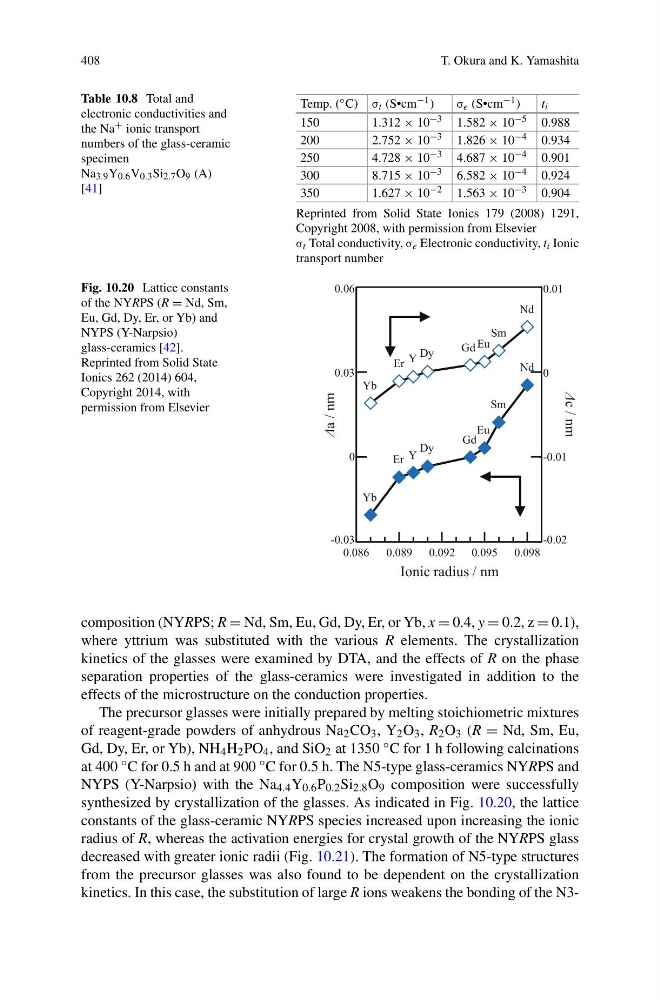
Fig. 10.20 Lattice constants
of the NYRPS (R = Nd, Sm,
Eu, Gd, Dy, Er, or Yb) and
NYPS (Y-Narpsio)
glass-ceramics [42].
Reprinted from Solid State
Ionics 262 (2014) 604,
Copyright 2014, with
permission from Elsevier
Δa / nm
Ionic radius / nm
0.086 0.089 0.092 0.095 0.098
0.06
0.03
0
-0.03
0.01
0
-0.01
-0.02
Δc / nm
Sm
Gd
Y
Er
Yb
Dy
Eu
Nd
Sm
Gd
Y
Er
Yb
Dy
Eu
Nd
composition (NYRPS; R = Nd, Sm, Eu, Gd, Dy, Er, or Yb, x = 0.4, y = 0.2, z = 0.1),
where yttrium was substituted with the various R elements. The crystallization
kinetics of the glasses were examined by DTA, and the effects of R on the phase
separation properties of the glass-ceramics were investigated in addition to the
effects of the microstructure on the conduction properties.
The precursor glasses were initially prepared by melting stoichiometric mixtures
of reagent-grade powders of anhydrous Na 2 CO 3 , Y 2 O 3 , R 2 O 3 (R = Nd, Sm, Eu,
Gd, Dy, Er, or Yb), NH 4 H 2 PO 4 , and SiO 2 at 1350 ◦ C for 1 h following calcinations
at 400 ◦ C for 0.5 h and at 900 ◦ C for 0.5 h. The N5-type glass-ceramics NYRPS and
NYPS (Y-Narpsio) with the Na 4.4 Y 0.6 P 0.2 Si 2.8 O 9 composition were successfully
synthesized by crystallization of the glasses. As indicated in Fig. 10.20, the lattice
constants of the glass-ceramic NYRPS species increased upon increasing the ionic
radius of R, whereas the activation energies for crystal growth of the NYRPS glass
decreased with greater ionic radii (Fig. 10.21). The formation of N5-type structures
from the precursor glasses was also found to be dependent on the crystallization
kinetics. In this case, the substitution of large R ions weakens the bonding of the N3-
T. Okura and K. Yamashita
Table 10.8 Total and
electronic conductivities and
the Na + ionic transport
numbers of the glass-ceramic
specimen
Na 3.9 Y 0.6 V 0.3 Si 2.7 O 9 (A)
[41]
Temp. ( ◦ C) σ t (S•cm −1 )
σ e (S•cm −1 )
t i
150
1.312 × 10 −3 1.582 × 10 −5 0.988
200
2.752 × 10 −3 1.826 × 10 −4 0.934
250
4.728 × 10 −3 4.687 × 10 −4 0.901
300
8.715 × 10 −3 6.582 × 10 −4 0.924
350
1.627 × 10 −2 1.563 × 10 −3 0.904
Reprinted from Solid State Ionics 179 (2008) 1291,
Copyright 2008, with permission from Elsevier
σ t Total conductivity, σ e Electronic conductivity, t i Ionic
transport number
Fig. 10.20 Lattice constants
of the NYRPS (R = Nd, Sm,
Eu, Gd, Dy, Er, or Yb) and
NYPS (Y-Narpsio)
glass-ceramics [42].
Reprinted from Solid State
Ionics 262 (2014) 604,
Copyright 2014, with
permission from Elsevier
Δa / nm
Ionic radius / nm
0.086 0.089 0.092 0.095 0.098
0.06
0.03
0
-0.03
0.01
0
-0.01
-0.02
Δc / nm
Sm
Gd
Y
Er
Yb
Dy
Eu
Nd
Sm
Gd
Y
Er
Yb
Dy
Eu
Nd
composition (NYRPS; R = Nd, Sm, Eu, Gd, Dy, Er, or Yb, x = 0.4, y = 0.2, z = 0.1),
where yttrium was substituted with the various R elements. The crystallization
kinetics of the glasses were examined by DTA, and the effects of R on the phase
separation properties of the glass-ceramics were investigated in addition to the
effects of the microstructure on the conduction properties.
The precursor glasses were initially prepared by melting stoichiometric mixtures
of reagent-grade powders of anhydrous Na 2 CO 3 , Y 2 O 3 , R 2 O 3 (R = Nd, Sm, Eu,
Gd, Dy, Er, or Yb), NH 4 H 2 PO 4 , and SiO 2 at 1350 ◦ C for 1 h following calcinations
at 400 ◦ C for 0.5 h and at 900 ◦ C for 0.5 h. The N5-type glass-ceramics NYRPS and
NYPS (Y-Narpsio) with the Na 4.4 Y 0.6 P 0.2 Si 2.8 O 9 composition were successfully
synthesized by crystallization of the glasses. As indicated in Fig. 10.20, the lattice
constants of the glass-ceramic NYRPS species increased upon increasing the ionic
radius of R, whereas the activation energies for crystal growth of the NYRPS glass
decreased with greater ionic radii (Fig. 10.21). The formation of N5-type structures
from the precursor glasses was also found to be dependent on the crystallization
kinetics. In this case, the substitution of large R ions weakens the bonding of the N3-