

10 New Na + Superionic Conductor Narpsio Glass-Ceramics
407
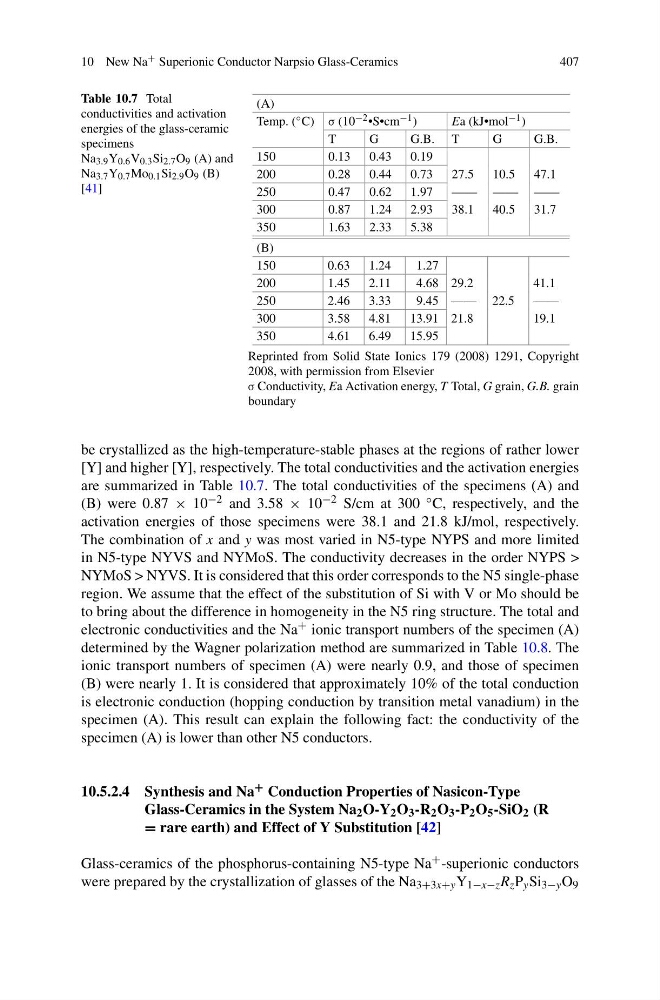
Table 10.7 Total
conductivities and activation
energies of the glass-ceramic
specimens
Na 3.9 Y 0.6 V 0.3 Si 2.7 O 9 (A) and
Na 3.7 Y 0.7 Mo 0.1 Si 2.9 O 9 (B)
[41]
(A)
Temp. ( ◦ C) σ (10 −2 •S•cm −1 )
Ea (kJ•mol −1 )
T
G
G.B. T
G
G.B.
150
0.13 0.43 0.19
200
0.28 0.44 0.73 27.5 10.5 47.1
250
0.47 0.62 1.97 —— —— ——
300
0.87 1.24 2.93 38.1 40.5 31.7
350
1.63 2.33 5.38
(B)
150
0.63 1.24
1.27
200
1.45 2.11
4.68 29.2
41.1
250
2.46 3.33
9.45 —— 22.5 ——
300
3.58 4.81 13.91 21.8
19.1
350
4.61 6.49 15.95
Reprinted from Solid State Ionics 179 (2008) 1291, Copyright
2008, with permission from Elsevier
σ Conductivity, Ea Activation energy, T Total, G grain, G.B. grain
boundary
be crystallized as the high-temperature-stable phases at the regions of rather lower
[Y] and higher [Y], respectively. The total conductivities and the activation energies
are summarized in Table 10.7. The total conductivities of the specimens (A) and
(B) were 0.87 × 10 −2 and 3.58 × 10 −2 S/cm at 300 ◦ C, respectively, and the
activation energies of those specimens were 38.1 and 21.8 kJ/mol, respectively.
The combination of x and y was most varied in N5-type NYPS and more limited
in N5-type NYVS and NYMoS. The conductivity decreases in the order NYPS >
NYMoS > NYVS. It is considered that this order corresponds to the N5 single-phase
region. We assume that the effect of the substitution of Si with V or Mo should be
to bring about the difference in homogeneity in the N5 ring structure. The total and
electronic conductivities and the Na + ionic transport numbers of the specimen (A)
determined by the Wagner polarization method are summarized in Table 10.8. The
ionic transport numbers of specimen (A) were nearly 0.9, and those of specimen
(B) were nearly 1. It is considered that approximately 10% of the total conduction
is electronic conduction (hopping conduction by transition metal vanadium) in the
specimen (A). This result can explain the following fact: the conductivity of the
specimen (A) is lower than other N5 conductors.
10.5.2.4 Synthesis and Na + Conduction Properties of Nasicon-Type
Glass-Ceramics in the System Na 2 O-Y 2 O 3 -R 2 O 3 -P 2 O 5 -SiO 2 (R
= rare earth) and Effect of Y Substitution [42]
Glass-ceramics of the phosphorus-containing N5-type Na + -superionic conductors
were prepared by the crystallization of glasses of the Na 3+3x+y Y 1−x−z R z P y Si 3−y O 9
407
Table 10.7 Total
conductivities and activation
energies of the glass-ceramic
specimens
Na 3.9 Y 0.6 V 0.3 Si 2.7 O 9 (A) and
Na 3.7 Y 0.7 Mo 0.1 Si 2.9 O 9 (B)
[41]
(A)
Temp. ( ◦ C) σ (10 −2 •S•cm −1 )
Ea (kJ•mol −1 )
T
G
G.B. T
G
G.B.
150
0.13 0.43 0.19
200
0.28 0.44 0.73 27.5 10.5 47.1
250
0.47 0.62 1.97 —— —— ——
300
0.87 1.24 2.93 38.1 40.5 31.7
350
1.63 2.33 5.38
(B)
150
0.63 1.24
1.27
200
1.45 2.11
4.68 29.2
41.1
250
2.46 3.33
9.45 —— 22.5 ——
300
3.58 4.81 13.91 21.8
19.1
350
4.61 6.49 15.95
Reprinted from Solid State Ionics 179 (2008) 1291, Copyright
2008, with permission from Elsevier
σ Conductivity, Ea Activation energy, T Total, G grain, G.B. grain
boundary
be crystallized as the high-temperature-stable phases at the regions of rather lower
[Y] and higher [Y], respectively. The total conductivities and the activation energies
are summarized in Table 10.7. The total conductivities of the specimens (A) and
(B) were 0.87 × 10 −2 and 3.58 × 10 −2 S/cm at 300 ◦ C, respectively, and the
activation energies of those specimens were 38.1 and 21.8 kJ/mol, respectively.
The combination of x and y was most varied in N5-type NYPS and more limited
in N5-type NYVS and NYMoS. The conductivity decreases in the order NYPS >
NYMoS > NYVS. It is considered that this order corresponds to the N5 single-phase
region. We assume that the effect of the substitution of Si with V or Mo should be
to bring about the difference in homogeneity in the N5 ring structure. The total and
electronic conductivities and the Na + ionic transport numbers of the specimen (A)
determined by the Wagner polarization method are summarized in Table 10.8. The
ionic transport numbers of specimen (A) were nearly 0.9, and those of specimen
(B) were nearly 1. It is considered that approximately 10% of the total conduction
is electronic conduction (hopping conduction by transition metal vanadium) in the
specimen (A). This result can explain the following fact: the conductivity of the
specimen (A) is lower than other N5 conductors.
10.5.2.4 Synthesis and Na + Conduction Properties of Nasicon-Type
Glass-Ceramics in the System Na 2 O-Y 2 O 3 -R 2 O 3 -P 2 O 5 -SiO 2 (R
= rare earth) and Effect of Y Substitution [42]
Glass-ceramics of the phosphorus-containing N5-type Na + -superionic conductors
were prepared by the crystallization of glasses of the Na 3+3x+y Y 1−x−z R z P y Si 3−y O 9