

406
T. Okura and K. Yamashita
10.5.2.3 Effect of Substitution of Si with V and Mo on Ionic Conductivity
of Na 5 YSi 4 O 12 -Type Glass-Ceramics [41]
Glass-ceramics of the vanadium- or molybdenum-containing N5-type Na + superionic conductors were prepared by crystallization of glasses with the compositions
Na 3+3x−y Y 1−x V y Si 3−y O 9 (NYVS) or Na 3+3x−2y Y 1−x Mo y Si 3−y O 9 (NYMoS) ranging in x = 0.3–0.5 and y = 0.1–0.4, and the effects of V or Mo elements on the
phase separation and the microstructural effects on the conduction properties of
glass-ceramics are discussed.
The precursor glasses were made by melting stoichiometric mixtures of reagentgrade powders of anhydrous Na 2 CO 3 , Y 2 O 3 , V 2 O 5 , MoO 3 , and SiO 2 at 1400 ◦ C
for 1 h, followed by annealing for several hours at an optimum temperature.
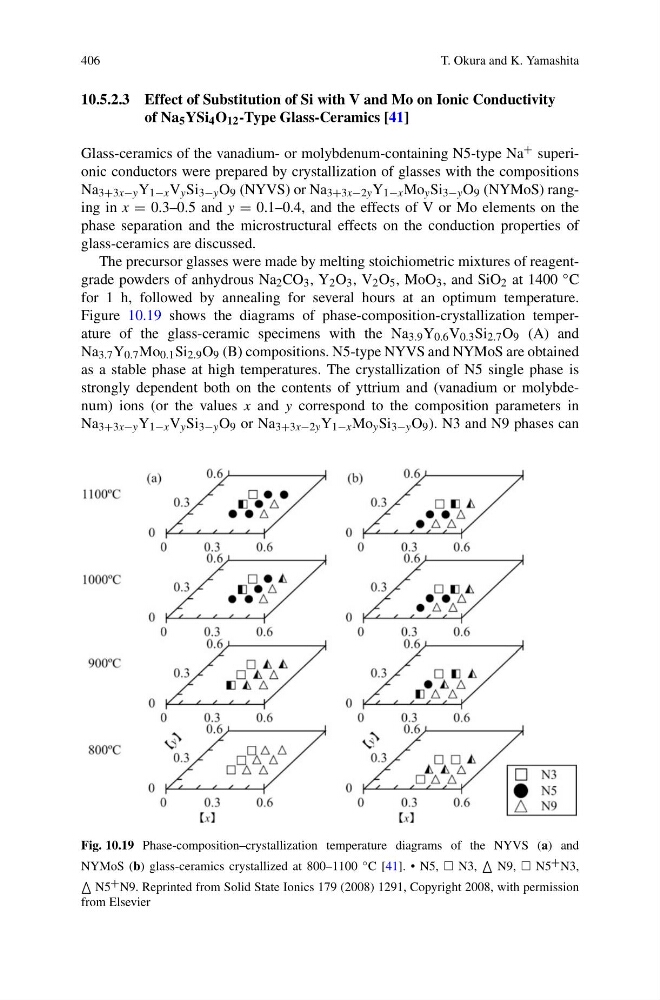
Figure 10.19 shows the diagrams of phase-composition-crystallization temperature of the glass-ceramic specimens with the Na 3.9 Y 0.6 V 0.3 Si 2.7 O 9 (A) and
Na 3.7 Y 0.7 Mo 0.1 Si 2.9 O 9 (B) compositions. N5-type NYVS and NYMoS are obtained
as a stable phase at high temperatures. The crystallization of N5 single phase is
strongly dependent both on the contents of yttrium and (vanadium or molybdenum) ions (or the values x and y correspond to the composition parameters in
Na 3+3x−y Y 1−x V y Si 3−y O 9 or Na 3+3x−2y Y 1−x Mo y Si 3−y O 9 ). N3 and N9 phases can
Fig. 10.19 Phase-composition–crystallization temperature diagrams of the NYVS (a) and
NYMoS (b) glass-ceramics crystallized at 800–1100 ◦ C [41]. • N5, N3,
N9, N5 + N3,
N5 + N9. Reprinted from Solid State Ionics 179 (2008) 1291, Copyright 2008, with permission
from Elsevier
T. Okura and K. Yamashita
10.5.2.3 Effect of Substitution of Si with V and Mo on Ionic Conductivity
of Na 5 YSi 4 O 12 -Type Glass-Ceramics [41]
Glass-ceramics of the vanadium- or molybdenum-containing N5-type Na + superionic conductors were prepared by crystallization of glasses with the compositions
Na 3+3x−y Y 1−x V y Si 3−y O 9 (NYVS) or Na 3+3x−2y Y 1−x Mo y Si 3−y O 9 (NYMoS) ranging in x = 0.3–0.5 and y = 0.1–0.4, and the effects of V or Mo elements on the
phase separation and the microstructural effects on the conduction properties of
glass-ceramics are discussed.
The precursor glasses were made by melting stoichiometric mixtures of reagentgrade powders of anhydrous Na 2 CO 3 , Y 2 O 3 , V 2 O 5 , MoO 3 , and SiO 2 at 1400 ◦ C
for 1 h, followed by annealing for several hours at an optimum temperature.
Figure 10.19 shows the diagrams of phase-composition-crystallization temperature of the glass-ceramic specimens with the Na 3.9 Y 0.6 V 0.3 Si 2.7 O 9 (A) and
Na 3.7 Y 0.7 Mo 0.1 Si 2.9 O 9 (B) compositions. N5-type NYVS and NYMoS are obtained
as a stable phase at high temperatures. The crystallization of N5 single phase is
strongly dependent both on the contents of yttrium and (vanadium or molybdenum) ions (or the values x and y correspond to the composition parameters in
Na 3+3x−y Y 1−x V y Si 3−y O 9 or Na 3+3x−2y Y 1−x Mo y Si 3−y O 9 ). N3 and N9 phases can
Fig. 10.19 Phase-composition–crystallization temperature diagrams of the NYVS (a) and
NYMoS (b) glass-ceramics crystallized at 800–1100 ◦ C [41]. • N5, N3,
N9, N5 + N3,
N5 + N9. Reprinted from Solid State Ionics 179 (2008) 1291, Copyright 2008, with permission
from Elsevier