

404
T. Okura and K. Yamashita
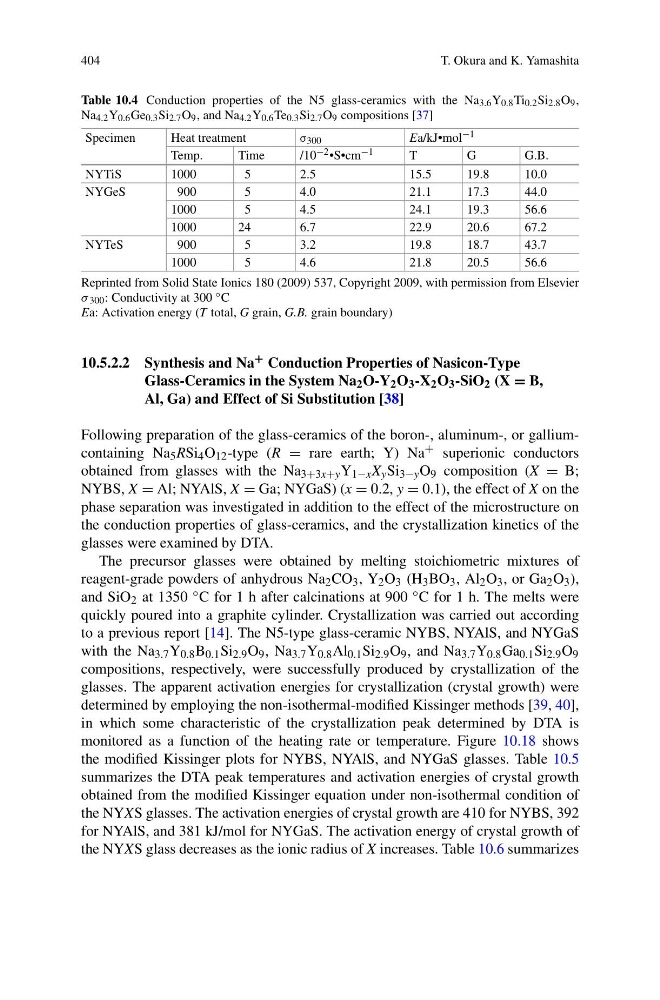
Table 10.4 Conduction properties of the N5 glass-ceramics with the Na 3.6 Y 0.8 Ti 0.2 Si 2.8 O 9 ,
Na 4.2 Y 0.6 Ge 0.3 Si 2.7 O 9 , and Na 4.2 Y 0.6 Te 0.3 Si 2.7 O 9 compositions [37]
Specimen
Heat treatment
σ 300
Ea/kJ•mol −1
Temp.
Time
/10 −2 •S•cm −1
T
G
G.B.
NYTiS
1000
5
2.5
15.5
19.8
10.0
NYGeS
900
5
4.0
21.1
17.3
44.0
1000
5
4.5
24.1
19.3
56.6
1000
24
6.7
22.9
20.6
67.2
NYTeS
900
5
3.2
19.8
18.7
43.7
1000
5
4.6
21.8
20.5
56.6
Reprinted from Solid State Ionics 180 (2009) 537, Copyright 2009, with permission from Elsevier
σ 300 : Conductivity at 300 ◦ C
Ea: Activation energy (T total, G grain, G.B. grain boundary)
10.5.2.2 Synthesis and Na + Conduction Properties of Nasicon-Type
Glass-Ceramics in the System Na 2 O-Y 2 O 3 -X 2 O 3 -SiO 2 (X = B,
Al, Ga) and Effect of Si Substitution [38]
Following preparation of the glass-ceramics of the boron-, aluminum-, or galliumcontaining Na 5 RSi 4 O 12 -type (R = rare earth; Y) Na + superionic conductors
obtained from glasses with the Na 3+3x+y Y 1−x X y Si 3−y O 9 composition (X = B;
NYBS, X = Al; NYAlS, X = Ga; NYGaS) (x = 0.2, y = 0.1), the effect of X on the
phase separation was investigated in addition to the effect of the microstructure on
the conduction properties of glass-ceramics, and the crystallization kinetics of the
glasses were examined by DTA.
The precursor glasses were obtained by melting stoichiometric mixtures of
reagent-grade powders of anhydrous Na 2 CO 3 , Y 2 O 3 (H 3 BO 3 , Al 2 O 3 , or Ga 2 O 3 ),
and SiO 2 at 1350 ◦ C for 1 h after calcinations at 900 ◦ C for 1 h. The melts were
quickly poured into a graphite cylinder. Crystallization was carried out according
to a previous report [14]. The N5-type glass-ceramic NYBS, NYAlS, and NYGaS
with the Na 3.7 Y 0.8 B 0.1 Si 2.9 O 9 , Na 3.7 Y 0.8 Al 0.1 Si 2.9 O 9 , and Na 3.7 Y 0.8 Ga 0.1 Si 2.9 O 9
compositions, respectively, were successfully produced by crystallization of the
glasses. The apparent activation energies for crystallization (crystal growth) were
determined by employing the non-isothermal-modified Kissinger methods [39, 40],
in which some characteristic of the crystallization peak determined by DTA is
monitored as a function of the heating rate or temperature. Figure 10.18 shows
the modified Kissinger plots for NYBS, NYAlS, and NYGaS glasses. Table 10.5
summarizes the DTA peak temperatures and activation energies of crystal growth
obtained from the modified Kissinger equation under non-isothermal condition of
the NYXS glasses. The activation energies of crystal growth are 410 for NYBS, 392
for NYAlS, and 381 kJ/mol for NYGaS. The activation energy of crystal growth of
the NYXS glass decreases as the ionic radius of X increases. Table 10.6 summarizes
T. Okura and K. Yamashita
Table 10.4 Conduction properties of the N5 glass-ceramics with the Na 3.6 Y 0.8 Ti 0.2 Si 2.8 O 9 ,
Na 4.2 Y 0.6 Ge 0.3 Si 2.7 O 9 , and Na 4.2 Y 0.6 Te 0.3 Si 2.7 O 9 compositions [37]
Specimen
Heat treatment
σ 300
Ea/kJ•mol −1
Temp.
Time
/10 −2 •S•cm −1
T
G
G.B.
NYTiS
1000
5
2.5
15.5
19.8
10.0
NYGeS
900
5
4.0
21.1
17.3
44.0
1000
5
4.5
24.1
19.3
56.6
1000
24
6.7
22.9
20.6
67.2
NYTeS
900
5
3.2
19.8
18.7
43.7
1000
5
4.6
21.8
20.5
56.6
Reprinted from Solid State Ionics 180 (2009) 537, Copyright 2009, with permission from Elsevier
σ 300 : Conductivity at 300 ◦ C
Ea: Activation energy (T total, G grain, G.B. grain boundary)
10.5.2.2 Synthesis and Na + Conduction Properties of Nasicon-Type
Glass-Ceramics in the System Na 2 O-Y 2 O 3 -X 2 O 3 -SiO 2 (X = B,
Al, Ga) and Effect of Si Substitution [38]
Following preparation of the glass-ceramics of the boron-, aluminum-, or galliumcontaining Na 5 RSi 4 O 12 -type (R = rare earth; Y) Na + superionic conductors
obtained from glasses with the Na 3+3x+y Y 1−x X y Si 3−y O 9 composition (X = B;
NYBS, X = Al; NYAlS, X = Ga; NYGaS) (x = 0.2, y = 0.1), the effect of X on the
phase separation was investigated in addition to the effect of the microstructure on
the conduction properties of glass-ceramics, and the crystallization kinetics of the
glasses were examined by DTA.
The precursor glasses were obtained by melting stoichiometric mixtures of
reagent-grade powders of anhydrous Na 2 CO 3 , Y 2 O 3 (H 3 BO 3 , Al 2 O 3 , or Ga 2 O 3 ),
and SiO 2 at 1350 ◦ C for 1 h after calcinations at 900 ◦ C for 1 h. The melts were
quickly poured into a graphite cylinder. Crystallization was carried out according
to a previous report [14]. The N5-type glass-ceramic NYBS, NYAlS, and NYGaS
with the Na 3.7 Y 0.8 B 0.1 Si 2.9 O 9 , Na 3.7 Y 0.8 Al 0.1 Si 2.9 O 9 , and Na 3.7 Y 0.8 Ga 0.1 Si 2.9 O 9
compositions, respectively, were successfully produced by crystallization of the
glasses. The apparent activation energies for crystallization (crystal growth) were
determined by employing the non-isothermal-modified Kissinger methods [39, 40],
in which some characteristic of the crystallization peak determined by DTA is
monitored as a function of the heating rate or temperature. Figure 10.18 shows
the modified Kissinger plots for NYBS, NYAlS, and NYGaS glasses. Table 10.5
summarizes the DTA peak temperatures and activation energies of crystal growth
obtained from the modified Kissinger equation under non-isothermal condition of
the NYXS glasses. The activation energies of crystal growth are 410 for NYBS, 392
for NYAlS, and 381 kJ/mol for NYGaS. The activation energy of crystal growth of
the NYXS glass decreases as the ionic radius of X increases. Table 10.6 summarizes