

402
T. Okura and K. Yamashita
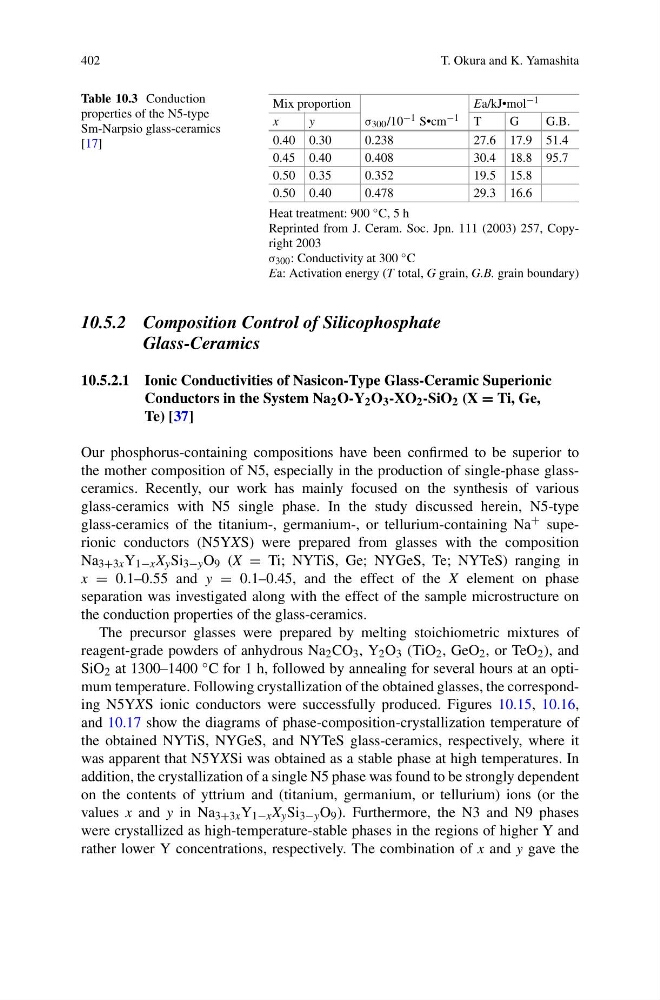
Table 10.3 Conduction
properties of the N5-type
Sm-Narpsio glass-ceramics
[17]
Mix proportion
Ea/kJ•mol −1
x
y
σ 300 /10 −1 S•cm −1 T
G
G.B.
0.40 0.30
0.238
27.6 17.9 51.4
0.45 0.40
0.408
30.4 18.8 95.7
0.50 0.35
0.352
19.5 15.8
0.50 0.40
0.478
29.3 16.6
Heat treatment: 900 ◦ C, 5 h
Reprinted from J. Ceram. Soc. Jpn. 111 (2003) 257, Copyright 2003
σ 300 : Conductivity at 300 ◦ C
Ea: Activation energy (T total, G grain, G.B. grain boundary)
10.5.2 Composition Control of Silicophosphate
Glass-Ceramics
10.5.2.1 Ionic Conductivities of Nasicon-Type Glass-Ceramic Superionic
Conductors in the System Na 2 O-Y 2 O 3 -XO 2 -SiO 2 (X = Ti, Ge,
Te) [37]
Our phosphorus-containing compositions have been confirmed to be superior to
the mother composition of N5, especially in the production of single-phase glassceramics. Recently, our work has mainly focused on the synthesis of various
glass-ceramics with N5 single phase. In the study discussed herein, N5-type
glass-ceramics of the titanium-, germanium-, or tellurium-containing Na + superionic conductors (N5YXS) were prepared from glasses with the composition
Na 3+3x Y 1−x X y Si 3−y O 9 (X = Ti; NYTiS, Ge; NYGeS, Te; NYTeS) ranging in
x = 0.1–0.55 and y = 0.1–0.45, and the effect of the X element on phase
separation was investigated along with the effect of the sample microstructure on
the conduction properties of the glass-ceramics.
The precursor glasses were prepared by melting stoichiometric mixtures of
reagent-grade powders of anhydrous Na 2 CO 3 , Y 2 O 3 (TiO 2 , GeO 2 , or TeO 2 ), and
SiO 2 at 1300–1400 ◦ C for 1 h, followed by annealing for several hours at an optimum temperature. Following crystallization of the obtained glasses, the corresponding N5YXS ionic conductors were successfully produced. Figures 10.15, 10.16,
and 10.17 show the diagrams of phase-composition-crystallization temperature of
the obtained NYTiS, NYGeS, and NYTeS glass-ceramics, respectively, where it
was apparent that N5YXSi was obtained as a stable phase at high temperatures. In
addition, the crystallization of a single N5 phase was found to be strongly dependent
on the contents of yttrium and (titanium, germanium, or tellurium) ions (or the
values x and y in Na 3+3x Y 1−x X y Si 3−y O 9 ). Furthermore, the N3 and N9 phases
were crystallized as high-temperature-stable phases in the regions of higher Y and
rather lower Y concentrations, respectively. The combination of x and y gave the
T. Okura and K. Yamashita
Table 10.3 Conduction
properties of the N5-type
Sm-Narpsio glass-ceramics
[17]
Mix proportion
Ea/kJ•mol −1
x
y
σ 300 /10 −1 S•cm −1 T
G
G.B.
0.40 0.30
0.238
27.6 17.9 51.4
0.45 0.40
0.408
30.4 18.8 95.7
0.50 0.35
0.352
19.5 15.8
0.50 0.40
0.478
29.3 16.6
Heat treatment: 900 ◦ C, 5 h
Reprinted from J. Ceram. Soc. Jpn. 111 (2003) 257, Copyright 2003
σ 300 : Conductivity at 300 ◦ C
Ea: Activation energy (T total, G grain, G.B. grain boundary)
10.5.2 Composition Control of Silicophosphate
Glass-Ceramics
10.5.2.1 Ionic Conductivities of Nasicon-Type Glass-Ceramic Superionic
Conductors in the System Na 2 O-Y 2 O 3 -XO 2 -SiO 2 (X = Ti, Ge,
Te) [37]
Our phosphorus-containing compositions have been confirmed to be superior to
the mother composition of N5, especially in the production of single-phase glassceramics. Recently, our work has mainly focused on the synthesis of various
glass-ceramics with N5 single phase. In the study discussed herein, N5-type
glass-ceramics of the titanium-, germanium-, or tellurium-containing Na + superionic conductors (N5YXS) were prepared from glasses with the composition
Na 3+3x Y 1−x X y Si 3−y O 9 (X = Ti; NYTiS, Ge; NYGeS, Te; NYTeS) ranging in
x = 0.1–0.55 and y = 0.1–0.45, and the effect of the X element on phase
separation was investigated along with the effect of the sample microstructure on
the conduction properties of the glass-ceramics.
The precursor glasses were prepared by melting stoichiometric mixtures of
reagent-grade powders of anhydrous Na 2 CO 3 , Y 2 O 3 (TiO 2 , GeO 2 , or TeO 2 ), and
SiO 2 at 1300–1400 ◦ C for 1 h, followed by annealing for several hours at an optimum temperature. Following crystallization of the obtained glasses, the corresponding N5YXS ionic conductors were successfully produced. Figures 10.15, 10.16,
and 10.17 show the diagrams of phase-composition-crystallization temperature of
the obtained NYTiS, NYGeS, and NYTeS glass-ceramics, respectively, where it
was apparent that N5YXSi was obtained as a stable phase at high temperatures. In
addition, the crystallization of a single N5 phase was found to be strongly dependent
on the contents of yttrium and (titanium, germanium, or tellurium) ions (or the
values x and y in Na 3+3x Y 1−x X y Si 3−y O 9 ). Furthermore, the N3 and N9 phases
were crystallized as high-temperature-stable phases in the regions of higher Y and
rather lower Y concentrations, respectively. The combination of x and y gave the