

400
T. Okura and K. Yamashita
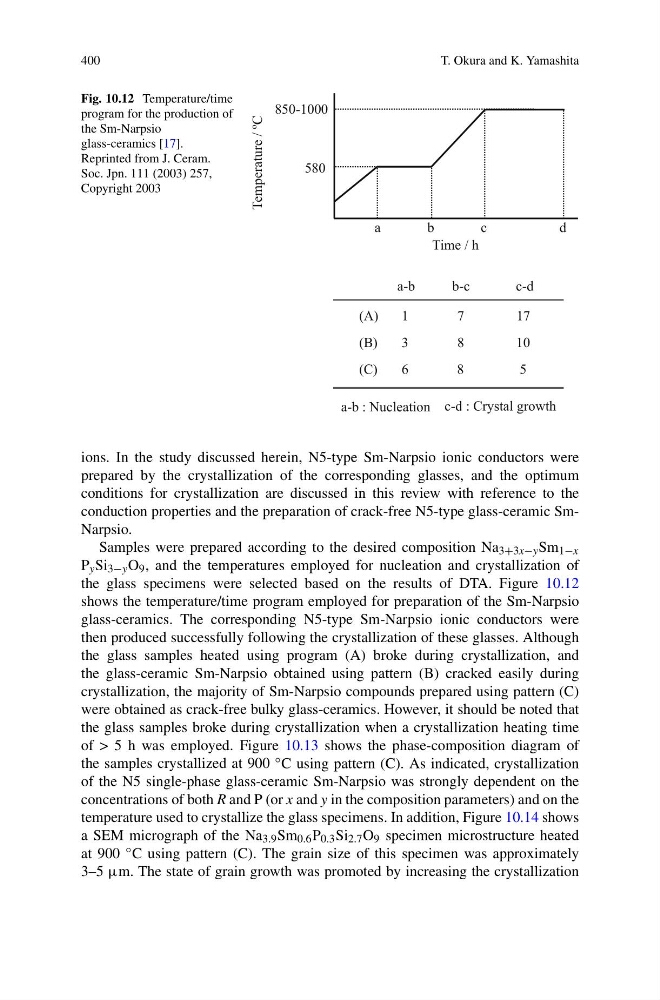
Fig. 10.12 Temperature/time
program for the production of
the Sm-Narpsio
glass-ceramics [17].
Reprinted from J. Ceram.
Soc. Jpn. 111 (2003) 257,
Copyright 2003
a
d
c
b
580
850-1000
Temperature / ºC
Time / h
(A)
1
7
17
(B)
3
8
10
(C)
6
8
5
a-b
b-c
c-d
a-b : Nucleation c-d : Crystal growth
ions. In the study discussed herein, N5-type Sm-Narpsio ionic conductors were
prepared by the crystallization of the corresponding glasses, and the optimum
conditions for crystallization are discussed in this review with reference to the
conduction properties and the preparation of crack-free N5-type glass-ceramic SmNarpsio.
Samples were prepared according to the desired composition Na 3+3x−y Sm 1−x
P y Si 3−y O 9 , and the temperatures employed for nucleation and crystallization of
the glass specimens were selected based on the results of DTA. Figure 10.12
shows the temperature/time program employed for preparation of the Sm-Narpsio
glass-ceramics. The corresponding N5-type Sm-Narpsio ionic conductors were
then produced successfully following the crystallization of these glasses. Although
the glass samples heated using program (A) broke during crystallization, and
the glass-ceramic Sm-Narpsio obtained using pattern (B) cracked easily during
crystallization, the majority of Sm-Narpsio compounds prepared using pattern (C)
were obtained as crack-free bulky glass-ceramics. However, it should be noted that
the glass samples broke during crystallization when a crystallization heating time
of > 5 h was employed. Figure 10.13 shows the phase-composition diagram of
the samples crystallized at 900 ◦ C using pattern (C). As indicated, crystallization
of the N5 single-phase glass-ceramic Sm-Narpsio was strongly dependent on the
concentrations of both R and P (or x and y in the composition parameters) and on the
temperature used to crystallize the glass specimens. In addition, Figure 10.14 shows
a SEM micrograph of the Na 3.9 Sm 0.6 P 0.3 Si 2.7 O 9 specimen microstructure heated
at 900 ◦ C using pattern (C). The grain size of this specimen was approximately
3–5 μm. The state of grain growth was promoted by increasing the crystallization
T. Okura and K. Yamashita
Fig. 10.12 Temperature/time
program for the production of
the Sm-Narpsio
glass-ceramics [17].
Reprinted from J. Ceram.
Soc. Jpn. 111 (2003) 257,
Copyright 2003
a
d
c
b
580
850-1000
Temperature / ºC
Time / h
(A)
1
7
17
(B)
3
8
10
(C)
6
8
5
a-b
b-c
c-d
a-b : Nucleation c-d : Crystal growth
ions. In the study discussed herein, N5-type Sm-Narpsio ionic conductors were
prepared by the crystallization of the corresponding glasses, and the optimum
conditions for crystallization are discussed in this review with reference to the
conduction properties and the preparation of crack-free N5-type glass-ceramic SmNarpsio.
Samples were prepared according to the desired composition Na 3+3x−y Sm 1−x
P y Si 3−y O 9 , and the temperatures employed for nucleation and crystallization of
the glass specimens were selected based on the results of DTA. Figure 10.12
shows the temperature/time program employed for preparation of the Sm-Narpsio
glass-ceramics. The corresponding N5-type Sm-Narpsio ionic conductors were
then produced successfully following the crystallization of these glasses. Although
the glass samples heated using program (A) broke during crystallization, and
the glass-ceramic Sm-Narpsio obtained using pattern (B) cracked easily during
crystallization, the majority of Sm-Narpsio compounds prepared using pattern (C)
were obtained as crack-free bulky glass-ceramics. However, it should be noted that
the glass samples broke during crystallization when a crystallization heating time
of > 5 h was employed. Figure 10.13 shows the phase-composition diagram of
the samples crystallized at 900 ◦ C using pattern (C). As indicated, crystallization
of the N5 single-phase glass-ceramic Sm-Narpsio was strongly dependent on the
concentrations of both R and P (or x and y in the composition parameters) and on the
temperature used to crystallize the glass specimens. In addition, Figure 10.14 shows
a SEM micrograph of the Na 3.9 Sm 0.6 P 0.3 Si 2.7 O 9 specimen microstructure heated
at 900 ◦ C using pattern (C). The grain size of this specimen was approximately
3–5 μm. The state of grain growth was promoted by increasing the crystallization