

10 New Na + Superionic Conductor Narpsio Glass-Ceramics
399
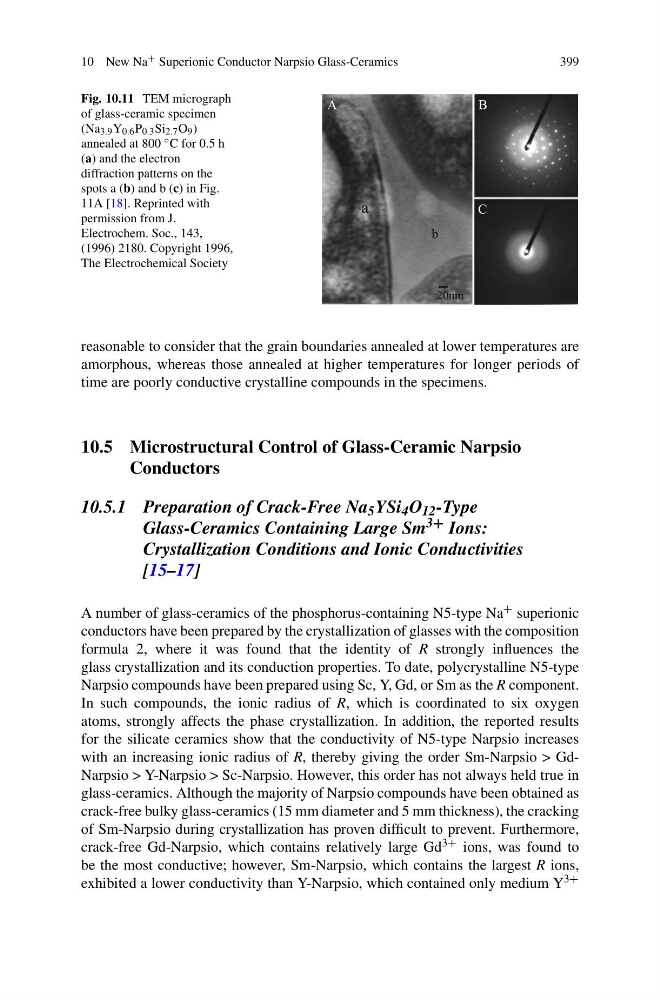
Fig. 10.11 TEM micrograph
of glass-ceramic specimen
(Na 3.9 Y 0.6 P 0.3 Si 2.7 O 9 )
annealed at 800 ◦ C for 0.5 h
(a) and the electron
diffraction patterns on the
spots a (b) and b (c) in Fig.
11A [18]. Reprinted with
permission from J.
Electrochem. Soc., 143,
(1996) 2180. Copyright 1996,
The Electrochemical Society
A
B
C
a
b
20nm
reasonable to consider that the grain boundaries annealed at lower temperatures are
amorphous, whereas those annealed at higher temperatures for longer periods of
time are poorly conductive crystalline compounds in the specimens.
10.5 Microstructural Control of Glass-Ceramic Narpsio
Conductors
10.5.1 Preparation of Crack-Free Na 5 YSi 4 O 12 -Type
Glass-Ceramics Containing Large Sm 3+ Ions:
Crystallization Conditions and Ionic Conductivities
[15–17]
A number of glass-ceramics of the phosphorus-containing N5-type Na + superionic
conductors have been prepared by the crystallization of glasses with the composition
formula 2, where it was found that the identity of R strongly influences the
glass crystallization and its conduction properties. To date, polycrystalline N5-type
Narpsio compounds have been prepared using Sc, Y, Gd, or Sm as the R component.
In such compounds, the ionic radius of R, which is coordinated to six oxygen
atoms, strongly affects the phase crystallization. In addition, the reported results
for the silicate ceramics show that the conductivity of N5-type Narpsio increases
with an increasing ionic radius of R, thereby giving the order Sm-Narpsio > GdNarpsio > Y-Narpsio > Sc-Narpsio. However, this order has not always held true in
glass-ceramics. Although the majority of Narpsio compounds have been obtained as
crack-free bulky glass-ceramics (15 mm diameter and 5 mm thickness), the cracking
of Sm-Narpsio during crystallization has proven difficult to prevent. Furthermore,
crack-free Gd-Narpsio, which contains relatively large Gd 3+ ions, was found to
be the most conductive; however, Sm-Narpsio, which contains the largest R ions,
exhibited a lower conductivity than Y-Narpsio, which contained only medium Y 3+
399
Fig. 10.11 TEM micrograph
of glass-ceramic specimen
(Na 3.9 Y 0.6 P 0.3 Si 2.7 O 9 )
annealed at 800 ◦ C for 0.5 h
(a) and the electron
diffraction patterns on the
spots a (b) and b (c) in Fig.
11A [18]. Reprinted with
permission from J.
Electrochem. Soc., 143,
(1996) 2180. Copyright 1996,
The Electrochemical Society
A
B
C
a
b
20nm
reasonable to consider that the grain boundaries annealed at lower temperatures are
amorphous, whereas those annealed at higher temperatures for longer periods of
time are poorly conductive crystalline compounds in the specimens.
10.5 Microstructural Control of Glass-Ceramic Narpsio
Conductors
10.5.1 Preparation of Crack-Free Na 5 YSi 4 O 12 -Type
Glass-Ceramics Containing Large Sm 3+ Ions:
Crystallization Conditions and Ionic Conductivities
[15–17]
A number of glass-ceramics of the phosphorus-containing N5-type Na + superionic
conductors have been prepared by the crystallization of glasses with the composition
formula 2, where it was found that the identity of R strongly influences the
glass crystallization and its conduction properties. To date, polycrystalline N5-type
Narpsio compounds have been prepared using Sc, Y, Gd, or Sm as the R component.
In such compounds, the ionic radius of R, which is coordinated to six oxygen
atoms, strongly affects the phase crystallization. In addition, the reported results
for the silicate ceramics show that the conductivity of N5-type Narpsio increases
with an increasing ionic radius of R, thereby giving the order Sm-Narpsio > GdNarpsio > Y-Narpsio > Sc-Narpsio. However, this order has not always held true in
glass-ceramics. Although the majority of Narpsio compounds have been obtained as
crack-free bulky glass-ceramics (15 mm diameter and 5 mm thickness), the cracking
of Sm-Narpsio during crystallization has proven difficult to prevent. Furthermore,
crack-free Gd-Narpsio, which contains relatively large Gd 3+ ions, was found to
be the most conductive; however, Sm-Narpsio, which contains the largest R ions,
exhibited a lower conductivity than Y-Narpsio, which contained only medium Y 3+