

394
T. Okura and K. Yamashita
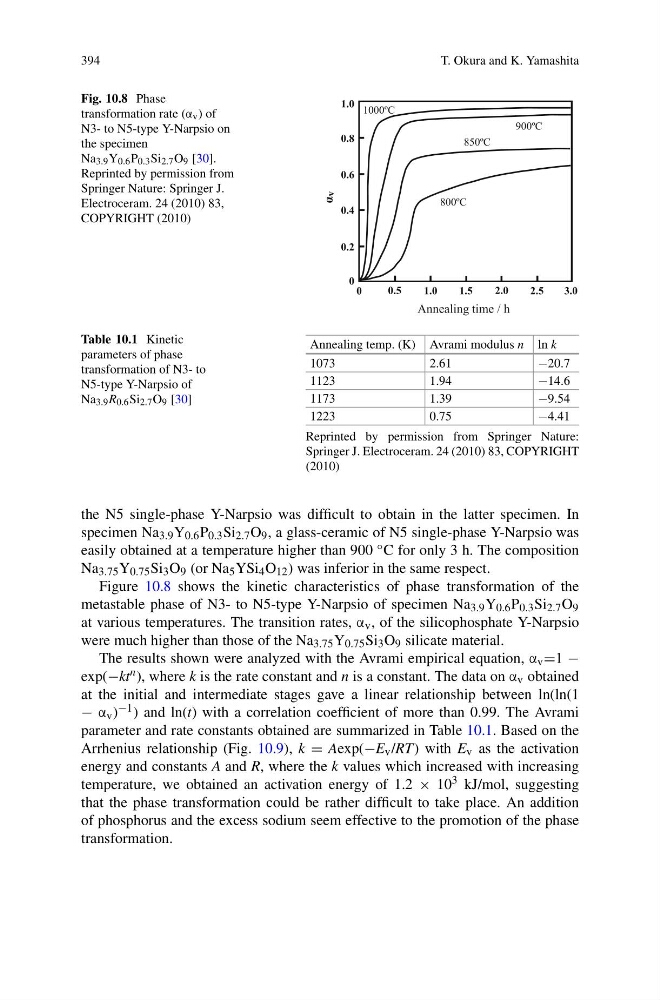
Fig. 10.8 Phase
transformation rate (α v ) of
N3- to N5-type Y-Narpsio on
the specimen
Na 3.9 Y 0.6 P 0.3 Si 2.7 O 9 [30].
Reprinted by permission from
Springer Nature: Springer J.
Electroceram. 24 (2010) 83,
COPYRIGHT (2010)
Annealing time / h
0
0.5
1.0
1.5
2.0
2.5
1.0
0.8
0.6
0.4
0.2
0
αv
800ºC
850ºC
900ºC
1000ºC
3.0
Table 10.1 Kinetic
parameters of phase
transformation of N3- to
N5-type Y-Narpsio of
Na 3.9 R 0.6 Si 2.7 O 9 [30]
Annealing temp. (K) Avrami modulus n ln k
1073
2.61
−20.7
1123
1.94
−14.6
1173
1.39
−9.54
1223
0.75
−4.41
Reprinted by permission from Springer Nature:
Springer J. Electroceram. 24 (2010) 83, COPYRIGHT
(2010)
the N5 single-phase Y-Narpsio was difficult to obtain in the latter specimen. In
specimen Na 3.9 Y 0.6 P 0.3 Si 2.7 O 9 , a glass-ceramic of N5 single-phase Y-Narpsio was
easily obtained at a temperature higher than 900 ◦ C for only 3 h. The composition
Na 3.75 Y 0.75 Si 3 O 9 (or Na 5 YSi 4 O 12 ) was inferior in the same respect.
Figure 10.8 shows the kinetic characteristics of phase transformation of the
metastable phase of N3- to N5-type Y-Narpsio of specimen Na 3.9 Y 0.6 P 0.3 Si 2.7 O 9
at various temperatures. The transition rates, α v , of the silicophosphate Y-Narpsio
were much higher than those of the Na 3.75 Y 0.75 Si 3 O 9 silicate material.
The results shown were analyzed with the Avrami empirical equation, α v =1 −
exp(−kt n ), where k is the rate constant and n is a constant. The data on α v obtained
at the initial and intermediate stages gave a linear relationship between ln(ln(1
− α v ) −1 ) and ln(t) with a correlation coefficient of more than 0.99. The Avrami
parameter and rate constants obtained are summarized in Table 10.1. Based on the
Arrhenius relationship (Fig. 10.9), k = Aexp(−E v /RT) with E v as the activation
energy and constants A and R, where the k values which increased with increasing
temperature, we obtained an activation energy of 1.2 × 10 3 kJ/mol, suggesting
that the phase transformation could be rather difficult to take place. An addition
of phosphorus and the excess sodium seem effective to the promotion of the phase
transformation.
T. Okura and K. Yamashita
Fig. 10.8 Phase
transformation rate (α v ) of
N3- to N5-type Y-Narpsio on
the specimen
Na 3.9 Y 0.6 P 0.3 Si 2.7 O 9 [30].
Reprinted by permission from
Springer Nature: Springer J.
Electroceram. 24 (2010) 83,
COPYRIGHT (2010)
Annealing time / h
0
0.5
1.0
1.5
2.0
2.5
1.0
0.8
0.6
0.4
0.2
0
αv
800ºC
850ºC
900ºC
1000ºC
3.0
Table 10.1 Kinetic
parameters of phase
transformation of N3- to
N5-type Y-Narpsio of
Na 3.9 R 0.6 Si 2.7 O 9 [30]
Annealing temp. (K) Avrami modulus n ln k
1073
2.61
−20.7
1123
1.94
−14.6
1173
1.39
−9.54
1223
0.75
−4.41
Reprinted by permission from Springer Nature:
Springer J. Electroceram. 24 (2010) 83, COPYRIGHT
(2010)
the N5 single-phase Y-Narpsio was difficult to obtain in the latter specimen. In
specimen Na 3.9 Y 0.6 P 0.3 Si 2.7 O 9 , a glass-ceramic of N5 single-phase Y-Narpsio was
easily obtained at a temperature higher than 900 ◦ C for only 3 h. The composition
Na 3.75 Y 0.75 Si 3 O 9 (or Na 5 YSi 4 O 12 ) was inferior in the same respect.
Figure 10.8 shows the kinetic characteristics of phase transformation of the
metastable phase of N3- to N5-type Y-Narpsio of specimen Na 3.9 Y 0.6 P 0.3 Si 2.7 O 9
at various temperatures. The transition rates, α v , of the silicophosphate Y-Narpsio
were much higher than those of the Na 3.75 Y 0.75 Si 3 O 9 silicate material.
The results shown were analyzed with the Avrami empirical equation, α v =1 −
exp(−kt n ), where k is the rate constant and n is a constant. The data on α v obtained
at the initial and intermediate stages gave a linear relationship between ln(ln(1
− α v ) −1 ) and ln(t) with a correlation coefficient of more than 0.99. The Avrami
parameter and rate constants obtained are summarized in Table 10.1. Based on the
Arrhenius relationship (Fig. 10.9), k = Aexp(−E v /RT) with E v as the activation
energy and constants A and R, where the k values which increased with increasing
temperature, we obtained an activation energy of 1.2 × 10 3 kJ/mol, suggesting
that the phase transformation could be rather difficult to take place. An addition
of phosphorus and the excess sodium seem effective to the promotion of the phase
transformation.