

10 New Na + Superionic Conductor Narpsio Glass-Ceramics
395
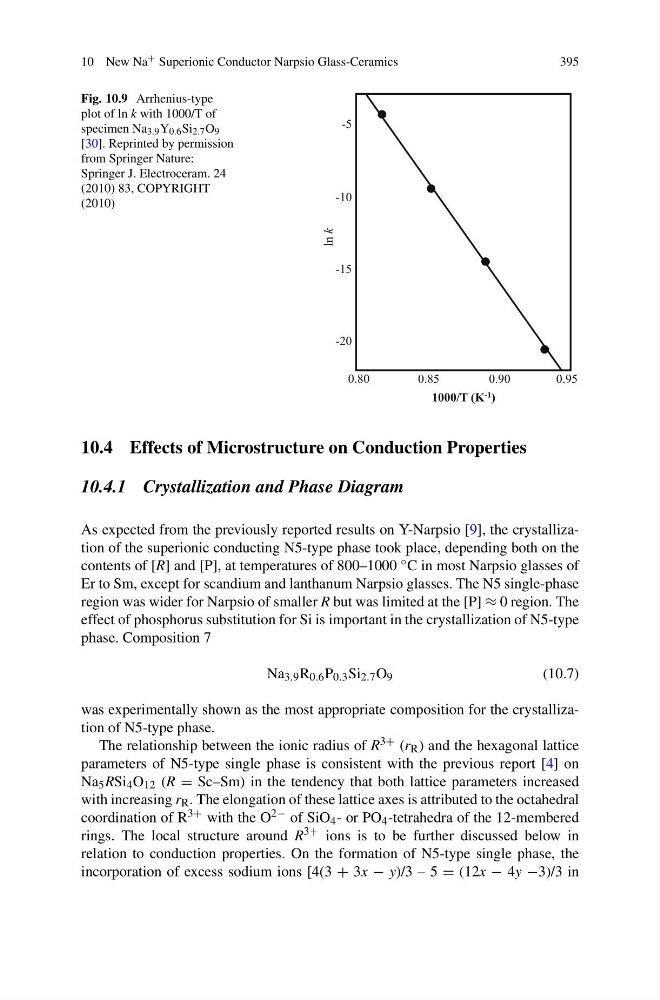
Fig. 10.9 Arrhenius-type
plot of ln k with 1000/T of
specimen Na 3.9 Y 0.6 Si 2.7 O 9
[30]. Reprinted by permission
from Springer Nature:
Springer J. Electroceram. 24
(2010) 83, COPYRIGHT
(2010)
1000/T (K -1 )
0.80
0.85
0.95
0.90
ln k
-20
-15
-10
-5
䖃
䖃
䖃
䖃
10.4 Effects of Microstructure on Conduction Properties
10.4.1 Crystallization and Phase Diagram
As expected from the previously reported results on Y-Narpsio [9], the crystallization of the superionic conducting N5-type phase took place, depending both on the
contents of [R] and [P], at temperatures of 800–1000 ◦ C in most Narpsio glasses of
Er to Sm, except for scandium and lanthanum Narpsio glasses. The N5 single-phase
region was wider for Narpsio of smaller R but was limited at the [P] ≈ 0 region. The
effect of phosphorus substitution for Si is important in the crystallization of N5-type
phase. Composition 7
Na 3.9 R 0.6 P 0.3 Si 2.7 O 9
(10.7)
was experimentally shown as the most appropriate composition for the crystallization of N5-type phase.
The relationship between the ionic radius of R 3+ (r R ) and the hexagonal lattice
parameters of N5-type single phase is consistent with the previous report [4] on
Na 5 RSi 4 O 12 (R = Sc–Sm) in the tendency that both lattice parameters increased
with increasing r R . The elongation of these lattice axes is attributed to the octahedral
coordination of R 3+ with the O 2− of SiO 4 - or PO 4 -tetrahedra of the 12-membered
rings. The local structure around R 3+ ions is to be further discussed below in
relation to conduction properties. On the formation of N5-type single phase, the
incorporation of excess sodium ions [4(3 + 3x − y)/3 – 5 = (12x − 4y −3)/3 in
395
Fig. 10.9 Arrhenius-type
plot of ln k with 1000/T of
specimen Na 3.9 Y 0.6 Si 2.7 O 9
[30]. Reprinted by permission
from Springer Nature:
Springer J. Electroceram. 24
(2010) 83, COPYRIGHT
(2010)
1000/T (K -1 )
0.80
0.85
0.95
0.90
ln k
-20
-15
-10
-5
䖃
䖃
䖃
䖃
10.4 Effects of Microstructure on Conduction Properties
10.4.1 Crystallization and Phase Diagram
As expected from the previously reported results on Y-Narpsio [9], the crystallization of the superionic conducting N5-type phase took place, depending both on the
contents of [R] and [P], at temperatures of 800–1000 ◦ C in most Narpsio glasses of
Er to Sm, except for scandium and lanthanum Narpsio glasses. The N5 single-phase
region was wider for Narpsio of smaller R but was limited at the [P] ≈ 0 region. The
effect of phosphorus substitution for Si is important in the crystallization of N5-type
phase. Composition 7
Na 3.9 R 0.6 P 0.3 Si 2.7 O 9
(10.7)
was experimentally shown as the most appropriate composition for the crystallization of N5-type phase.
The relationship between the ionic radius of R 3+ (r R ) and the hexagonal lattice
parameters of N5-type single phase is consistent with the previous report [4] on
Na 5 RSi 4 O 12 (R = Sc–Sm) in the tendency that both lattice parameters increased
with increasing r R . The elongation of these lattice axes is attributed to the octahedral
coordination of R 3+ with the O 2− of SiO 4 - or PO 4 -tetrahedra of the 12-membered
rings. The local structure around R 3+ ions is to be further discussed below in
relation to conduction properties. On the formation of N5-type single phase, the
incorporation of excess sodium ions [4(3 + 3x − y)/3 – 5 = (12x − 4y −3)/3 in