

10 New Na + Superionic Conductor Narpsio Glass-Ceramics
391
0 0.1 0.2 0.3 0.4 0.5 0.6
0.3
0.4
0.5
0.6
0.7
0.8
0.9
3.2
4.2
4.0
3.8
3.6
3.4
4.4
4.6
Y
P
Na
P
Y
Na
(a)
(c)
(b)
P-Na
P-Y
Y-Na
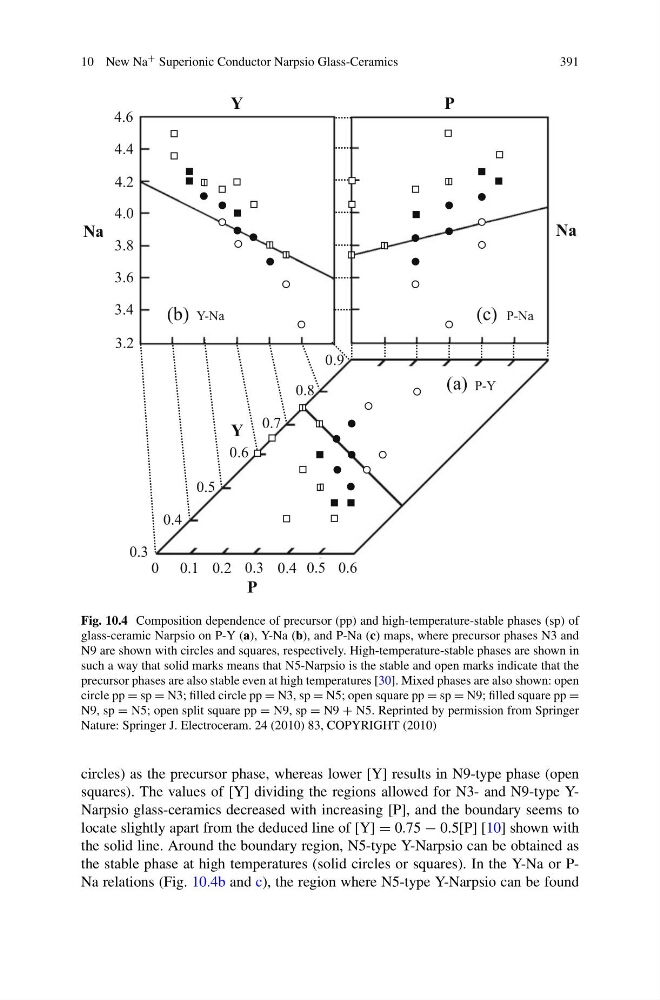
Fig. 10.4 Composition dependence of precursor (pp) and high-temperature-stable phases (sp) of
glass-ceramic Narpsio on P-Y (a), Y-Na (b), and P-Na (c) maps, where precursor phases N3 and
N9 are shown with circles and squares, respectively. High-temperature-stable phases are shown in
such a way that solid marks means that N5-Narpsio is the stable and open marks indicate that the
precursor phases are also stable even at high temperatures [30]. Mixed phases are also shown: open
circle pp = sp = N3; filled circle pp = N3, sp = N5; open square pp = sp = N9; filled square pp =
N9, sp = N5; open split square pp = N9, sp = N9 + N5. Reprinted by permission from Springer
Nature: Springer J. Electroceram. 24 (2010) 83, COPYRIGHT (2010)
circles) as the precursor phase, whereas lower [Y] results in N9-type phase (open
squares). The values of [Y] dividing the regions allowed for N3- and N9-type YNarpsio glass-ceramics decreased with increasing [P], and the boundary seems to
locate slightly apart from the deduced line of [Y] = 0.75 − 0.5[P] [10] shown with
the solid line. Around the boundary region, N5-type Y-Narpsio can be obtained as
the stable phase at high temperatures (solid circles or squares). In the Y-Na or PNa relations (Fig. 10.4b and c), the region where N5-type Y-Narpsio can be found
391
0 0.1 0.2 0.3 0.4 0.5 0.6
0.3
0.4
0.5
0.6
0.7
0.8
0.9
3.2
4.2
4.0
3.8
3.6
3.4
4.4
4.6
Y
P
Na
P
Y
Na
(a)
(c)
(b)
P-Na
P-Y
Y-Na
Fig. 10.4 Composition dependence of precursor (pp) and high-temperature-stable phases (sp) of
glass-ceramic Narpsio on P-Y (a), Y-Na (b), and P-Na (c) maps, where precursor phases N3 and
N9 are shown with circles and squares, respectively. High-temperature-stable phases are shown in
such a way that solid marks means that N5-Narpsio is the stable and open marks indicate that the
precursor phases are also stable even at high temperatures [30]. Mixed phases are also shown: open
circle pp = sp = N3; filled circle pp = N3, sp = N5; open square pp = sp = N9; filled square pp =
N9, sp = N5; open split square pp = N9, sp = N9 + N5. Reprinted by permission from Springer
Nature: Springer J. Electroceram. 24 (2010) 83, COPYRIGHT (2010)
circles) as the precursor phase, whereas lower [Y] results in N9-type phase (open
squares). The values of [Y] dividing the regions allowed for N3- and N9-type YNarpsio glass-ceramics decreased with increasing [P], and the boundary seems to
locate slightly apart from the deduced line of [Y] = 0.75 − 0.5[P] [10] shown with
the solid line. Around the boundary region, N5-type Y-Narpsio can be obtained as
the stable phase at high temperatures (solid circles or squares). In the Y-Na or PNa relations (Fig. 10.4b and c), the region where N5-type Y-Narpsio can be found