

388
T. Okura and K. Yamashita
Y''
ARC 1
ARC 2
L 1
L 2
R G(c) + R GB(g)
1
R G(c)
1
Y'
0
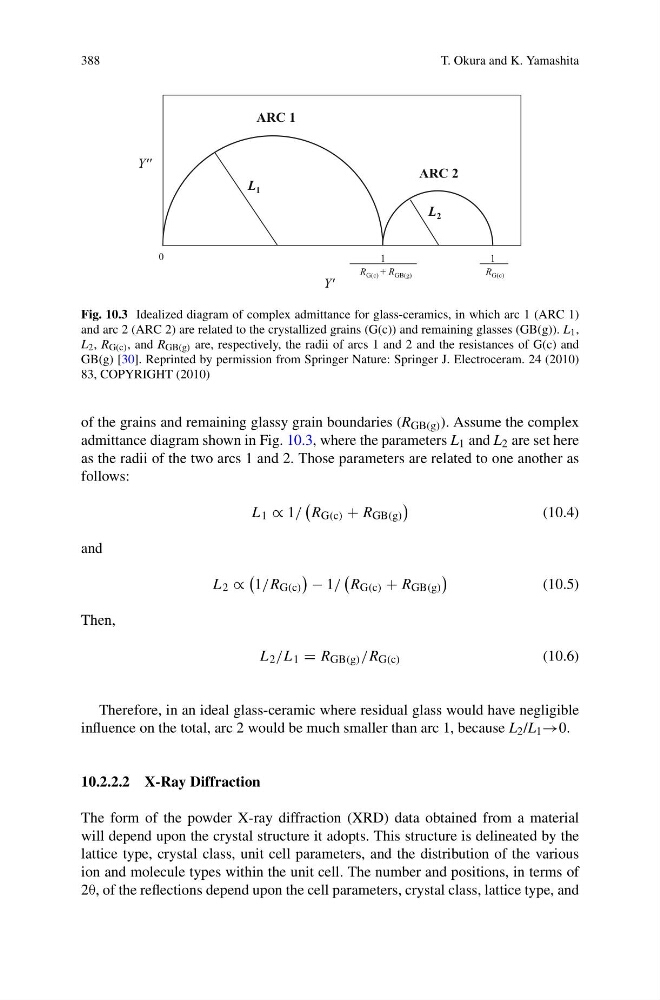
Fig. 10.3 Idealized diagram of complex admittance for glass-ceramics, in which arc 1 (ARC 1)
and arc 2 (ARC 2) are related to the crystallized grains (G(c)) and remaining glasses (GB(g)). L 1 ,
L 2 , R G(c) , and R GB(g) are, respectively, the radii of arcs 1 and 2 and the resistances of G(c) and
GB(g) [30]. Reprinted by permission from Springer Nature: Springer J. Electroceram. 24 (2010)
83, COPYRIGHT (2010)
of the grains and remaining glassy grain boundaries (R GB(g) ). Assume the complex
admittance diagram shown in Fig. 10.3, where the parameters L 1 and L 2 are set here
as the radii of the two arcs 1 and 2. Those parameters are related to one another as
follows:
L 1 ∝ 1/
R G(c) + R GB(g)
(10.4)
and
L 2 ∝
1/R G(c)
− 1/
R G(c) + R GB(g)
(10.5)
Then,
L 2 /L 1 = R GB(g) /R G(c)
(10.6)
Therefore, in an ideal glass-ceramic where residual glass would have negligible
influence on the total, arc 2 would be much smaller than arc 1, because L 2 /L 1 →0.
10.2.2.2 X-Ray Diffraction
The form of the powder X-ray diffraction (XRD) data obtained from a material
will depend upon the crystal structure it adopts. This structure is delineated by the
lattice type, crystal class, unit cell parameters, and the distribution of the various
ion and molecule types within the unit cell. The number and positions, in terms of
2θ, of the reflections depend upon the cell parameters, crystal class, lattice type, and
T. Okura and K. Yamashita
Y''
ARC 1
ARC 2
L 1
L 2
R G(c) + R GB(g)
1
R G(c)
1
Y'
0
Fig. 10.3 Idealized diagram of complex admittance for glass-ceramics, in which arc 1 (ARC 1)
and arc 2 (ARC 2) are related to the crystallized grains (G(c)) and remaining glasses (GB(g)). L 1 ,
L 2 , R G(c) , and R GB(g) are, respectively, the radii of arcs 1 and 2 and the resistances of G(c) and
GB(g) [30]. Reprinted by permission from Springer Nature: Springer J. Electroceram. 24 (2010)
83, COPYRIGHT (2010)
of the grains and remaining glassy grain boundaries (R GB(g) ). Assume the complex
admittance diagram shown in Fig. 10.3, where the parameters L 1 and L 2 are set here
as the radii of the two arcs 1 and 2. Those parameters are related to one another as
follows:
L 1 ∝ 1/
R G(c) + R GB(g)
(10.4)
and
L 2 ∝
1/R G(c)
− 1/
R G(c) + R GB(g)
(10.5)
Then,
L 2 /L 1 = R GB(g) /R G(c)
(10.6)
Therefore, in an ideal glass-ceramic where residual glass would have negligible
influence on the total, arc 2 would be much smaller than arc 1, because L 2 /L 1 →0.
10.2.2.2 X-Ray Diffraction
The form of the powder X-ray diffraction (XRD) data obtained from a material
will depend upon the crystal structure it adopts. This structure is delineated by the
lattice type, crystal class, unit cell parameters, and the distribution of the various
ion and molecule types within the unit cell. The number and positions, in terms of
2θ, of the reflections depend upon the cell parameters, crystal class, lattice type, and