

10 New Na + Superionic Conductor Narpsio Glass-Ceramics
387
For the description of a specific Narpsio, R of the term will be replaced,
respectively, with Y, Sc, In, Er, Gd, Sm, Eu, Nd, and La as Y-Narpsio, Sc-Narpsio,
In-Narpsio, Er-Narpsio, Gd-Narpsio, Sm-Narpsio, Eu-Narpsio, Nd-Narpsio, and
La-Narpsio for Y 2 O 3 , Sc 2 O 3 , In 2 O 3 , Er 2 O 3 , Gd 2 O 3 , Sm 2 O 3 , Eu 2 O 3 , Nd 2 O 3 , and
La 2 O 3 , respectively.
10.2.2 Characterization
10.2.2.1 AC Impedance Measurement
Ionic conductivities were evaluated by the compleximpedance method on cylindrical glasses or glass-ceramics, typically 15 mm in diameter and 2 mm in thickness.
Electrodes were prepared by sputtering of gold on polished surfaces. The applied
ac field ranged from 5 to 10 MHz in frequency. The temperature dependence
of the conductivity was measured similarly at several temperatures ranging from
room temperature to 350 ◦ C. The complex impedance or admittance loci of glass
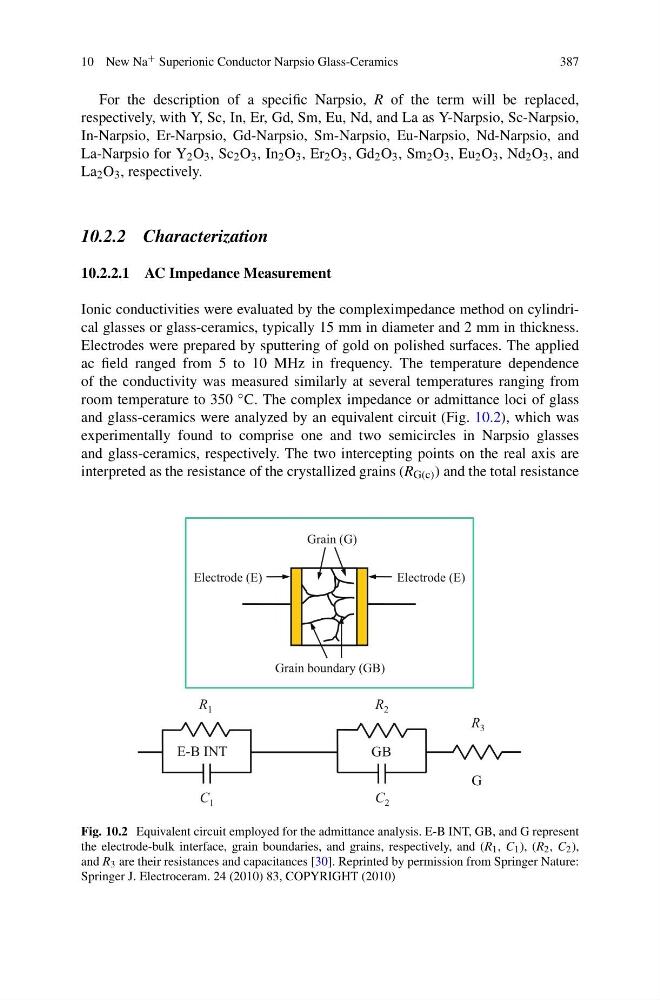
and glass-ceramics were analyzed by an equivalent circuit (Fig. 10.2), which was
experimentally found to comprise one and two semicircles in Narpsio glasses
and glass-ceramics, respectively. The two intercepting points on the real axis are
interpreted as the resistance of the crystallized grains (R G(c) ) and the total resistance
R 1
E-B INT
C 1
R 2
GB
C 2
R 3
G
Grain (G)
Grain boundary (GB)
Electrode (E)
Electrode (E)
Fig. 10.2 Equivalent circuit employed for the admittance analysis. E-B INT, GB, and G represent
the electrode-bulk interface, grain boundaries, and grains, respectively, and (R 1 , C 1 ), (R 2 , C 2 ),
and R 3 are their resistances and capacitances [30]. Reprinted by permission from Springer Nature:
Springer J. Electroceram. 24 (2010) 83, COPYRIGHT (2010)
387
For the description of a specific Narpsio, R of the term will be replaced,
respectively, with Y, Sc, In, Er, Gd, Sm, Eu, Nd, and La as Y-Narpsio, Sc-Narpsio,
In-Narpsio, Er-Narpsio, Gd-Narpsio, Sm-Narpsio, Eu-Narpsio, Nd-Narpsio, and
La-Narpsio for Y 2 O 3 , Sc 2 O 3 , In 2 O 3 , Er 2 O 3 , Gd 2 O 3 , Sm 2 O 3 , Eu 2 O 3 , Nd 2 O 3 , and
La 2 O 3 , respectively.
10.2.2 Characterization
10.2.2.1 AC Impedance Measurement
Ionic conductivities were evaluated by the compleximpedance method on cylindrical glasses or glass-ceramics, typically 15 mm in diameter and 2 mm in thickness.
Electrodes were prepared by sputtering of gold on polished surfaces. The applied
ac field ranged from 5 to 10 MHz in frequency. The temperature dependence
of the conductivity was measured similarly at several temperatures ranging from
room temperature to 350 ◦ C. The complex impedance or admittance loci of glass
and glass-ceramics were analyzed by an equivalent circuit (Fig. 10.2), which was
experimentally found to comprise one and two semicircles in Narpsio glasses
and glass-ceramics, respectively. The two intercepting points on the real axis are
interpreted as the resistance of the crystallized grains (R G(c) ) and the total resistance
R 1
E-B INT
C 1
R 2
GB
C 2
R 3
G
Grain (G)
Grain boundary (GB)
Electrode (E)
Electrode (E)
Fig. 10.2 Equivalent circuit employed for the admittance analysis. E-B INT, GB, and G represent
the electrode-bulk interface, grain boundaries, and grains, respectively, and (R 1 , C 1 ), (R 2 , C 2 ),
and R 3 are their resistances and capacitances [30]. Reprinted by permission from Springer Nature:
Springer J. Electroceram. 24 (2010) 83, COPYRIGHT (2010)