

9 Si Nanopowder for Photoluminescence and Hydrogen Generation Materials
377
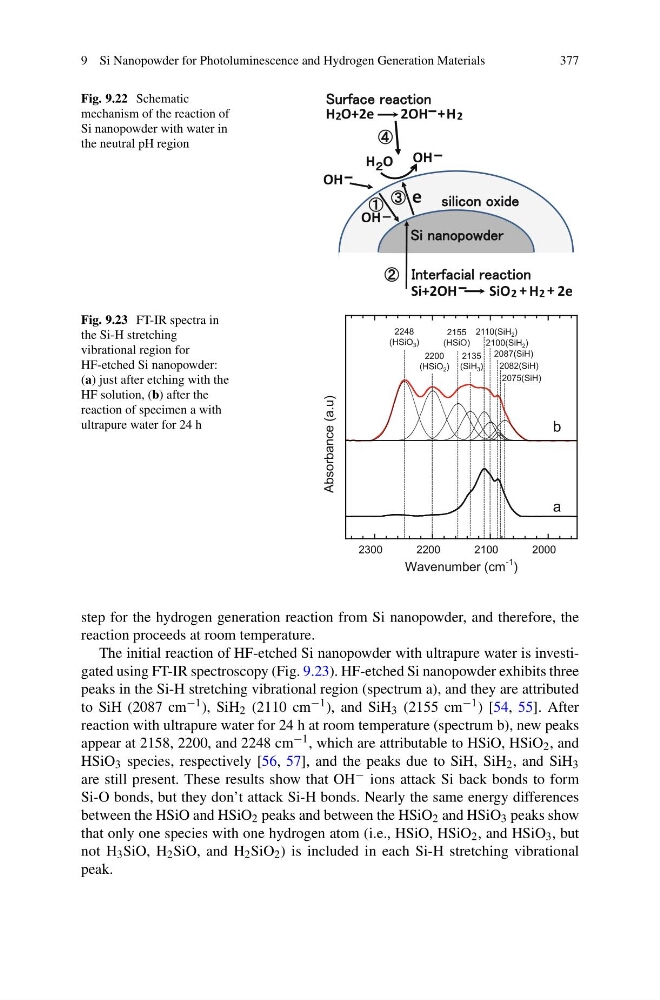
Fig. 9.22 Schematic
mechanism of the reaction of
Si nanopowder with water in
the neutral pH region
v
e
e
Fig. 9.23 FT-IR spectra in
the Si-H stretching
vibrational region for
HF-etched Si nanopowder:
(a) just after etching with the
HF solution, (b) after the
reaction of specimen a with
ultrapure water for 24 h
2000
2100
2200
2300
Wavenumber (cm
-1 )
Absorbance (a.u)
2248
(HSiO 3 )
2155
(HSiO)
2110(SiH 2 )
2100(SiH 2 )
2087(SiH)
a
b
2082(SiH)
2075(SiH)
2200
(HSiO 2 )
2135
(SiH 3 )
step for the hydrogen generation reaction from Si nanopowder, and therefore, the
reaction proceeds at room temperature.
The initial reaction of HF-etched Si nanopowder with ultrapure water is investigated using FT-IR spectroscopy (Fig. 9.23). HF-etched Si nanopowder exhibits three
peaks in the Si-H stretching vibrational region (spectrum a), and they are attributed
to SiH (2087 cm −1 ), SiH 2 (2110 cm −1 ), and SiH 3 (2155 cm −1 ) [54, 55]. After
reaction with ultrapure water for 24 h at room temperature (spectrum b), new peaks
appear at 2158, 2200, and 2248 cm −1 , which are attributable to HSiO, HSiO 2 , and
HSiO 3 species, respectively [56, 57], and the peaks due to SiH, SiH 2 , and SiH 3
are still present. These results show that OH − ions attack Si back bonds to form
Si-O bonds, but they don’t attack Si-H bonds. Nearly the same energy differences
between the HSiO and HSiO 2 peaks and between the HSiO 2 and HSiO 3 peaks show
that only one species with one hydrogen atom (i.e., HSiO, HSiO 2 , and HSiO 3 , but
not H 3 SiO, H 2 SiO, and H 2 SiO 2 ) is included in each Si-H stretching vibrational
peak.
377
Fig. 9.22 Schematic
mechanism of the reaction of
Si nanopowder with water in
the neutral pH region
v
e
e
Fig. 9.23 FT-IR spectra in
the Si-H stretching
vibrational region for
HF-etched Si nanopowder:
(a) just after etching with the
HF solution, (b) after the
reaction of specimen a with
ultrapure water for 24 h
2000
2100
2200
2300
Wavenumber (cm
-1 )
Absorbance (a.u)
2248
(HSiO 3 )
2155
(HSiO)
2110(SiH 2 )
2100(SiH 2 )
2087(SiH)
a
b
2082(SiH)
2075(SiH)
2200
(HSiO 2 )
2135
(SiH 3 )
step for the hydrogen generation reaction from Si nanopowder, and therefore, the
reaction proceeds at room temperature.
The initial reaction of HF-etched Si nanopowder with ultrapure water is investigated using FT-IR spectroscopy (Fig. 9.23). HF-etched Si nanopowder exhibits three
peaks in the Si-H stretching vibrational region (spectrum a), and they are attributed
to SiH (2087 cm −1 ), SiH 2 (2110 cm −1 ), and SiH 3 (2155 cm −1 ) [54, 55]. After
reaction with ultrapure water for 24 h at room temperature (spectrum b), new peaks
appear at 2158, 2200, and 2248 cm −1 , which are attributable to HSiO, HSiO 2 , and
HSiO 3 species, respectively [56, 57], and the peaks due to SiH, SiH 2 , and SiH 3
are still present. These results show that OH − ions attack Si back bonds to form
Si-O bonds, but they don’t attack Si-H bonds. Nearly the same energy differences
between the HSiO and HSiO 2 peaks and between the HSiO 2 and HSiO 3 peaks show
that only one species with one hydrogen atom (i.e., HSiO, HSiO 2 , and HSiO 3 , but
not H 3 SiO, H 2 SiO, and H 2 SiO 2 ) is included in each Si-H stretching vibrational
peak.