

9 Si Nanopowder for Photoluminescence and Hydrogen Generation Materials
373
0
5
10
15
0
50 100 150 200 250 300 350 400
Hydrogen Volume (mL/g)
Reaction Time (min)
0
1
2
3
4
5
0
2 0
4 0
6 0
8 0
1 0 0
Hydrogen Volume (mL/g)
Reaction Time (min)
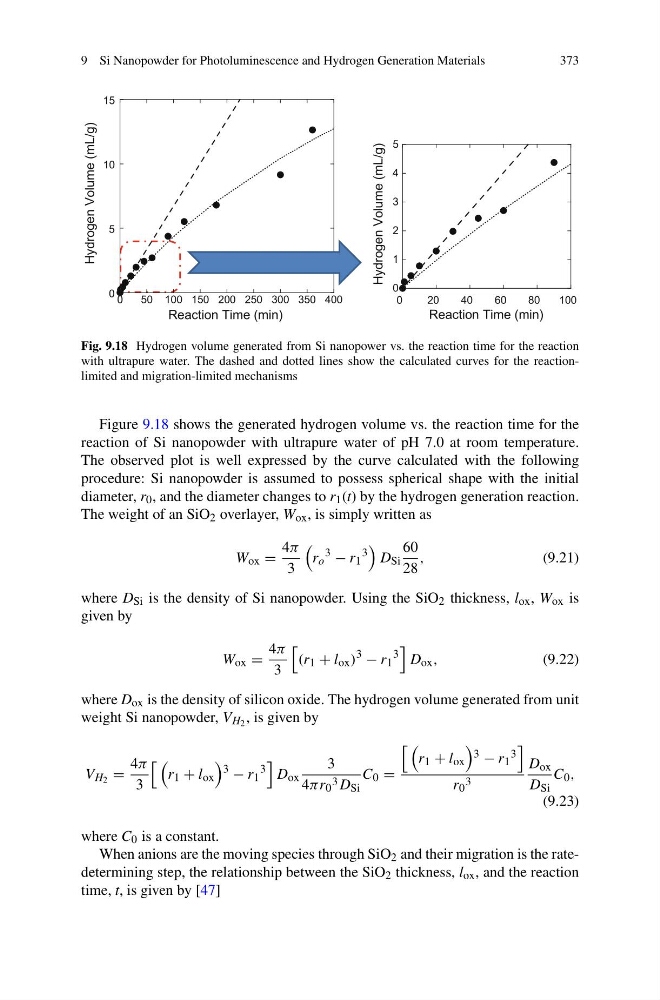
Fig. 9.18 Hydrogen volume generated from Si nanopower vs. the reaction time for the reaction
with ultrapure water. The dashed and dotted lines show the calculated curves for the reactionlimited and migration-limited mechanisms
Figure 9.18 shows the generated hydrogen volume vs. the reaction time for the
reaction of Si nanopowder with ultrapure water of pH 7.0 at room temperature.
The observed plot is well expressed by the curve calculated with the following
procedure: Si nanopowder is assumed to possess spherical shape with the initial
diameter, r 0 , and the diameter changes to r 1 (t) by the hydrogen generation reaction.
The weight of an SiO 2 overlayer, W ox , is simply written as
W ox =
4π
3
r o
3
− r 1
3
D Si
60
28
,
(9.21)
where D Si is the density of Si nanopowder. Using the SiO 2 thickness, l ox , W ox is
given by
W ox =
4π
3
(r 1 + l ox )
3
− r 1
3
D ox ,
(9.22)
where D ox is the density of silicon oxide. The hydrogen volume generated from unit
weight Si nanopowder, V H 2 , is given by
V H 2 =
4π
3
r 1 + l ox
3
− r 1
3
D ox
3
4πr 0
3 D Si
C 0 =
r 1 + l ox
3 − r 1
3
r 0
3
D ox
D Si
C 0 ,
(9.23)
where C 0 is a constant.
When anions are the moving species through SiO 2 and their migration is the ratedetermining step, the relationship between the SiO 2 thickness, l ox , and the reaction
time, t, is given by [47]
373
0
5
10
15
0
50 100 150 200 250 300 350 400
Hydrogen Volume (mL/g)
Reaction Time (min)
0
1
2
3
4
5
0
2 0
4 0
6 0
8 0
1 0 0
Hydrogen Volume (mL/g)
Reaction Time (min)
Fig. 9.18 Hydrogen volume generated from Si nanopower vs. the reaction time for the reaction
with ultrapure water. The dashed and dotted lines show the calculated curves for the reactionlimited and migration-limited mechanisms
Figure 9.18 shows the generated hydrogen volume vs. the reaction time for the
reaction of Si nanopowder with ultrapure water of pH 7.0 at room temperature.
The observed plot is well expressed by the curve calculated with the following
procedure: Si nanopowder is assumed to possess spherical shape with the initial
diameter, r 0 , and the diameter changes to r 1 (t) by the hydrogen generation reaction.
The weight of an SiO 2 overlayer, W ox , is simply written as
W ox =
4π
3
r o
3
− r 1
3
D Si
60
28
,
(9.21)
where D Si is the density of Si nanopowder. Using the SiO 2 thickness, l ox , W ox is
given by
W ox =
4π
3
(r 1 + l ox )
3
− r 1
3
D ox ,
(9.22)
where D ox is the density of silicon oxide. The hydrogen volume generated from unit
weight Si nanopowder, V H 2 , is given by
V H 2 =
4π
3
r 1 + l ox
3
− r 1
3
D ox
3
4πr 0
3 D Si
C 0 =
r 1 + l ox
3 − r 1
3
r 0
3
D ox
D Si
C 0 ,
(9.23)
where C 0 is a constant.
When anions are the moving species through SiO 2 and their migration is the ratedetermining step, the relationship between the SiO 2 thickness, l ox , and the reaction
time, t, is given by [47]